“Doddington hall such a shame to see this stunning place just left like this,” wrote Urbex Lost & Found on 15 August 2024, posting 48 photographs of a stone hall with, in the poster’s words, “some great features inside even its own rail track underneath.” The post drew about 2,700 reactions and 526 comments, and the comments are part of the story here, because they immediately raised a question the post itself does not answer: which Doddington Hall is this?
That question, and the care it demands, runs through this article. The poster calls the building Doddington Hall, and that is the name used here. But several commenters who know the Doddington Hall near Lincoln said the building in the photographs looks nothing like it. Others added claims of their own — about a boarding school, about a listing, about plans to build houses on the site — and none of those claims is verified in the post. This article reports what the poster says, describes what the five photographs show, and keeps everything else in the frame it belongs in: unverified, and not to be repeated as fact.
A Stone Hall That Stops You in Your Tracks
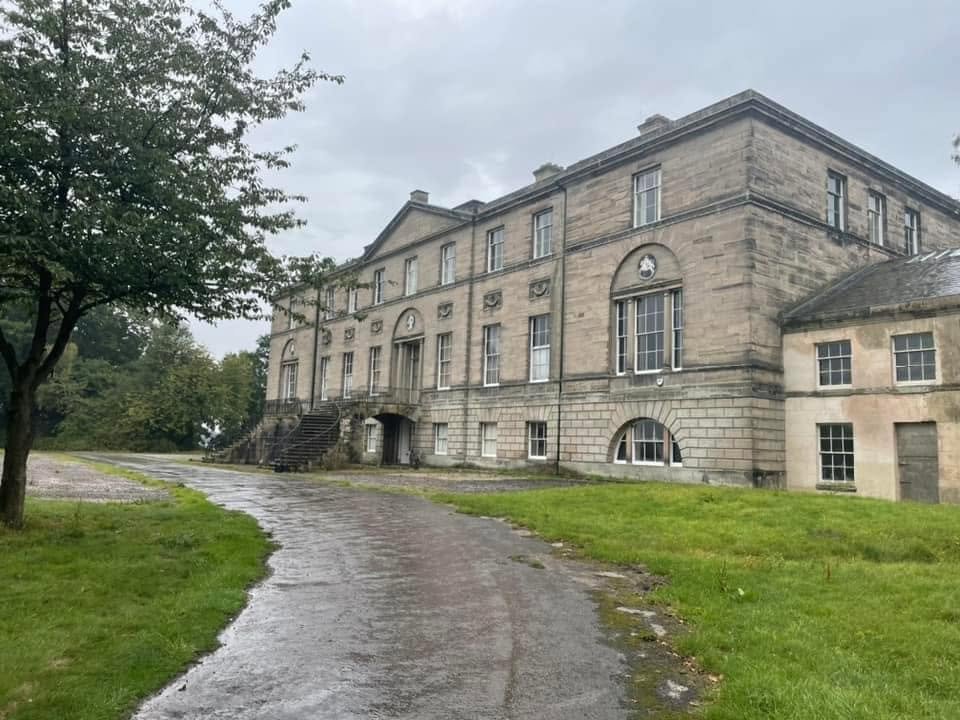
The first photograph is the exterior, and it is the photograph that makes the post’s 2,700 reactions easy to understand. The building is a long, three-storey stone hall with a classical facade: rows of tall sash windows, a central arched window with a circular medallion above it, and an external stone staircase rising to a first-floor entrance. A lower two-storey wing stands at one end. A wet driveway curves in front of the house across green lawns, and the sky is overcast. A tree frames the left of the shot.
The facade is the most intact thing about the place. The windows are unbroken in the photograph, the stonework is sound, and the roofline is straight. Whatever has happened inside this hall, the outside still presents the face of a grand house, and it is easy to see why commenters called it beautiful and gorgeous, and why one wrote that it was a shame to see a building like this “going to wrack and ruin.” The post gives no location for the hall, and this article does not try to supply one. That matters more here than usual, because of the identity question the comments raise, which is dealt with below.
The Gilded Dome
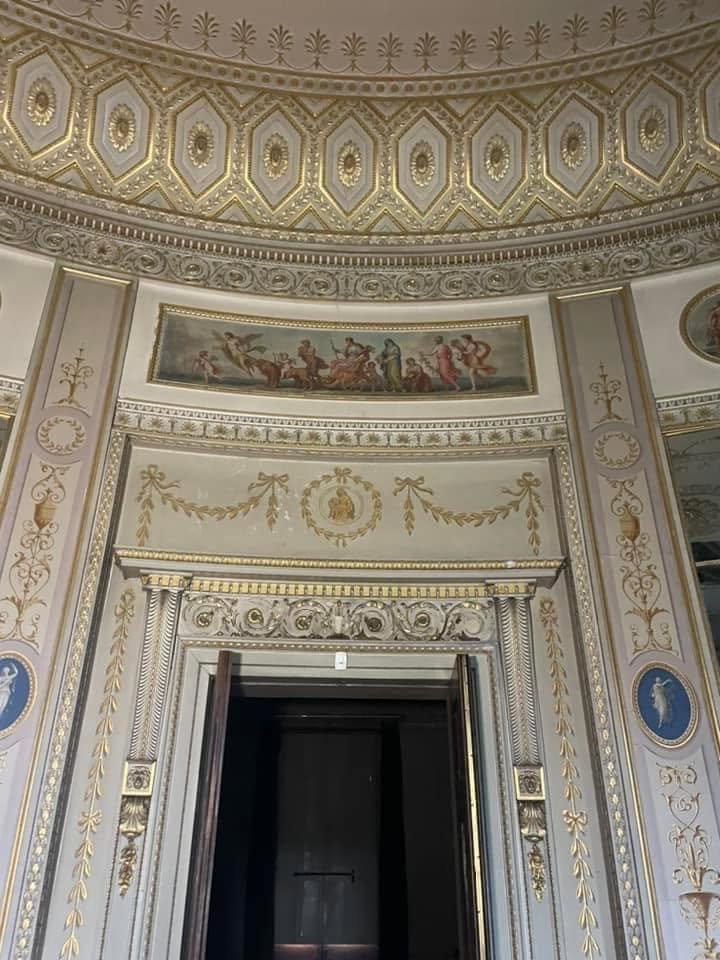
If the exterior is restrained, the interior is not. The second photograph looks up at a domed ceiling covered in gilded geometric coffers, each one picked out in gold, with a classical mural frieze running below it — figures in a landscape, painted in soft colours — and gold swags, blue oval medallions, and carved plasterwork framing an elaborately carved doorway. It is the most ornate room in the set, and the one that most justifies the poster’s word “stunning.”
Commenters on the post reached for the same language. One called the plasterwork stunning, another praised the “glorious details in the woodwork,” and a third wrote that the hall ought to be handed to the National Trust or English Heritage “to be preserved for the nation.” Those are commenters’ opinions, not facts about the building’s status, and they are reported here as such. What the photograph itself shows is a ceiling that has survived remarkably well — the gilding is still bright, the mural is still legible, and the carving around the doorway is intact. For a house described as “just left like this,” the dome is in far better condition than the kitchen or the tunnel below.
A Bath Like a Piece of Furniture
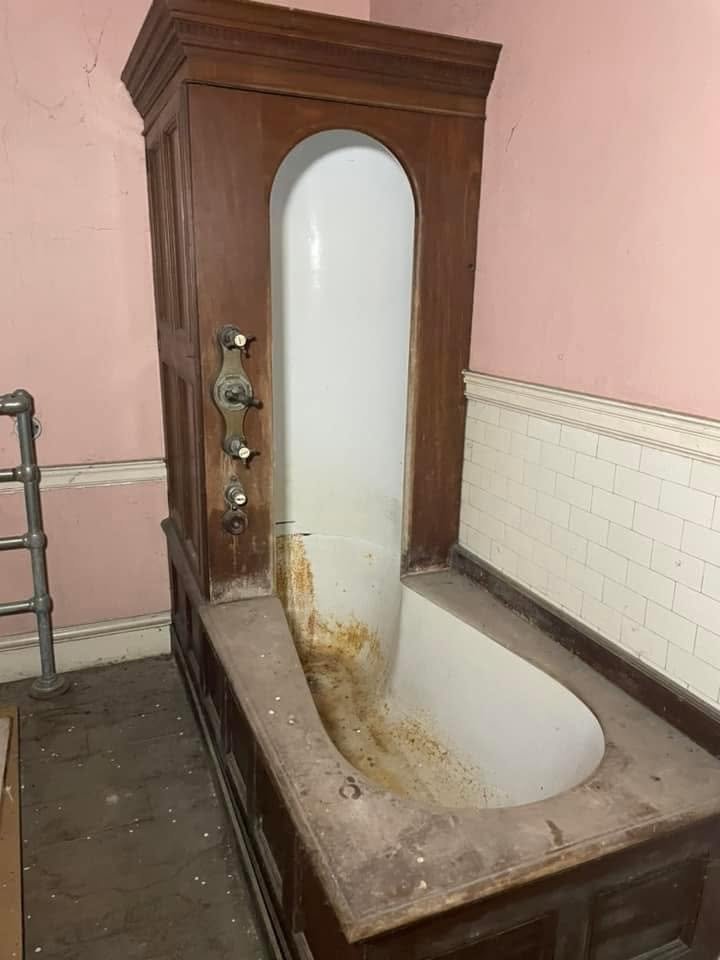
The third photograph is the oddest object in the house: a bath and shower combined into a single tall wooden cabinet. The cabinet is dark wood with panelled sides, and it rises to a cornice above a tall arched white interior. Brass taps and controls are mounted on the side of the cabinet, and below them sits a white bath, stained brown at the far end where water has stood. The walls of the room are pink above white subway tiles, and a metal towel rail stands at the left of the frame. The wooden floor is dirty and worn.
Commenters on the post spent some time debating what this object is. One asked whether it was a Cadzow shower, another said they had one in their own house, and others asked whether it was a shower, a tub, or a combination of the two. That debate is reported here as a debate, not settled: the photograph shows a bath with an overhead shower arrangement built into a wooden cabinet, and the make of the fitting is not identified in the post. Whatever its make, it is a remarkable survival — a piece of bathroom furniture from a time when a bath was a piece of joinery, not a moulded shell, and it is one of the most memorable images in the post.
The Tunnel Under the Hall
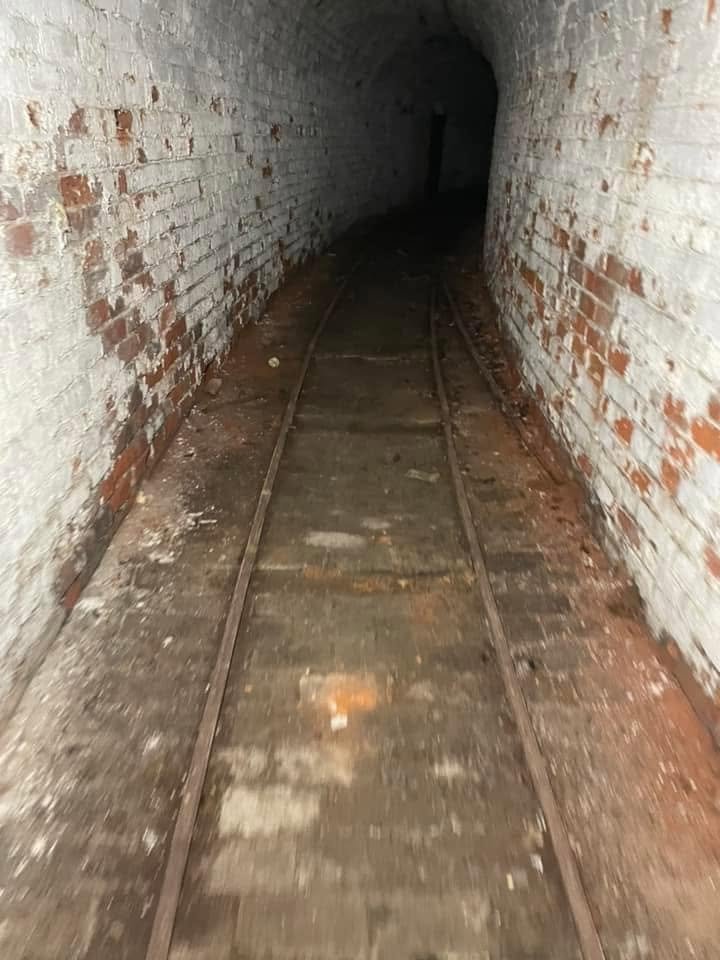
The fourth photograph is the one the caption promises: the hall’s own rail track underneath. It shows a brick-lined tunnel, the walls whitewashed with red brick showing through where the wash has worn away, and two narrow-gauge rails running down the centre of a damp concrete floor, curving away into darkness at the far end. There is no light at the end of the tunnel in the photograph, and no sign of where it leads.
Commenters on the post offered explanations for the track. One wrote that “a lot of stately homes had a track underneath,” with the kitchen on the other side of the house, so that food could be moved without cooking smells reaching the main rooms. Another said such tracks were usually used to move coal to where it was stored in the basement, and named another house with one. Those are commenters’ explanations, and they are plausible as general history, but the post itself says nothing about what the track was for, and nothing in the photograph shows its purpose or its destination. Commenters also asked where the tunnel leads, and that question was left unanswered in the visible comments. The tunnel is, on the evidence of the post, a rail track underneath a hall, going somewhere dark. That is all that can safely be said about it.
The Kitchen’s Giant AGA
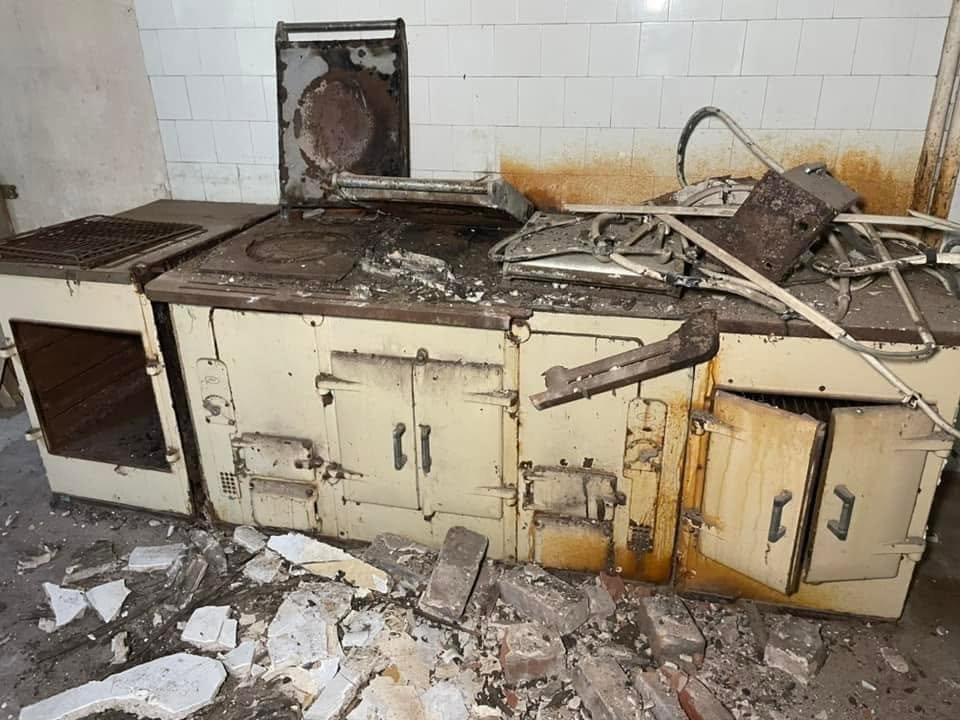
The fifth photograph is the kitchen, and it is dominated by a single object: a huge cream AGA cooker, rust-stained, with its doors hanging open and its top covered in broken metal, wire, and debris. The floor in front of it is covered in rubble — broken tiles, bricks, and plaster. Behind it, a white tiled wall is stained brown with rust. At the left of the frame, another oven compartment stands with its door missing.
Commenters on the post were struck by the size of it. One wrote, “That is the biggest AGA I’ve ever seen,” and another, “Wow size of the Aga.” Those are reactions, not measurements, and the post gives no dimensions. But the photograph supports the impression: the cooker spans most of the width of the frame, with multiple oven doors and hotplates, and it is far larger than a domestic cooker. It is also the most ruined object in the set, which makes it a useful counterweight to the gilded dome — the same house, the same abandonment, and two very different states of survival.
Which Doddington Hall Is This?
This is the question the comments keep coming back to, and it has to be answered honestly: on the evidence of the post, it cannot be settled here. The poster calls the building Doddington Hall and gives no location. Several commenters said they knew a Doddington Hall near Lincoln and that the building in the photographs looks nothing like it. One wrote that the post had confused them at first, because they were familiar with the Doddington Hall a few miles from Lincoln, “which is a st…” — the comment is cut off in the visible text, but the point is clear. Another commenter said their mother went to boarding school at the hall in the 1950s. Another called it a Grade 1 Listed building and said there had been plans to renovate it. Another wrote that planning had been granted for houses to be built on the site to fund work, and another mentioned a baronetcy.
None of those claims is verified in the post, and none of them is asserted in this article. The listing grade, the boarding-school history, the renovation plans, the planning permission, and the baronetcy are all things commenters said, and they are reported here only as things commenters said. The location of the hall is not stated in the post, and this article does not name one. Readers who know a Doddington Hall should not assume this is the one they know, and readers who do not should not assume the post proves which one it is. The photographs show a stone hall with a gilded dome, a bath cabinet, a rail tunnel, and a giant AGA. That is what can be verified. The rest is [TO VERIFY].
What We Know, and What We Don’t
The known facts are short. Urbex Lost & Found posted 48 photographs of a building it calls Doddington Hall on 15 August 2024. The building is a three-storey stone hall with a classical facade. Inside are a gilded domed ceiling, a wood-panelled bath and shower cabinet, a brick tunnel with narrow-gauge rails underneath, and a large ruined AGA cooker. The post drew about 2,700 reactions, 526 comments, and 233 shares. That is the whole of it.
Everything else is [TO VERIFY]: the location of the hall, whether it is the Doddington Hall near Lincoln or another building of the same name, its listing status, its history as a school or anything else, any planning permission or renovation plans, and what will happen to it. The post gives no agent, no price, no sale status, and no owner name. Until a reliable record is cited, this article treats the hall as the poster presents it and nothing more.
For more grand empty buildings, see more abandoned mansions, and for smaller houses in the same state, abandoned houses. A lived-in home of the same period is the 1902 Noonan home in Alexandria, Minnesota, and everything on the site begins at the front page of abandoned.blog.
Frequently Asked Questions
Where is Doddington Hall?
The post does not give a location. It calls the building Doddington Hall and nothing more. The exact location is not public and is not published here.
Is it the Doddington Hall near Lincoln?
That cannot be confirmed from the post. Several commenters who know the Doddington Hall near Lincoln said the building in the photographs looks nothing like it. This article does not assert that it is, or is not, that building.
What is the rail track under the hall for?
The post does not say. Commenters suggested that such tracks in large houses were used to move food from a separate kitchen, or to move coal to basement stores. Those are commenters’ explanations, not facts from the post, and where the tunnel leads is unanswered in the visible comments.
What is the bath in the pink-tiled bathroom?
The photographs show a bath with an overhead shower arrangement built into a tall wooden cabinet, with brass taps and controls. Commenters debated whether it was a Cadzow shower. Its make is not identified in the post.
How big is the AGA cooker?
The post gives no dimensions. Commenters called it the biggest AGA they had ever seen. The photograph shows a very large cream range with multiple oven doors and hotplates, rust-stained and ruined.
Is the hall a listed building?
A commenter called it a Grade 1 Listed building, but that is a commenter’s claim and has not been verified from the post or any record cited in it. Its listing status is [TO VERIFY].
Can I visit Doddington Hall?
No. The location is not public, the building is private property, and entering an abandoned building is trespassing and can be dangerous — the tunnel and the ruined kitchen are not safe places.
Disclaimer
This article is based only on the Urbex Lost & Found Facebook post of 15 August 2024 and the five photographs shown here. The identity of the building, its listing status, its history, and any planning or renovation claims are unverified commenters’ claims, not established facts, and the location is not stated in the source. All such details are marked [TO VERIFY]. Do not attempt to find or enter this property. Abandoned buildings are private property, may be structurally unsafe, and entering them is trespassing.
Photos
Photos by Urbex Lost & Found, via the original Facebook post: https://www.facebook.com/UrbexLostNFound/posts/doddington-hall-such-a-shame-to-see-this-stunning-place-just-left-like-this-some/921658809979682/ — 5 of the 48 photos are shown here.