In 2020, this house changed forever. That is how the BigBankz post opens, and it is the whole story in one sentence. The home in the south belonged to a woman who worked in finance. She lived a simple life: working, taking care of her family, travelling when she could. As she got older, life started to shift. In 2020 she died. The house was left frozen in time, with everything still inside.
BigBankz posted the house on 23 November 2026. The post carries 13 photographs; five are shown here. There is no name for the house and no name for the woman. What follows is built only from the post’s caption and those five photographs. Anything the post does not say is marked as not verified, not guessed.
A simple life, told by her things
The caption gives the shape of a life in four lines: work, family, occasional travel, and then a slow change as she got older. It is not much, but the photographs fill in the texture. This was a home that was lived in properly and kept with care.
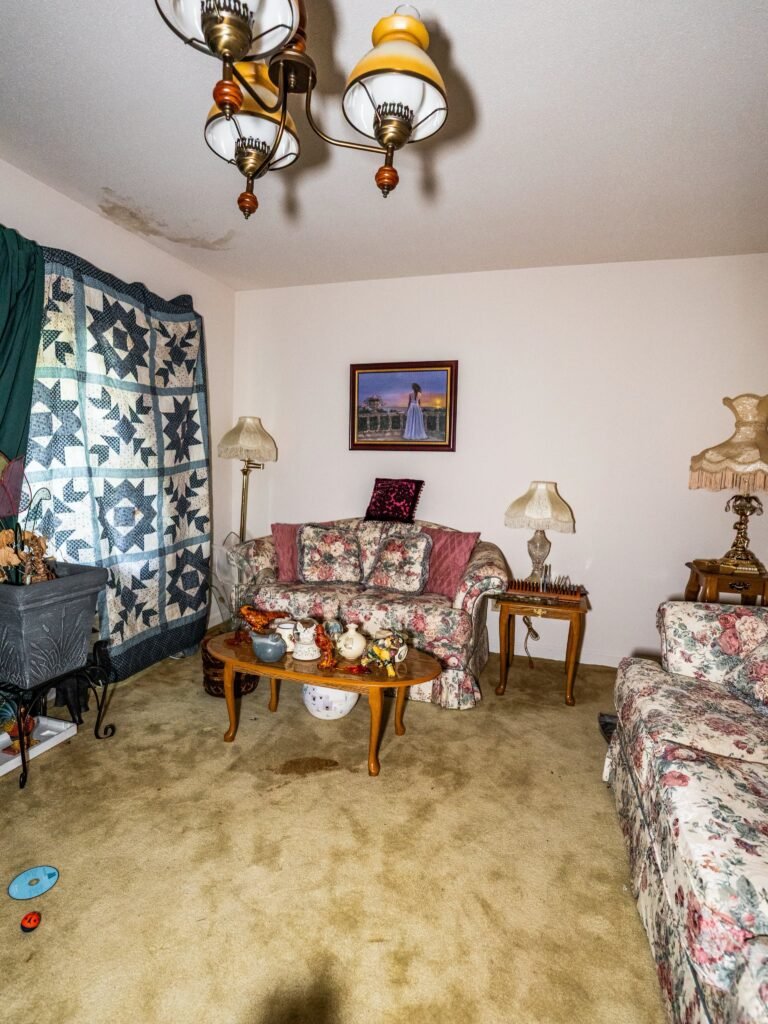
The living room is the clearest evidence. Two floral-patterned sofas face each other across a low wooden coffee table. The cushions are still plumped and in place. Framed pictures hang straight on the walls. The lamps still stand on their side tables, their fringed shades intact. Nothing has been knocked over, stripped, or smashed. The house looks less abandoned than paused, as if the owner had stepped out and simply never came back.
That is what makes a “frozen in time” house different from a derelict one. In the more abandoned homes on this site, many houses have been picked over, vandalised, or left to rot for decades. This one has not. The damage here is slow and quiet: a water stain spreading across the living-room ceiling, dust settling on the ornaments, leaves piling up against the windows outside. Six years is enough for a house to start showing its age, but not enough to hide the fact that someone once kept it well.
The living room that never got tidied again
The widest photograph of the living room shows how complete the house still is. A chandelier with amber glass shades hangs from the ceiling. A patchwork quilt in blue and white stars hangs over the window as a curtain. A floor lamp stands in the corner. On the coffee table sit glass birds, snow globes, candles, and a painted ceramic elephant — small decorative things, arranged with care, and never moved since.
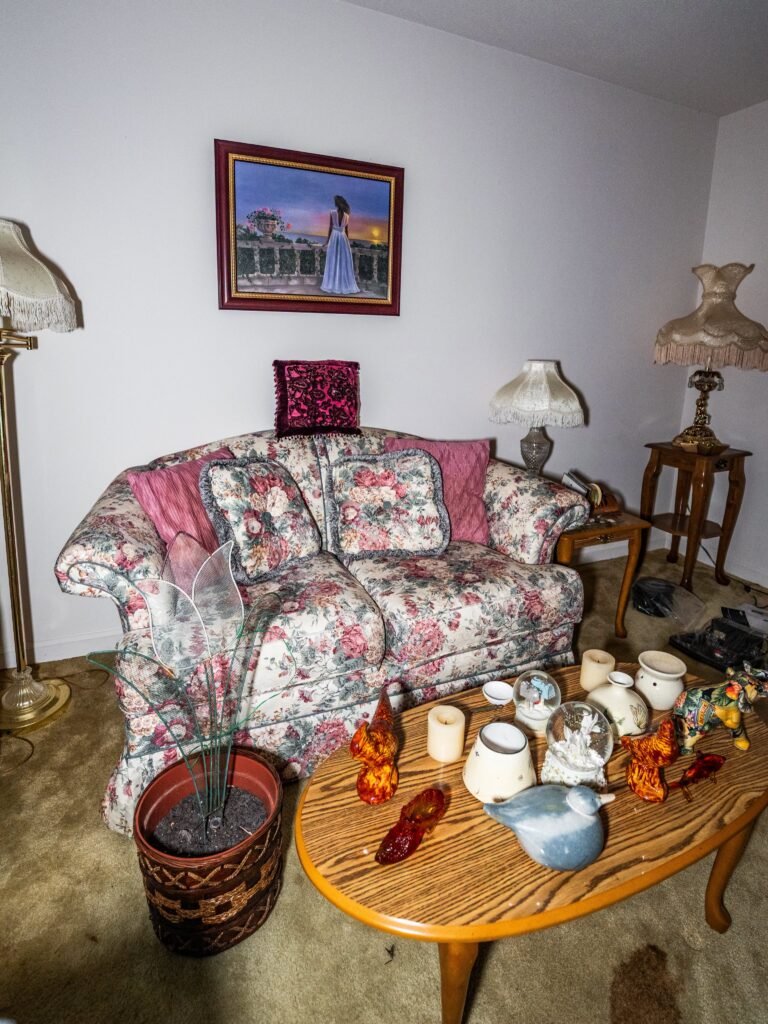
A closer photograph of the same sofa shows the details: the floral upholstery, pink cushions, a framed painting of a woman in a white dress looking out to sea above it, and the same ornaments on the table. A potted plant with bare wire stems stands beside the sofa, its leaves long gone. A CD lies on the carpet. A small orange ball sits nearby.
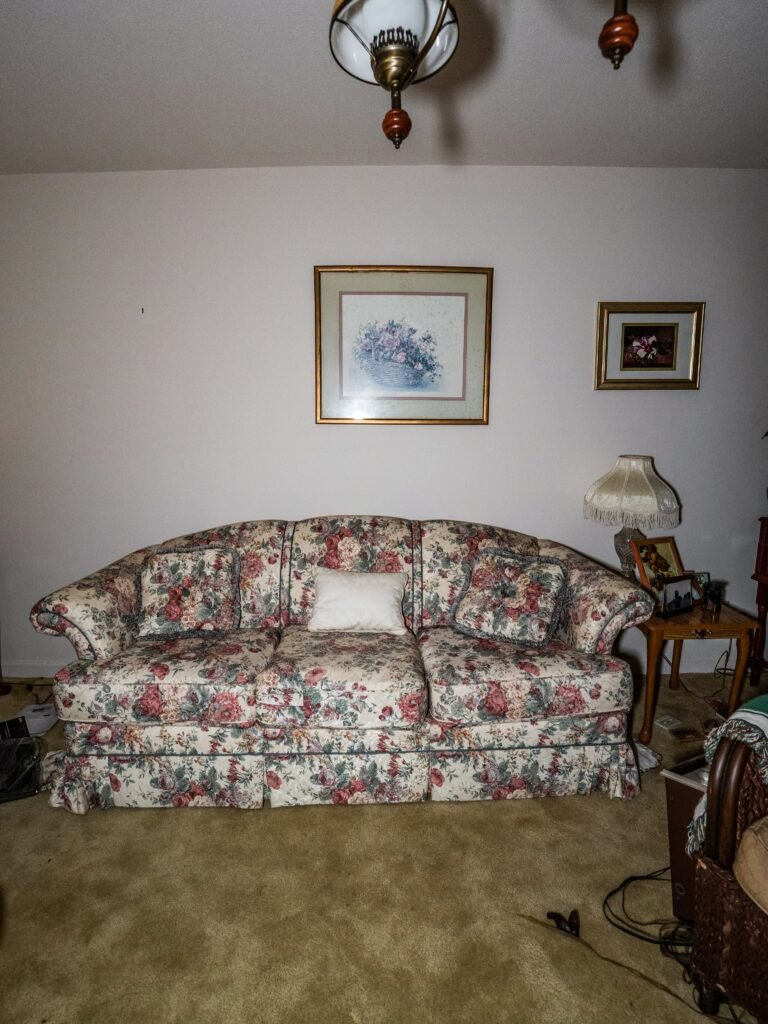
A third photograph shows the other sofa against the opposite wall, beneath a framed print of a basket of flowers. A white cushion sits in the middle. A lamp with a fringed shade stands on the side table beside it, next to framed photographs. The carpet is stained in places, and a few items lie scattered near the edges of the room, but the furniture is all in its place.
None of this tells us her name, or where exactly in the south the house stands, or what happened to her family after 2020. The post does not say, and this article does not guess. What it does tell us is that she lived simply and kept a tidy, comfortable home, and that nobody has cleared it out since she died.
The hallway view
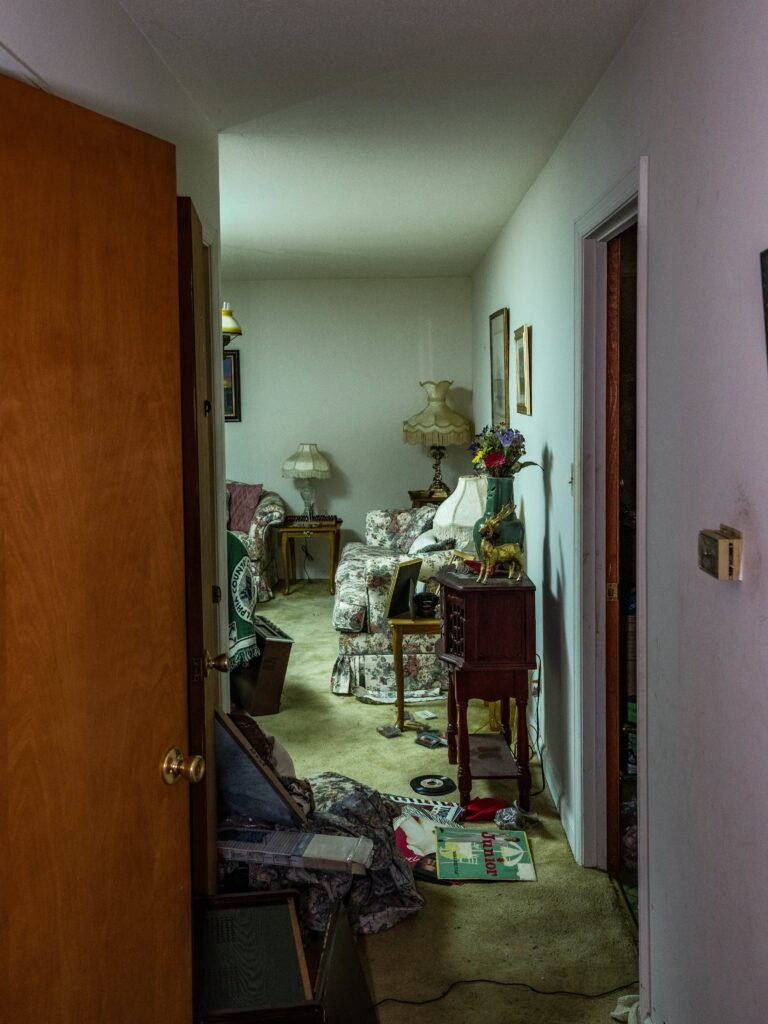
The fifth photograph is taken from a hallway, looking through a doorway into the living room, and it shows the house from a different angle. Records lie scattered on the carpet. A green vase holding bright flowers stands on a small wooden cabinet, next to a golden deer figurine. A door stands open on the left, and another doorway leads off to the right. A thermostat is fixed to the hallway wall.
It is the kind of photograph that makes the house feel inhabited rather than empty. The flowers in the vase are artificial, so they have not wilted, and the records on the floor look as if someone had been sorting through them. A jacket hangs over a chair. A bag sits on the floor. The house is not a ruin. It is a home that stopped at a particular moment and has been waiting ever since.
The small things that stayed put
What stands out across all five photographs is how much of the house is small and ordinary. A CD on the carpet. A ball on the floor. Candles and snow globes on a coffee table. A quilt hung over a window instead of curtains. None of these things is valuable, and none of them was worth coming back for — or, more likely, nobody came back at all.
That is the quiet side of a house left frozen in time. The big things — the sofas, the lamps, the chandelier — stay because they are too heavy to move casually. The small things stay because nobody thought them worth taking, or because the person who valued them is gone. A painted ceramic elephant on a coffee table meant something to the woman who put it there. To everyone else, it is just an ornament in an empty house. The photographs keep both truths at once: the house is full, and the person who made it a home is not there any more.
What the house looks like from outside
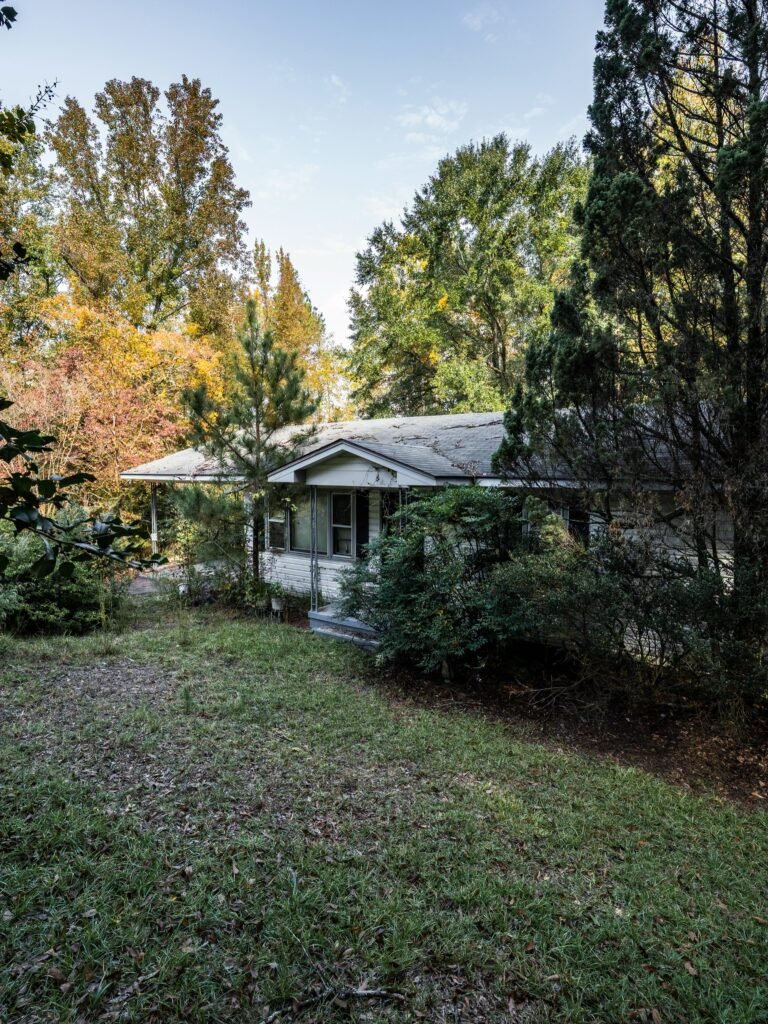
The first photograph shows the house from the garden: a single-storey white house with a grey shingled roof, half-hidden by trees and shrubs. Autumn leaves in gold and red fill the trees around it. The garden is overgrown, the grass long, the shrubs pressing in against the walls. The windows are curtained and dark.
There is no sign outside of what happened here. No boarded windows, no collapsed roof, no fence or warning sign. From the road, it would look like any other small house in a wooded plot. That is true of many abandoned houses: the outside gives almost nothing away, and the story only shows itself once you are inside.
What the post does not say
The post gives no name for the woman, no town or state, and no address, and this article publishes none of those. It does not say how old she was, what her family did with the house, whether it has been sold, or what will happen to it. It does not say how old the house is, or when she moved in. The phrase “in the south” is all the location the post gives, and it is not enough to identify the house.
All of those are [TO VERIFY]. They are listed here so the reader knows exactly where the verified facts end. The house is private property, and its location is not public. Do not attempt to find or enter it.
The post also says she “lived a pretty simple life”. That is the post’s own wording, and it is the only description of her that exists in the source. This article has not added to it. A house full of ordinary, well-kept things backs it up, but the words themselves come from BigBankz, not from this site.
Frequently Asked Questions
Who owned this southern house?
A woman who worked in finance, according to the BigBankz post of 23 November 2026. Her name, age, and employer are not given in the post, so they are [TO VERIFY].
When did she die?
In 2020, according to the post. The exact date is not stated. The house has been left untouched since then.
Where is the house?
The post says only that it is “in the south”. No town, state, or address is given, and this article does not publish one. The house is private property.
What is still inside the house?
Everything, according to the post. The five photographs here show floral sofas, lamps, ornaments, records, framed pictures, and a chandelier, all still in place. They are 5 of the 13 photographs in the original post.
Why was the house left empty?
The post says the house was left frozen in time after the owner died in 2020. It does not say what her family did, whether the house was inherited, or whether it is for sale. Those details are [TO VERIFY].
Disclaimer
This article is based only on the BigBankz Facebook post of 23 November 2026 and the five photographs in that post shown here. The caption is quoted as published. The owner’s name, the house’s location, its age, and what has happened to it since 2020 are not stated in the source and are marked [TO VERIFY]. Do not attempt to find or enter this property. Abandoned buildings are private property, may be structurally unsafe, and entering them is trespassing. This article is general information only, not legal, tax, or financial advice; rules differ by state and county, so check county records and a local professional before acting.
Photos
Photos by BigBankz, via the original Facebook post: https://www.facebook.com/BigBankz2/posts/pfbid022W3NXoRMdGFcxgLYPNTCECG5H2ML179KMBS6h2g7Cw5ijdCnfrdn5XWxEJRP8qUMl — 5 of the 13 photos are shown here.