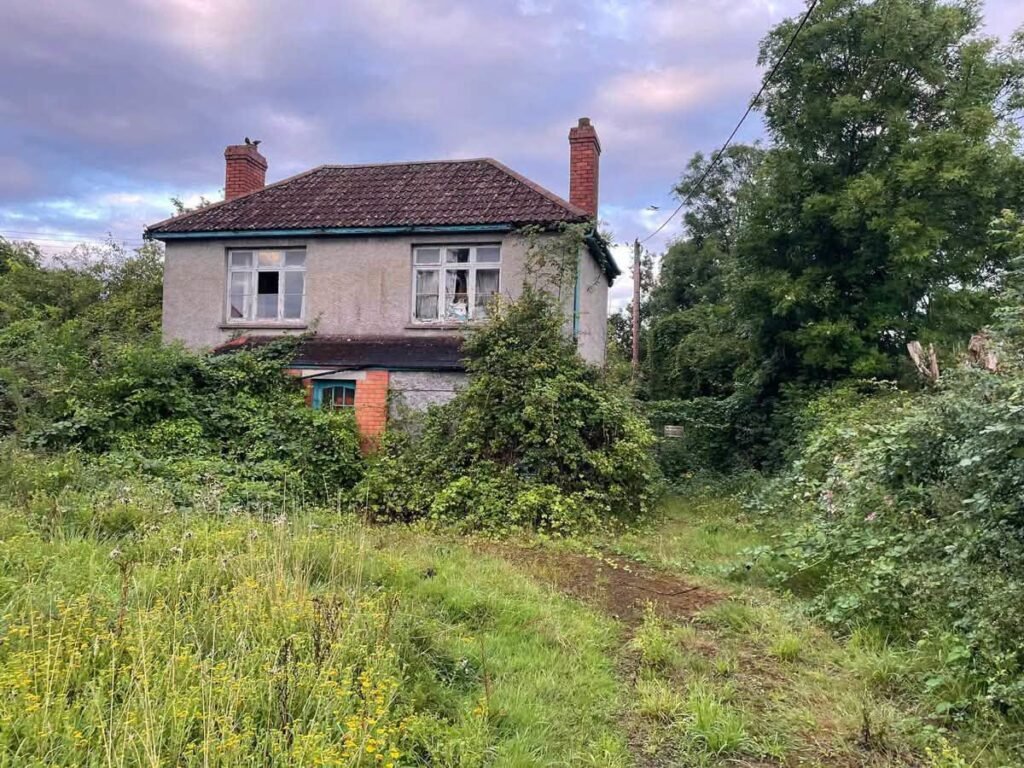
“Old house sat decaying away down Devon — always sad to see these places falling into this state, everything left behind.” That is the whole caption. Urbex Lost & Found posted it on 23 November 2026 with 34 photographs, and those two sentences are everything the post says about the house.
Some houses on this site come with a story: a name, a date, a reason. This one does not. There is no name for the house, no name for anyone who lived there, no date for when it was last occupied, and no reason given for why it was left. What there is, instead, is a set of photographs that show a home in detail — and the details are worth looking at closely, because they are all we have.
Five of the 34 photographs are shown here. What follows is built only from the post’s caption and those five photographs. Anything the post does not say is marked as not verified, not guessed.
The outside tells the story first
The first photograph is the outside of the house, and it says more than the caption does. It is a two-storey house with a tiled roof and two tall brick chimneys, standing at the end of an overgrown track. The garden has gone wild: long grass, brambles, and shrubs crowd the walls, and a tree leans over the roof from the right. Two upstairs windows are broken. The window frames are painted a faded blue-green, and the ground floor is half-hidden behind the growth.
There is no driveway worth the name any more, no gate, no sign. The house looks as if the garden has been growing unchecked for years, and the broken windows suggest that nobody has been back to secure it. The sky above it is grey and pink, late in the day.
A house that looks like this from the outside is usually worse inside, but that is not always true, and the photographs that follow show something different: the inside is not stripped or smashed. It is full. Whoever lived here left nearly everything behind, and the house has been sitting with it all ever since.
Dolls, a teddy bear and a sewing machine
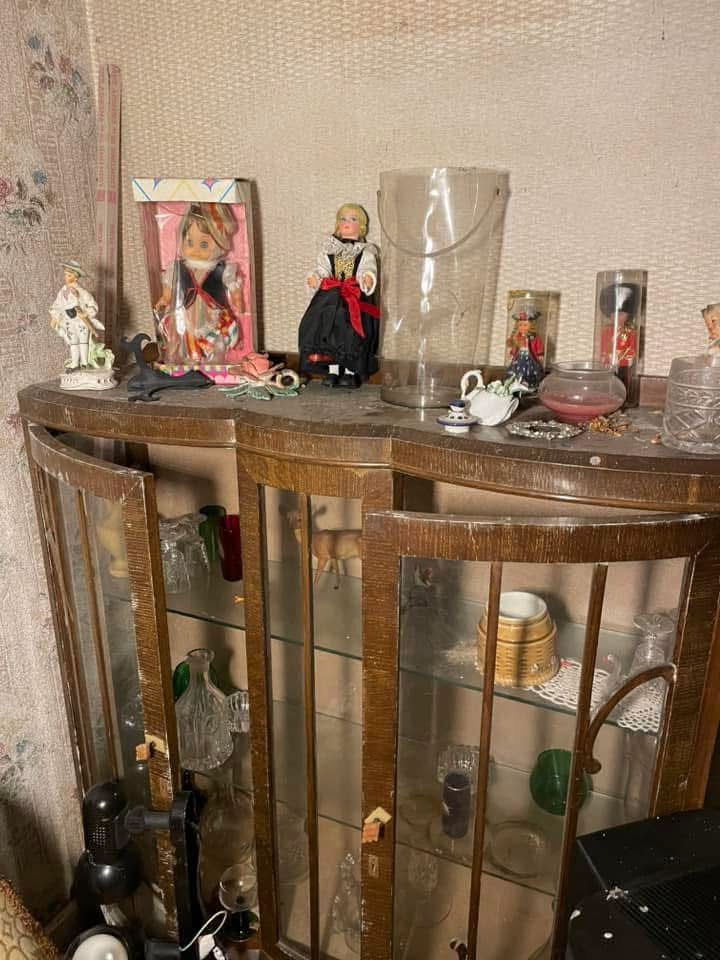
The second photograph shows a curved wooden display cabinet, its glass doors still shut, its shelves still full. On top of it stand dolls: one in a box, one in a folk costume with a red sash, a small porcelain figure, and a toy soldier in a tube. A large empty glass vase stands among them, and a small pink bowl. Inside the cabinet are glasses, a green vase, and a small model deer. The cabinet is dusty, but nothing in it has been disturbed.
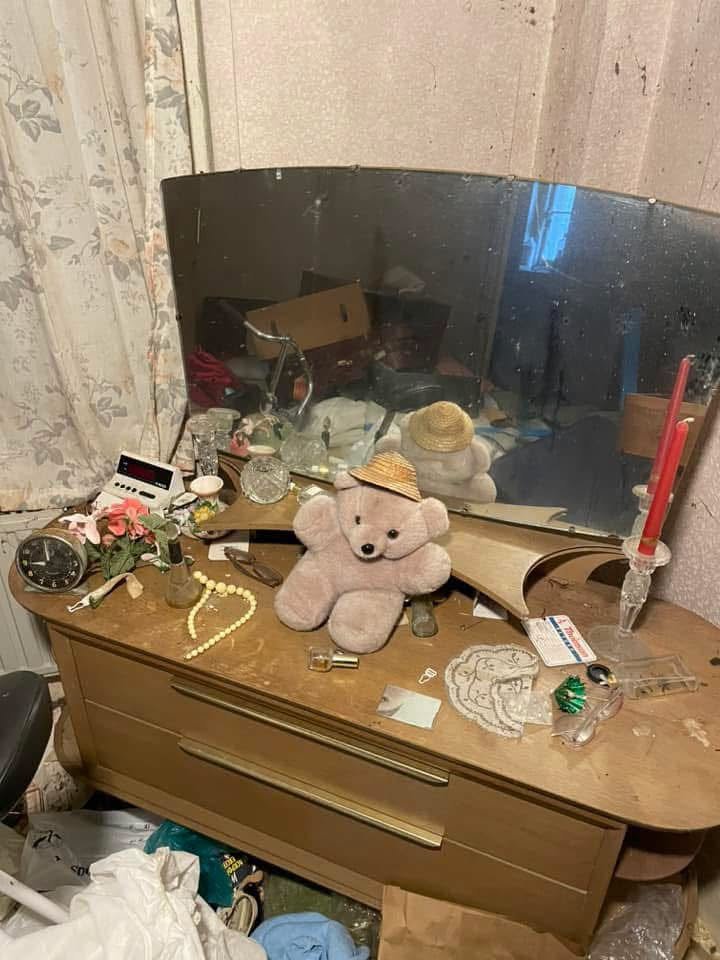
The third photograph is a dressing table. A large mirror, its surface darkened with age, stands at the back. In front of it sits a soft teddy bear wearing a small straw hat, flanked by a string of beads, a perfume bottle, an alarm clock, and two tall red candles in glass holders. A bunch of artificial pink flowers lies on the left. A doily, a small green brooch, and a card sit on the right. Clothes and bags spill across the floor in front of it.
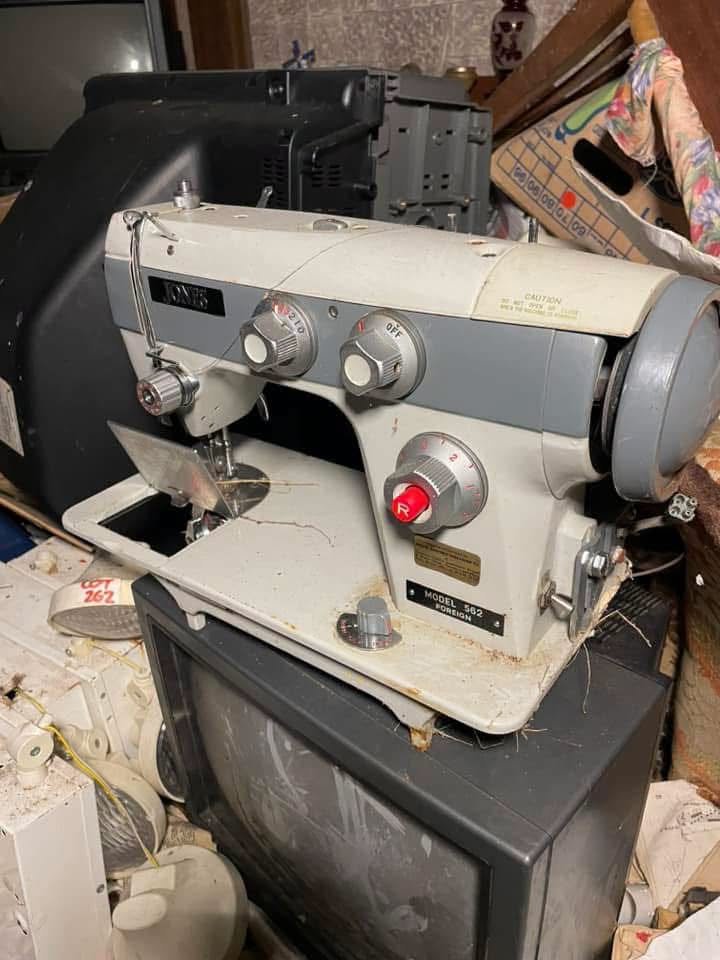
The fifth photograph shows a sewing machine — a Jones Model 502, its badge still legible — sitting on top of an old television set. Behind it are more old televisions, boxes, and a tangle of fabric and wires. The machine is dusty but whole, its red reverse button still bright.
These three photographs add up to a picture of a household, not a shell. Dolls kept in a cabinet. A teddy bear kept on a dressing table. A sewing machine kept, not thrown away. Whoever lived here kept things, and kept them in their places. That is the same pattern as the other abandoned houses where a home was left in a hurry or simply never cleared: the small, personal objects are the ones that stay, because nobody comes back for them.
Photographs of a grave
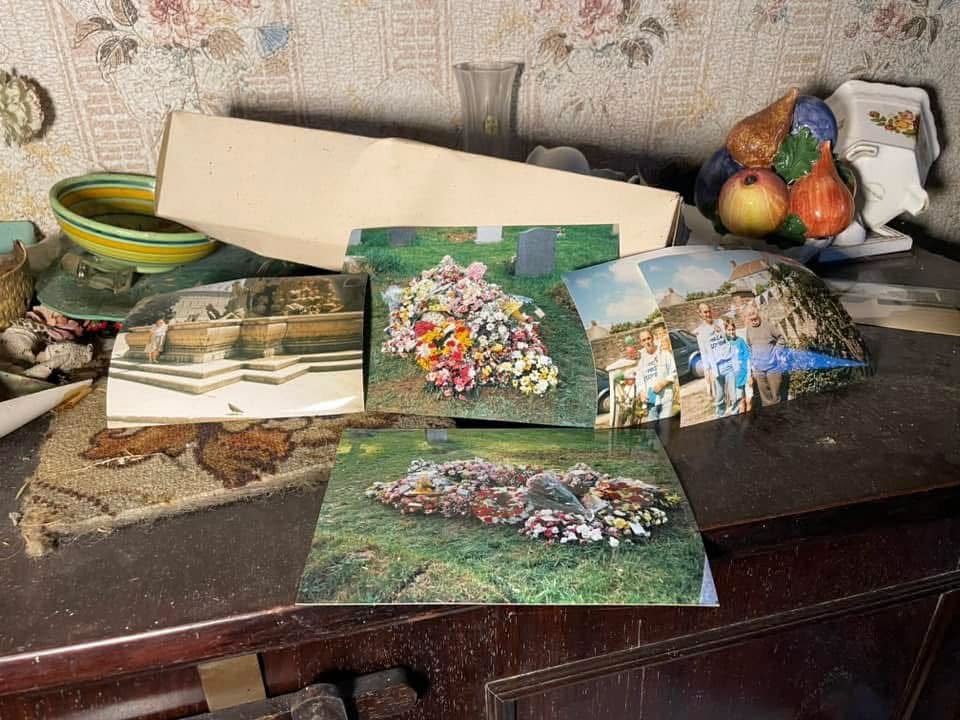
The fourth photograph is the one that stops you. Laid out on a dark wooden chest are several loose photographs. One shows a grave covered in flowers. Another shows a grave with a wreath laid on the grass. A third shows a family group standing outdoors, smiling. A fourth shows a stone fountain or monument with a person standing beside it.
These are not photographs of the house. They are photographs that were kept in the house, and they were laid out on the chest to be photographed. The grave photographs suggest that someone in the family died and was mourned, and that the photographs of the grave mattered enough to keep. But that is as far as the evidence goes.
It would be easy to build a story from this: to say that a death in the family is why the house was left, or that the grave belongs to someone who lived here. The post does not say that, and this article does not say it either. A grave photograph proves that someone died and was remembered. It does not prove whose grave it is, or when they died, or what it had to do with this house. The family group photograph shows people who may or may not have lived here. Their names are not given, and this article does not guess them.
What the photograph does prove is that this was a home where family mattered. The pictures were kept, and kept together, on a chest in the house. That is a fact. Everything beyond it is [TO VERIFY].
What the five photographs show, one by one
To keep the record straight, here is exactly what each photograph in this article shows: the exterior, a two-storey house with a tiled roof, two brick chimneys, broken upstairs windows, and a garden gone to brambles; the display cabinet with dolls on top and glasses inside; the dressing table with the teddy bear in a straw hat, the mirror, the alarm clock, the beads, and the red candles; the chest with loose photographs of a grave covered in flowers, a grave with a wreath, a family group outdoors, and a stone monument; and the Jones Model 502 sewing machine sitting on an old television.
That is the whole of what is known about this house from the source. Five photographs out of 34. The other 29 photographs in the post are not shown here, and this article does not describe them.
What is not known here
The post gives no name for the house and no name for anyone who lived there. It gives no date for when the house was last occupied, no age for the building, and no reason for why it was left. “Down Devon” is all the location the post gives — no town, no village, no road — and this article publishes no address.
It does not say who owns the house now, whether it has been sold, or what will happen to it. It does not say when the photographs were taken, only that the post was published on 23 November 2026.
All of those are [TO VERIFY]. They are listed here so the reader knows exactly where the verified facts end. The house is private property, and its location is not public. Do not attempt to find or enter it.
There is one more thing worth saying plainly. A house with this little information is easy to write a story about, and the temptation is to fill the gaps with what seems likely. This article has not done that. A decaying house in Devon with dolls, a teddy bear, a sewing machine, and photographs of a grave is already a complete picture, even without a name or a date. The gaps are part of the story, not something to be papered over.
Frequently Asked Questions
Where in Devon is this house?
The post says only “down Devon”. No town, village, or road is given, and this article does not publish an address. The house is private property.
Who lived in the house?
The post does not say. No names are given. The photographs show family pictures and a grave covered in flowers, but the post does not identify the people in them.
When was the house last lived in?
The post does not say. There is no date for when it was last occupied, and no calendar or dated object is visible in the five photographs shown here. The post was published on 23 November 2026.
What is inside the house?
Everything, according to the post. The five photographs here show a display cabinet with dolls, a dressing table with a teddy bear, a chest with family photographs, and a Jones Model 502 sewing machine. They are 5 of the 34 photographs in the original post.
Does the grave photograph mean someone from the house died?
The post does not say. The photographs show a grave covered in flowers and a family group, but they do not identify whose grave it is or what it had to do with this house. That is [TO VERIFY].
How old is the house?
The post does not say, and the photographs do not give a build date. The age is [TO VERIFY].
Can I visit the house?
No. The location is not public, the house is private property, and entering an abandoned building is trespassing and can be dangerous. This article is not a guide to finding or entering it.
Disclaimer
This article is based only on the Urbex Lost & Found Facebook post of 23 November 2026 and the five photographs in that post shown here. The caption is quoted as published. Location beyond Devon, ownership, the house’s age, the identities of the people in the photographs, and the reason the house was left are not stated in the source and are marked [TO VERIFY]. Do not attempt to find or enter this property. Abandoned buildings are private property, may be structurally unsafe, and entering them is trespassing. This article is general information only, not legal, tax, or financial advice; rules differ by state and county, so check county records and a local professional before acting.
Photos
Photos by Urbex Lost & Found, via the original Facebook post: https://www.facebook.com/UrbexLostNFound/posts/pfbid0yPBxcBaaFAsbevmU8Eshuy9S2gRP2oK8VVeR8s67RP2rBQWGWRdn94nHfpzRF1MAl — 5 of the 34 photos are shown here.