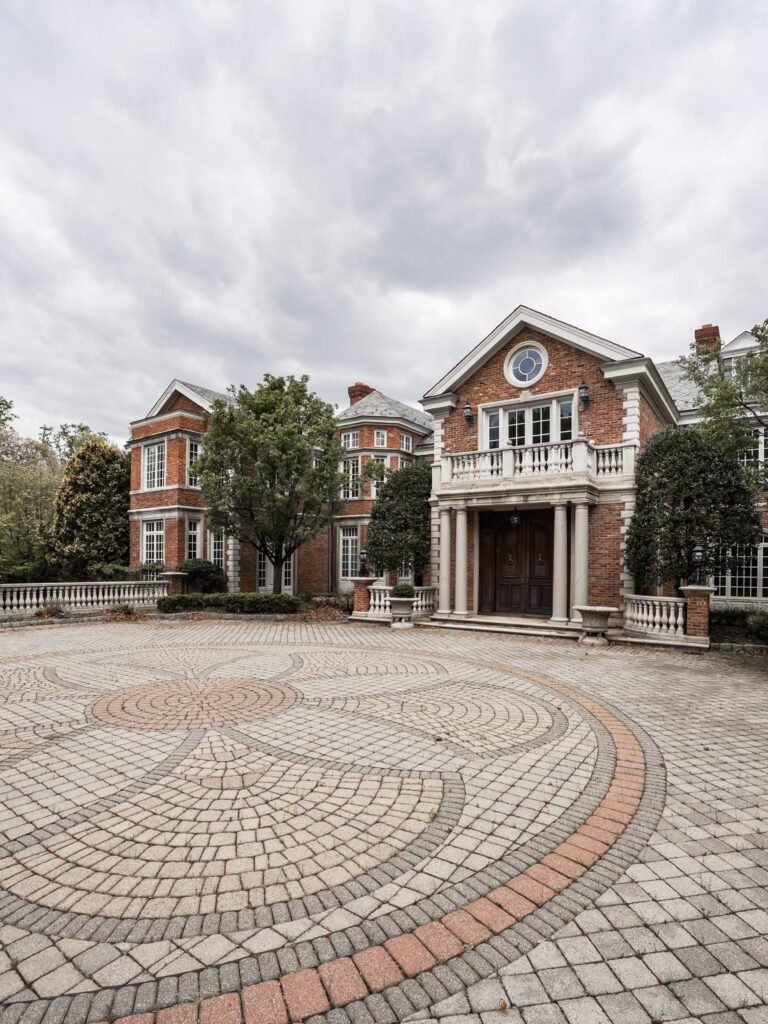
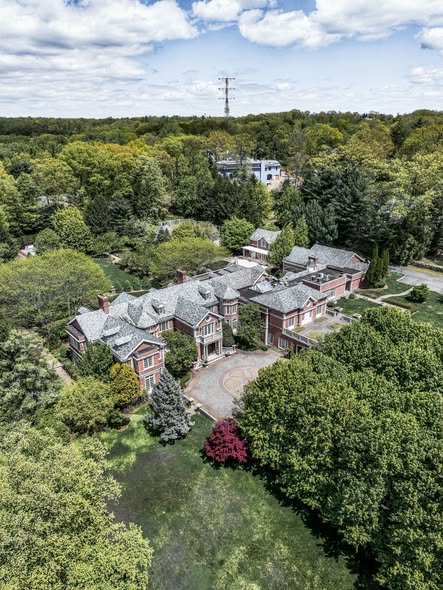
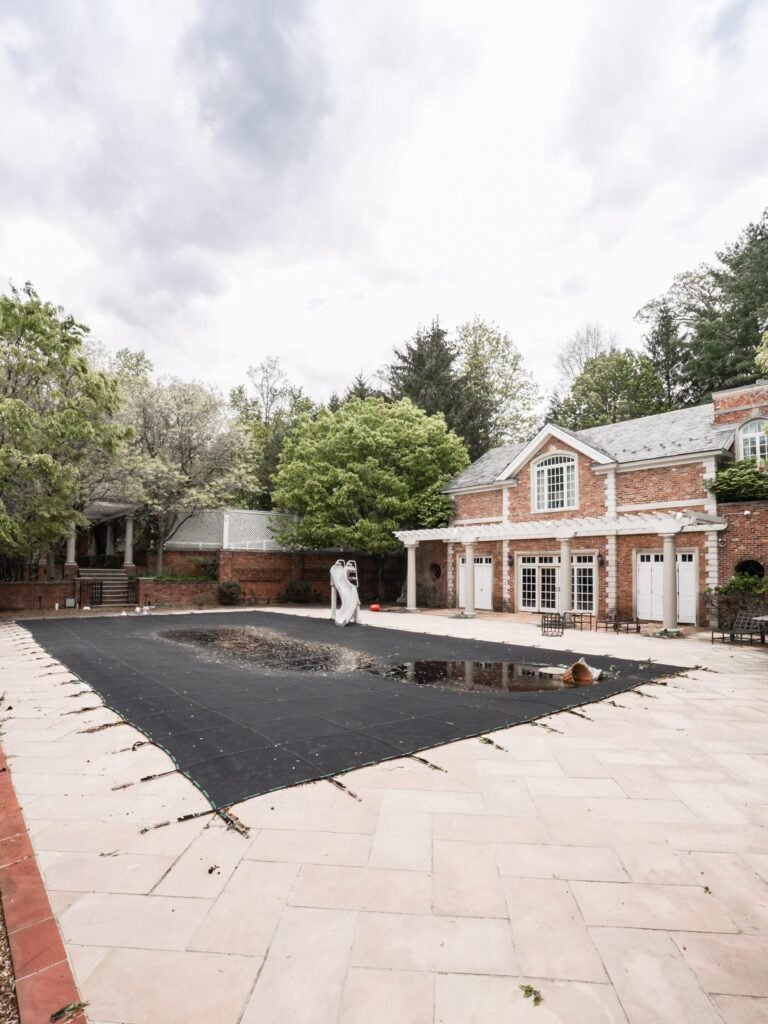
From the drone shot, the property reads more like a private campus than a single residence. A symmetrical main block with a columned portico faces a long paved drive. Behind it sit a covered pool with a slide, a pergola-shaded pool house, and a fountain garden. Off to one side, on its own slab of pavement, lies an outdoor basketball court.
The caption on the BigBankz Facebook post that published these photos calls it the “Big Pharma CEO’s Abandoned $30,000,000 Mega Mansion.” It credits the house with 35,000 square feet, a full indoor basketball court, an 8-car garage, and a movie theater. It says the mansion now sits abandoned and is awaiting demolition.
That caption is the entire public record behind this story. No state or city is named. No street address appears. No owner’s name is given. Everything below is drawn only from what the post states and what its seven accessible photos show — the latest entry in our abandoned mansions coverage, and a case study in how little a viral caption actually verifies.
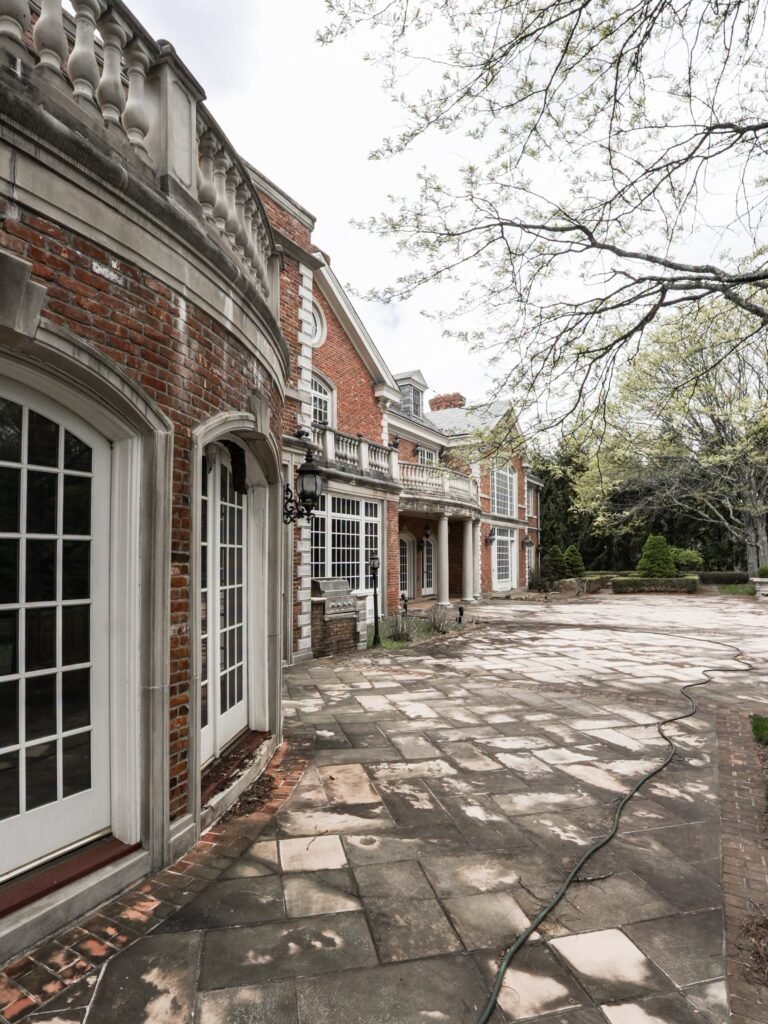
The seven photos, in order: an aerial drone view, the front facade with its columned portico, a side entrance with arched doors and a balcony above, the rear pool under its cover with a slide, the pool house from a pergola angle, a garden path leading to a fountain, and the outdoor basketball court. Exteriors only. Not a single interior frame.
Where the caption and the photos disagree, the disagreement is the story. Walk through both, carefully.
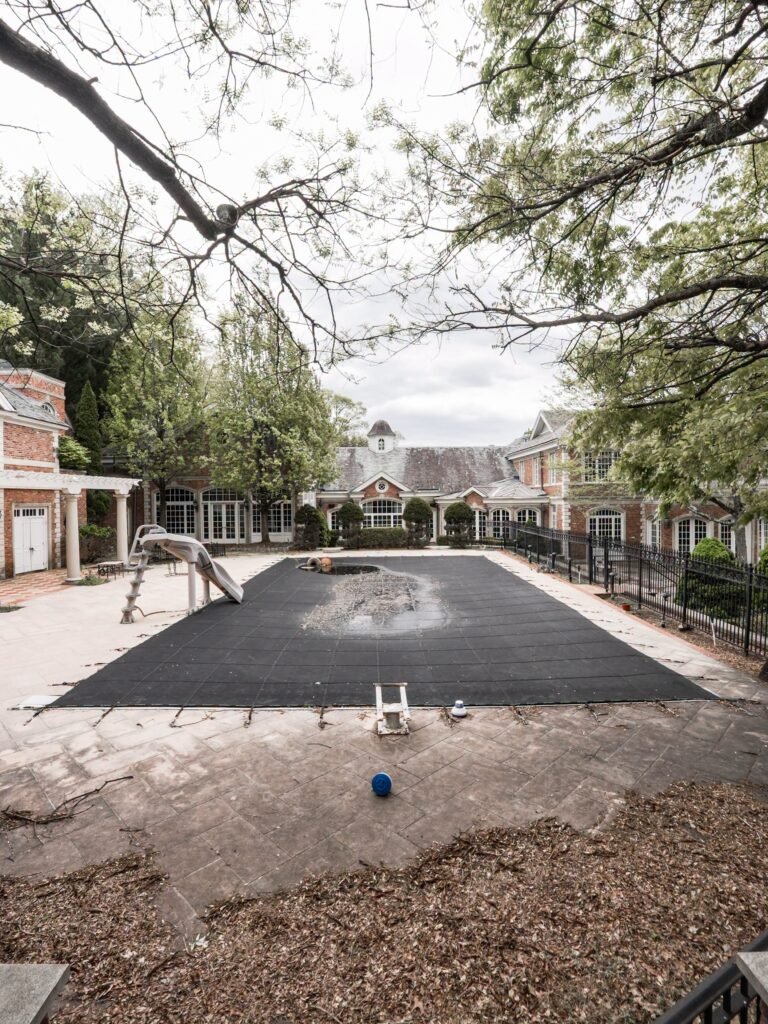
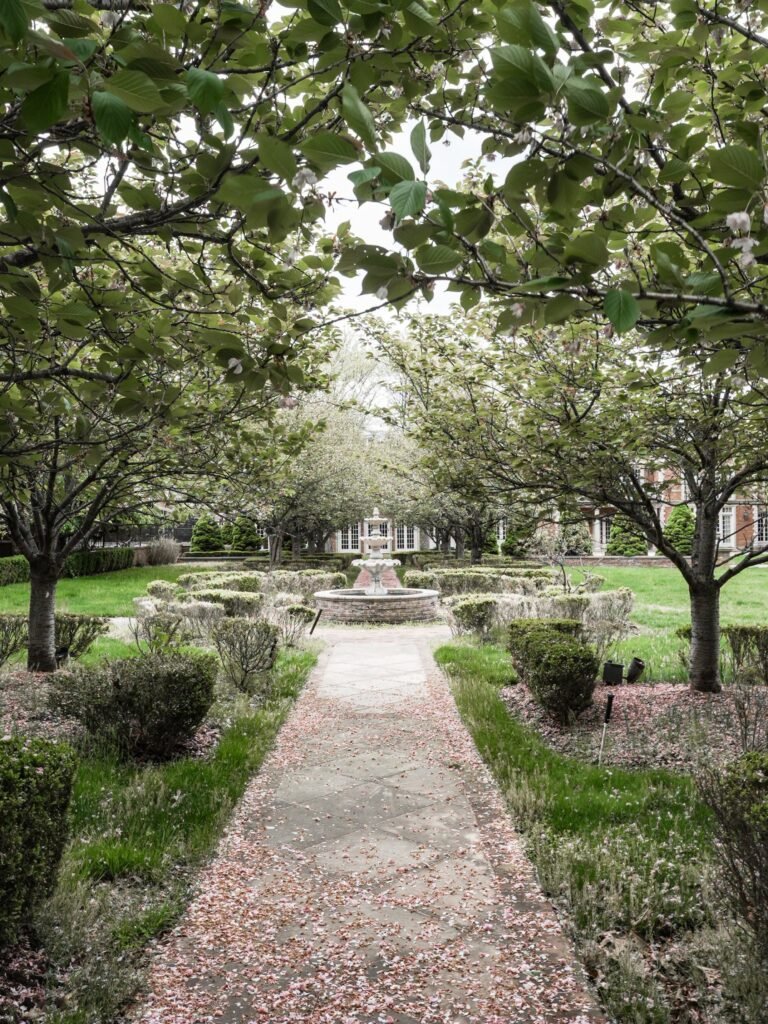
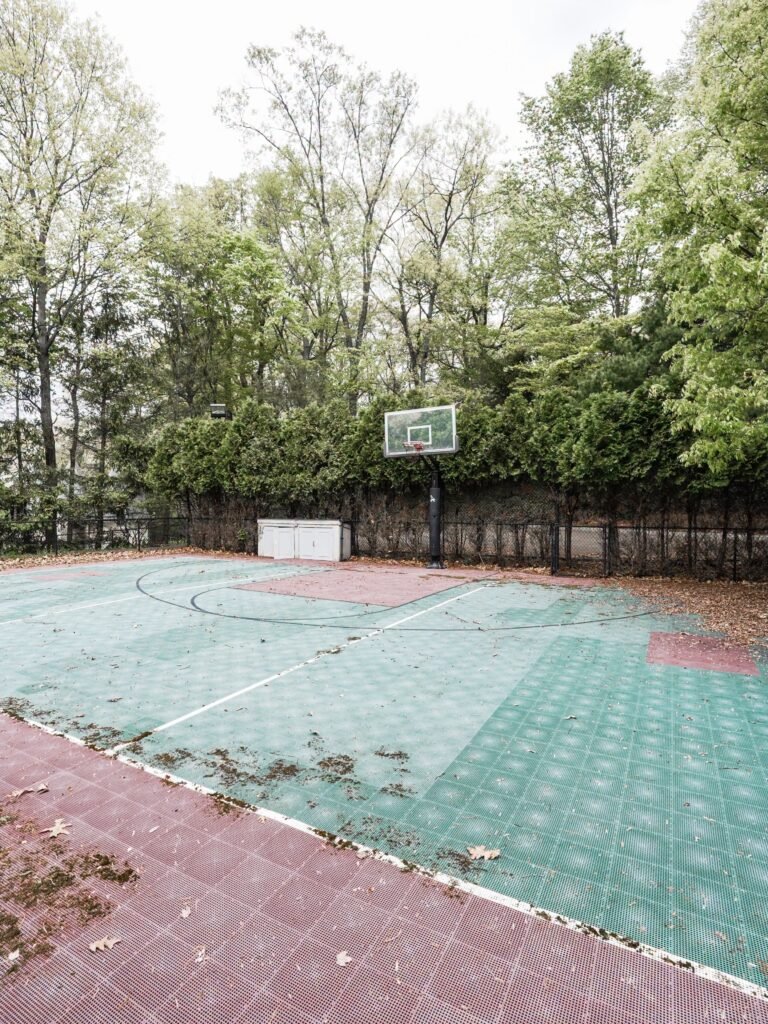
Photos: BigBankz on Facebook — original post: https://www.facebook.com/BigBankz2/posts/pfbid0WcKRT4xNNMi9zREAShxfXBuvr6mbTUXFz1p8k5EL4S7Di6EYZnyWmix861ED5dTAl (7 of the 19 photos in the original post are shown here; the rest were not accessible without signing in to Facebook).
Caption Claims vs. What the Seven Photos Actually Show
BigBankz’s original post carried 19 photos. Only 7 were accessible without signing in to Facebook, and those are the 7 shown here. Lining the caption’s claims up against exactly what those photos depict is a useful reality check — and a sobering one.
| What the caption claims | What the 7 photos actually show |
|---|---|
| “Big Pharma CEO’s Abandoned $30,000,000 Mega Mansion” | No price, owner, or location detail is visible in any photo; the label comes only from the caption. |
| 35,000 square feet | Square footage cannot be verified from exterior photos. |
| Full indoor basketball court | Photo 7 shows an outdoor court on an exterior slab. No indoor court appears in any of the seven photos. |
| 8-car garage | No garage is visible in the seven photos. |
| Movie theater | No theater is visible in the seven photos. |
| Last resident: a pharma executive arrested over alleged embezzlement | No person is identifiable in the photos; the claim comes only from the caption and is unverified. |
| Abandoned, awaiting demolition | The grounds look maintained in the photos; no interiors are shown, so the building’s true condition cannot be judged. |
The Embezzlement Allegation, Stated Carefully
According to the post, the last person to live in the house was an executive of a big pharmaceutical company who was arrested for allegedly embezzling nearly $4 million of investor money to fund a lavish lifestyle.
Read that sentence again and notice everything it does not contain: a name, a company, a court, a case number, a date. None of that was published in the post, and none of it could be verified from the material available. No name is repeated here because none was given.
That restraint is deliberate. Abandoned-property stories routinely attach crimes to buildings on thin sourcing, and a mega-mansion makes an easy villain’s lair in the telling. Until a named charge in a named court is on the record, this stays exactly what it is: an allegation inside a Facebook caption, explicitly unverified.
The post ties the alleged conduct to the lifestyle the house represents, and then ties the abandonment to the fallout. Even that chain is the post’s framing, not an established fact. It is included here only because the caption includes it — with the verification status attached.
Why a 35,000-Square-Foot House Ends Up Awaiting Demolition
Thirty-five thousand square feet is not a house so much as a small institution. Roofs, mechanical systems, staff, insurance, property taxes — the carrying costs scale with every square foot, and they do not pause when the owner walks away.
The buyer pool for a property that size is vanishingly small even in good condition. Add abandonment, possible legal entanglement, and interiors nobody has photographed, and the list of plausible buyers shrinks toward zero.
That is when demolition enters the conversation. Sometimes the land is worth more than the structure sitting on it. Sometimes a building deteriorates past the point where renovation math works. The post uses the phrase “awaiting demolition” without a date, a permit, or a named authority — so the timeline, like nearly everything else here, was not published.
Here is the honest complication: the photos do not look like ruin. Lawns trimmed, pool covered, facades intact. Either the abandonment is recent, someone is still maintaining the grounds, or the decay is all indoors where the cameras didn’t go. Seven exterior photos cannot settle it.
Viral posts also flatten demolition into a single dramatic event — the wrecking ball, the collapse. The real process is paperwork first: permits, asbestos surveys, utility disconnects, sometimes years of it. None of that appears in the post. What appears is a phrase, and a phrase is not a schedule.
Demolition or Rescue: Four Questions for This Specific Mansion
Skip the generic debate about whether old houses should be saved. For this mansion, four specific questions decide whether demolition or rescue is the realistic outcome — and three of them currently have no answer.
- Who actually holds title right now? No owner is named in the post. Without a verified owner there is no one to negotiate with, no one to buy from, and no one to grant access for inspections. Every rescue story starts with a name on a deed. This one doesn’t have it.
- Is the alleged legal trouble actually resolved? The post’s embezzlement allegation is unverified, but if anything like it were real, it could mean liens, frozen assets, or proceedings that cloud the title for years. A buyer can’t close on a question mark, and a preservation group can’t fundraise around one.
- Does the math work at 35,000 square feet? Restoration cost is a per-square-foot problem, and 35,000 of them is a punishing multiplier. Contrast this with the 1902 Noonan home in Alexandria, Minnesota — and note the difference carefully: that one is a lived-in house listed for sale, not an abandoned property, with a price, a listing, and rooms a buyer can actually walk through. This mansion has none of that scaffolding, which is exactly why the spreadsheet usually points at demolition.
- What do the seven photos really tell us about condition? Exteriors only — and tidy ones. No interiors, no roof close-ups, no mechanical rooms. A rescue decision requires the inside of the building; a demolition decision sometimes only requires the outside of the spreadsheet. Right now the public has the spreadsheet side and almost none of the building.
What We Still Don’t Know
The unknowns outnumber the facts. The post does not publish a state, city, or address. It does not name the executive or the company. It gives no demolition date, no interior views, and no indication of who took the photos or when.
Twelve of the post’s nineteen photos weren’t accessible without signing in to Facebook, so even the visual record is partial. Filling the gaps with guesses would be easy — and it would be exactly the kind of invention this site tries not to publish.
If verified details surface — a location, a records trail, a demolition permit — they’ll appear in new coverage on the abandoned.blog homepage.
Frequently Asked Questions
Where is the abandoned $30 million pharma mansion located?
The post does not publish a state, city, or street address, and locations that can’t be verified don’t get repeated here. Any page naming a location for this property is guessing.
Who owned the mansion?
No name was published. The post describes the last resident only as an executive of a big pharmaceutical company. That single clause is the full extent of what’s on the record.
Was the owner really arrested for embezzling nearly $4 million?
That is the post’s allegation, and it is explicitly unverified. No name, company, court, case number, or date was published alongside it. Treat it as a claim inside a caption — not as an established fact.
When will the mansion be demolished?
No demolition date was published. “Awaiting demolition” is the post’s phrasing; no permit, timeline, or authority is named. If a schedule exists, it isn’t public in the material available.
How big is the mansion?
35,000 square feet, according to the caption. The figure can’t be independently verified from seven exterior photos, but it’s the only size number the post gives.
Does it really have an indoor basketball court?
The caption claims a full indoor court. The photos disagree: the seventh photo shows an outdoor court on an exterior slab, and no indoor court appears in any of the seven available photos. The 8-car garage and the movie theater are likewise claimed but not visible.
Can I visit or buy the mansion?
Nothing in the post suggests the property is accessible or for sale, and no location is published. And the general rule stands: entering abandoned buildings is trespassing in most jurisdictions. See the disclaimer below.
This article is general information only — not legal, tax, or financial advice. Rules on abandoned property, demolition, liens, and trespass differ by state and county. Check county records and consult a local professional before acting on anything described here.