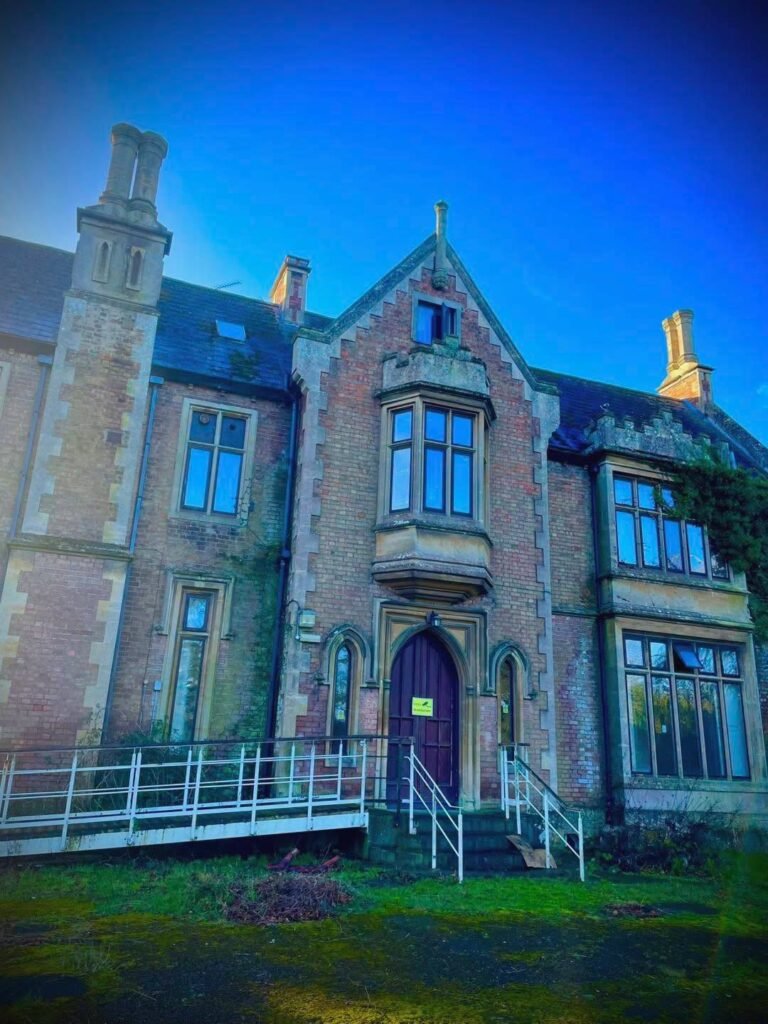
The front door is arched, dark wood, and boarded in spirit if not in fact: a small yellow notice is stuck to it, and a white metal ramp runs up to the steps. Above the door, a gabled bay window juts out over the entrance, and the chimneys rise in pairs against a hard blue sky. This is Frocester Manor, in the Cotswold village of Frocester, Gloucestershire — and it has been empty since the 1960s.
The post that documents it is dated 22 June 2026, and it is worth reading carefully, because it tells a long story in a short space, and not every part of that story sits comfortably with the rest. Everything in this article comes from that post and from the five photographs shown here. No location beyond the village is given, and no surname is used.
What the post says happened here
The manor itself, the post says, dates back to 1280 and was known as Frocester Court. The house standing now was built in the 1850s, and it is a Grade II listed building. It stands in a wooded park, is of stone and slate, and is a long rectangular range of two storeys, with four bays and projecting gabled wings. It was a residence of the lord of the manor.
Then the post gives a chain of owners that is hard to follow as written. It says the house was sold in the 1800s and re-bought by the present owners, and then that the house was bought in 1900 by the present owner. In 1912, the post says, the owner and the whole family died in a terrible fire. The house was then bought by a family who lived in it until 1960. It was then sold to a developer who wanted to turn it into flats, but the plan was rejected. The house has been empty since the 1960s.
That account is repeated here exactly as the post gives it, because it is the only account available — but it should be read as the post’s account, not as a verified history. The dates do not line up cleanly: a house bought in 1900 cannot easily have been re-bought by the same “present owners” after a sale in the 1800s, and a family dying in a fire in 1912 leaves questions about who owned the house between 1912 and the family who lived there until 1960. None of those questions is answered in the post, and none is answered here. What is certain, from the photographs and from the listing status, is the building itself: a substantial Victorian manor, listed, and empty for more than sixty years.
A listed building, on the at-risk register
The one fact the post states that can be checked against an official status is the listing. The house is a Grade II listed building and is on the Buildings at Risk register. That matters, because it means the building is recognised as important and recognised as in danger at the same time. The post says many original features are still in place, including windows, fireplace and cornicing, and that the house is in a state of disrepair, with the roof leaking and the walls damp.
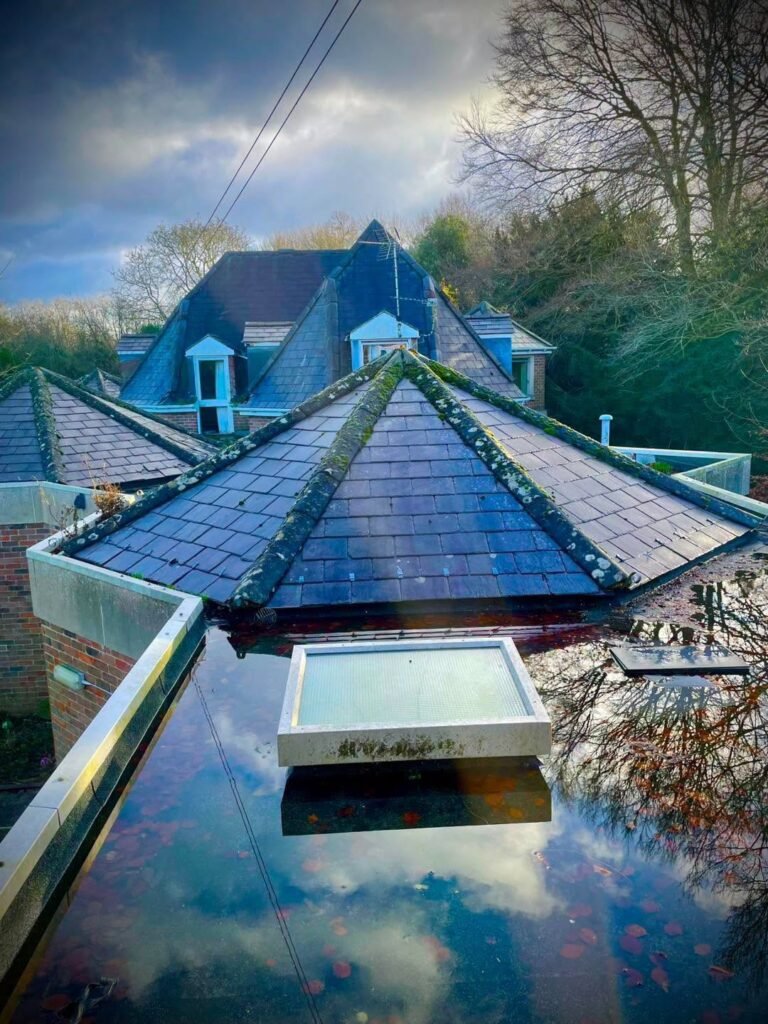
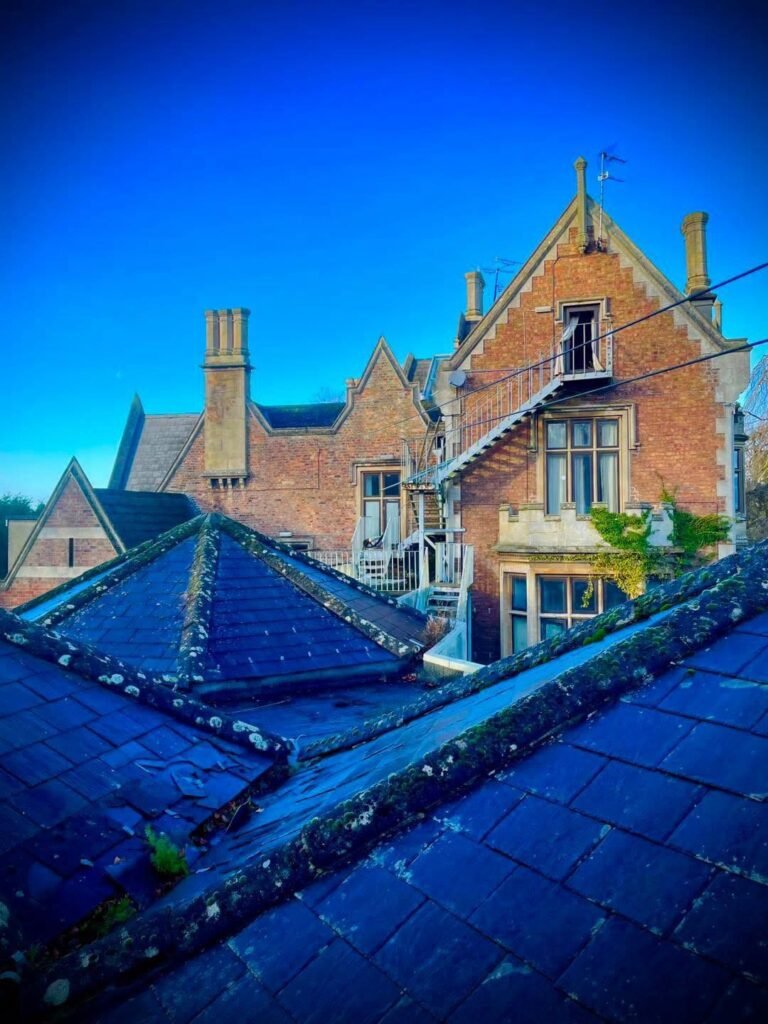
The photographs back up the disrepair. The second photograph looks down on the roof from above: mossy slate, a skylight, dormer windows, and a flat section where water has puddled. The third shows a red-brick gabled wing with an external metal fire-escape staircase bolted to the wall — a later addition, and a sign that the building was once adapted for some other use. Ivy climbs the brick, and the slate roofs run in several directions, which fits the post’s description of a long range with projecting wings.
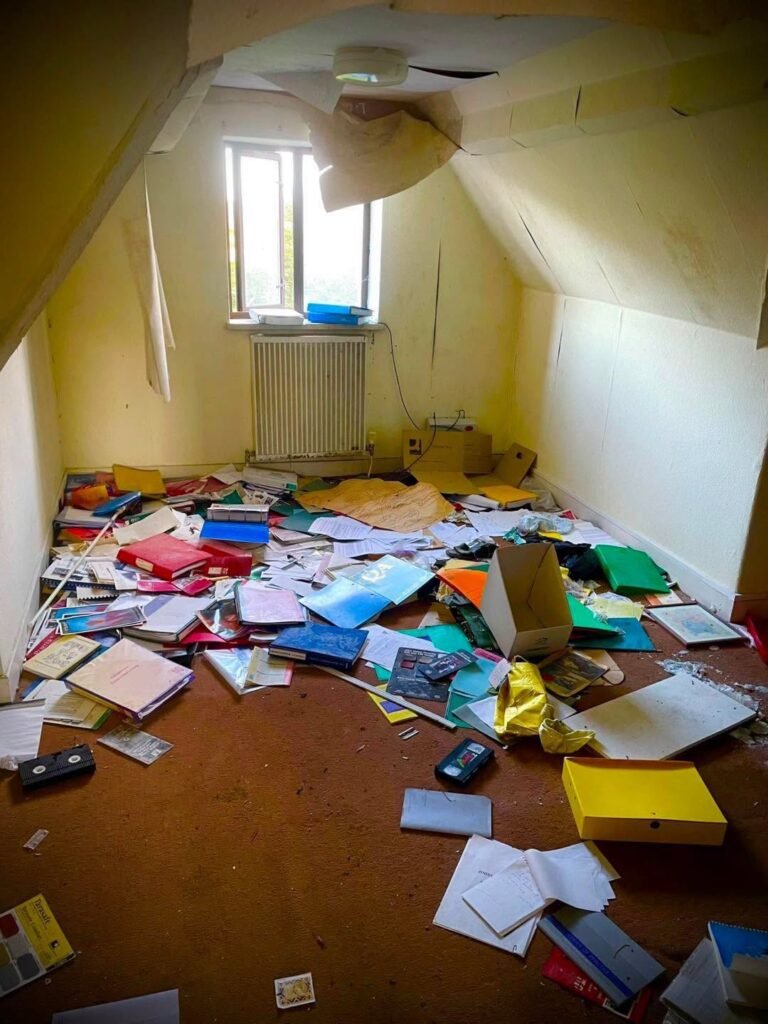
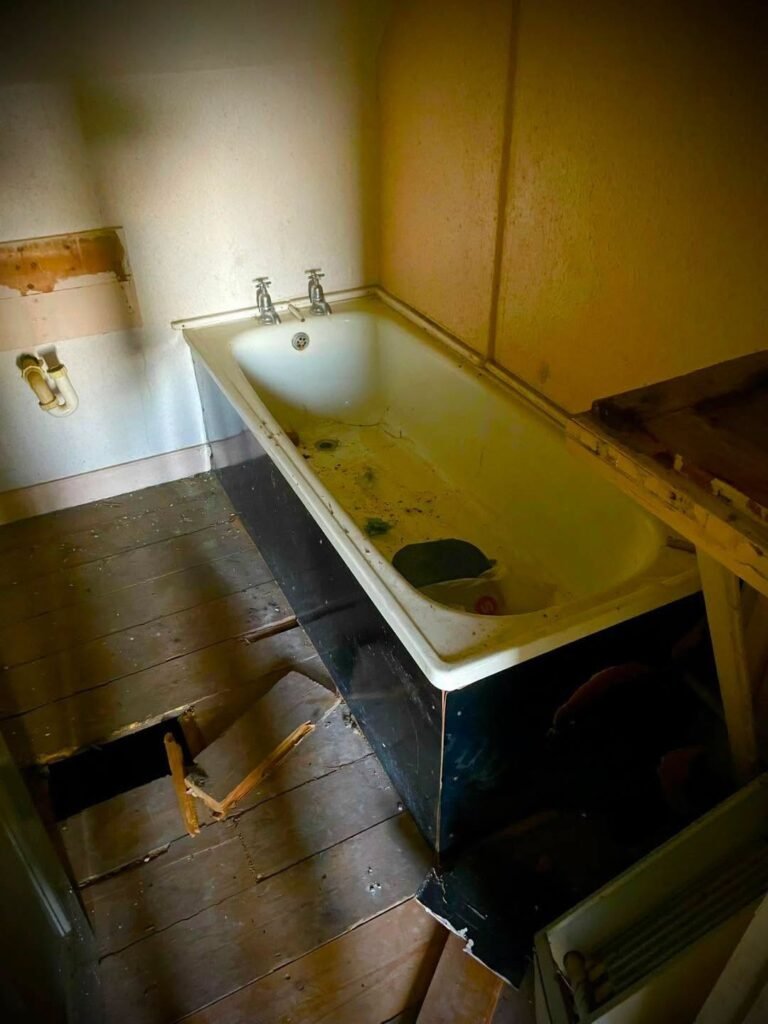
Inside, the damage is quieter but just as plain. The fourth photograph is an attic room with sloping ceilings and peeling paper, where the floor is covered with books, folders, loose papers, VHS tapes and cardboard boxes — the paper remains of somebody’s working life, spilled across the carpet. The fifth is a bathroom: a dirty white bathtub full of debris, yellow-stained walls, bare floorboards with a hole broken through them, and an exposed pipe. Nothing in these rooms looks staged. They look like rooms that were left, then entered, then left again.
The long emptying
| Period, as the post gives it | What the post says |
|---|---|
| 1280 | The manor dates back to this year, known as Frocester Court |
| 1850s | The present house built; a residence of the lord of the manor |
| 1800s | Sold, then re-bought by the present owners (as written) |
| 1900 | Bought by the present owner (as written) |
| 1912 | Owner and whole family died in a terrible fire (as the post says) |
| Until 1960 | A family lived in the house |
| After 1960 | Sold to a developer; plan to turn it into flats rejected |
| Since the 1960s | Empty |
The table is useful precisely because it shows the gaps. Between 1912 and 1960 there is a hole the post does not fill. Between the 1800s sale and the 1900 purchase there is a contradiction the post does not resolve. A reader who wants the real history of Frocester Manor would need the listing record and the county archive, not a social media caption — and this article does not pretend otherwise.
What the photographs do establish, without needing the caption, is the scale of the loss. This was not a cottage. It was a manor house with four bays, gabled wings, bay windows, tall chimneys and a wooded park, built for a family of standing and then left for six decades while the roof leaked and the walls grew damp. The eerie atmosphere the post mentions — the sound of the wind blowing through the broken windows — is easy to believe from the pictures alone.
For a contrast with a house that is lived in and on the market, see a lived-in 1902 home in Alexandria, Minnesota, where the questions are about upkeep and price rather than about what sixty years of emptiness does to a listed building. More houses in this condition are gathered in abandoned mansions and in abandoned houses, and the site’s front page is abandoned.blog.
FAQ
Where is Frocester Manor?
In the Cotswold village of Frocester, Gloucestershire, according to the post. No exact address is given here.
When was the house built?
The post says the present house was built in the 1850s, and that the manor itself dates back to 1280 as Frocester Court.
Is it listed?
According to the post, it is a Grade II listed building and on the Buildings at Risk register.
How long has it been empty?
The post says the house has been empty since the 1960s, after a developer’s plan to turn it into flats was rejected.
Did a family really die in a fire there in 1912?
The post says the owner and the whole family died in a terrible fire in 1912. That is the post’s account and has not been independently verified here.
What is left inside?
According to the post, many original features remain, including windows, fireplace and cornicing. The photographs show a leaking roof, damp walls, and rooms full of scattered books, papers and VHS tapes.
Can I visit it?
No visiting information is given here, and entering private property without permission is not encouraged.
Disclaimer
This article is general information only, not legal, tax, or financial advice. Rules on abandoned and private property differ by state and county; check county/local records and a local professional before acting. The account of the house, its owners and the 1912 fire is as reported in the source post and has not been independently verified.
Photos
Photos by Luke2Explore, via the original Facebook post: https://www.facebook.com/Luke2Explore/posts/abandoned-cotswold-house-frocester-manorthis-is-an-important-former-manor-house-/1479328417566175/ — 5 of the 16 photos are shown here.