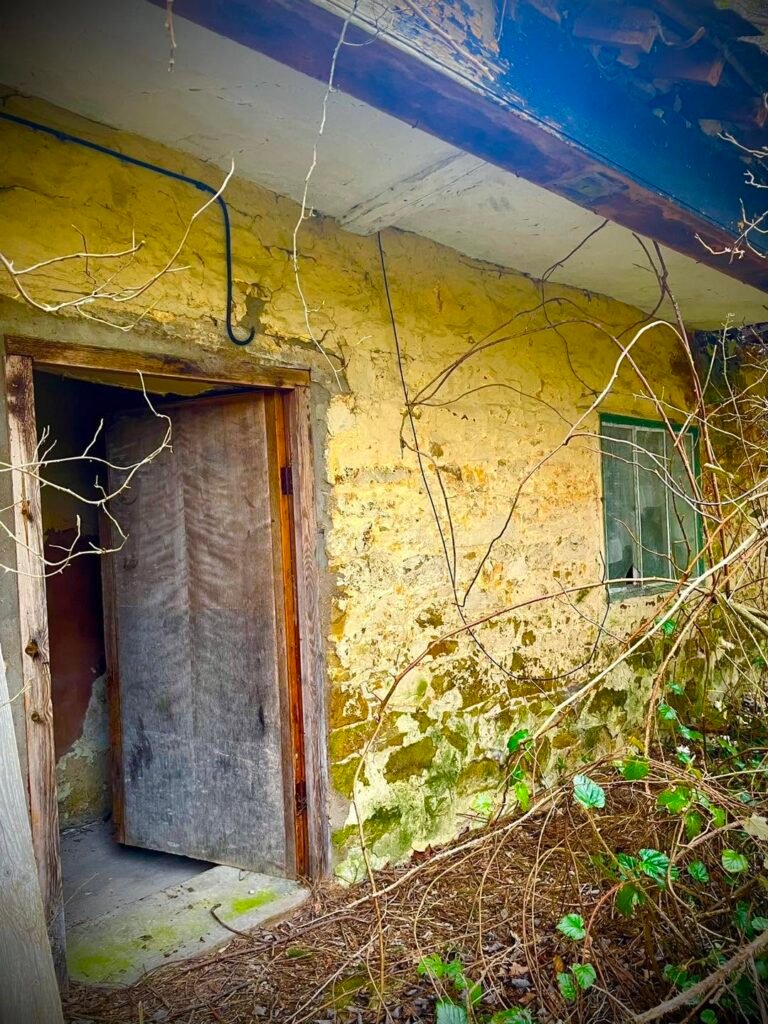
The post begins with a location that is almost a riddle: an old bungalow hidden away on a steep hill, in the middle of a forest, in the middle of nowhere. There is no road in the description, no village, no landmark. The bungalow is where it is because nobody built anything near it, and nobody has been near it for a long time. The explorer who found it, writing on 14 March 2024, says he does not have too much information on this one, and is not sure how long it has been abandoned and derelict. That is all the history there is, and it is the whole of it.
What there is, instead, is a set of objects — a television, a chair, a pair of shoes, a suit on a hanger, some bottles on a window sill — and from those objects, a guess. The post guesses, from the suit and the shoes and the chair, that a gentleman once lived here. That guess is the post’s, and it is presented here as a guess. Everything in this article comes from that post and from the five photographs shown here.
Five objects, one absent person
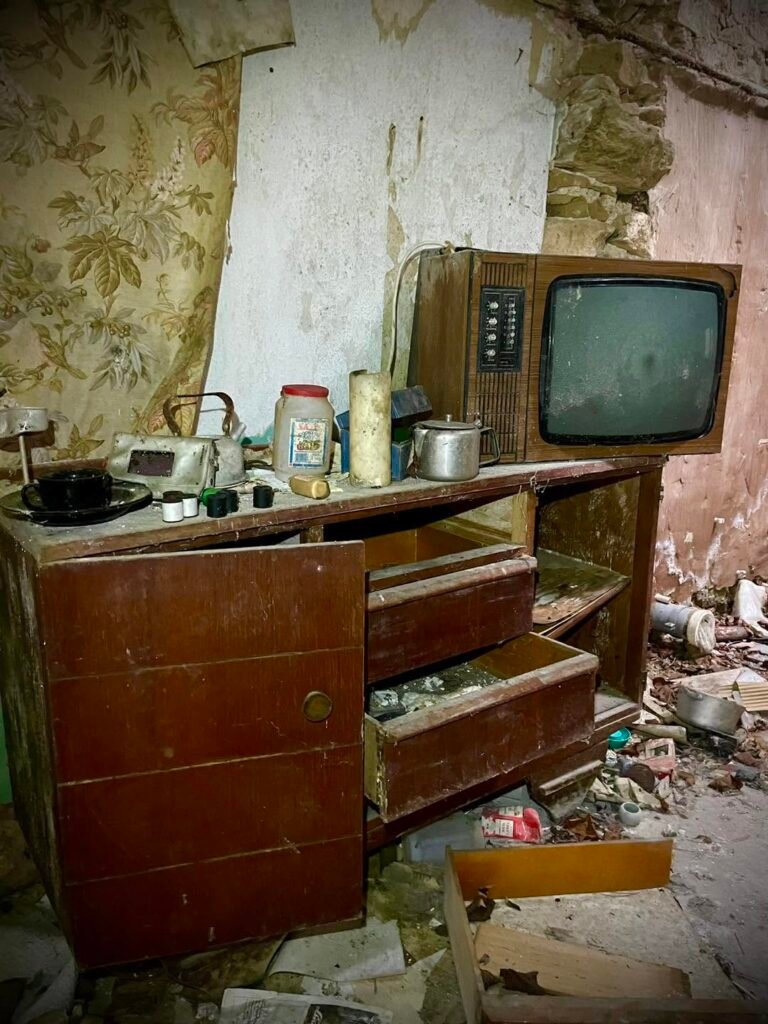
The second photograph is the television. An old CRT set, wood-cased, sits on a wooden dresser whose drawers hang open. On top of the dresser are the small things of a kitchen or a living room that was never tidied: a kettle, a metal teapot, a jar with a red lid, a candle, a black cup and saucer, film canisters. The floral wallpaper behind it is peeling, the plaster is crumbling, and the floor is covered in debris and fallen boards. A television like this dates the house more surely than any document could. It is a set from before flat screens, from a time when a television was a piece of furniture, and it has been sitting on that dresser, in that room, ever since.
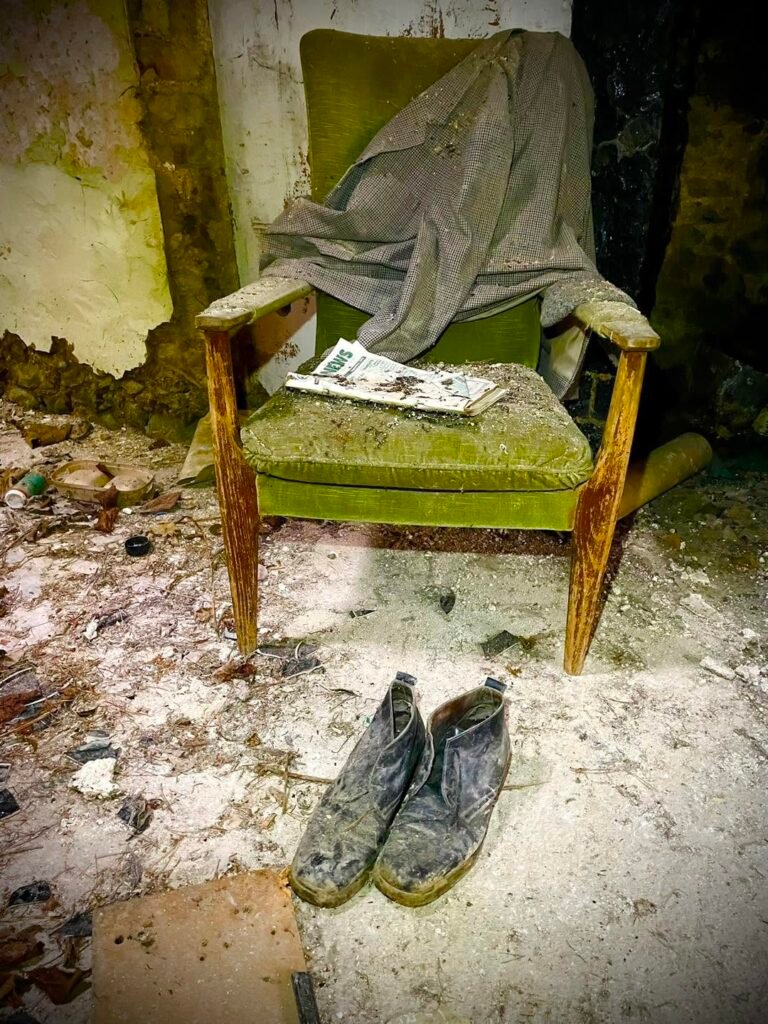
The third photograph is the chair. A green upholstered armchair with wooden arms stands in the middle of a ruined room, its fabric stained and dusty, a grey checked jacket draped over its back, and a folded newspaper on its seat — the word “NEWS” just visible on the masthead. On the debris-covered floor in front of the chair sits a pair of dusty old shoes, placed neatly side by side, as if somebody had stepped out of them and meant to step back in. The wallpaper behind the chair is peeling in great sheets. The shoes are the detail that stays with you. They are not thrown down. They are set down, together, in front of the chair where their owner sat.
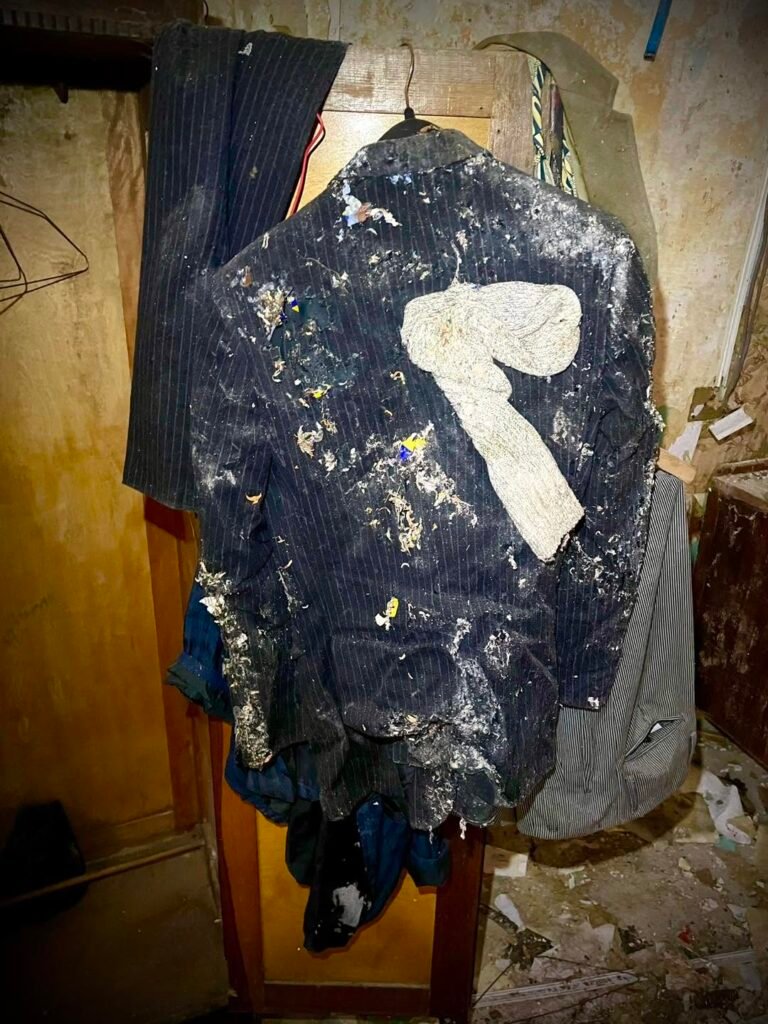
The fourth photograph is the suit. A mould-covered pinstripe blazer hangs on a wardrobe door, with a white knitted tie draped over its shoulder, and trousers and a striped shirt hanging behind it. The fabric is spotted with mould and dust, and the shoulders are sagging. The post says the blazer was still hanging up, covered in cobwebs, over the old wardrobe. It is the most deliberate-looking thing in the house: somebody hung this suit up, and nobody ever took it down. A suit is not left behind by accident in the way a newspaper is. It is left behind because the person who owned it did not come back for it, or could not.
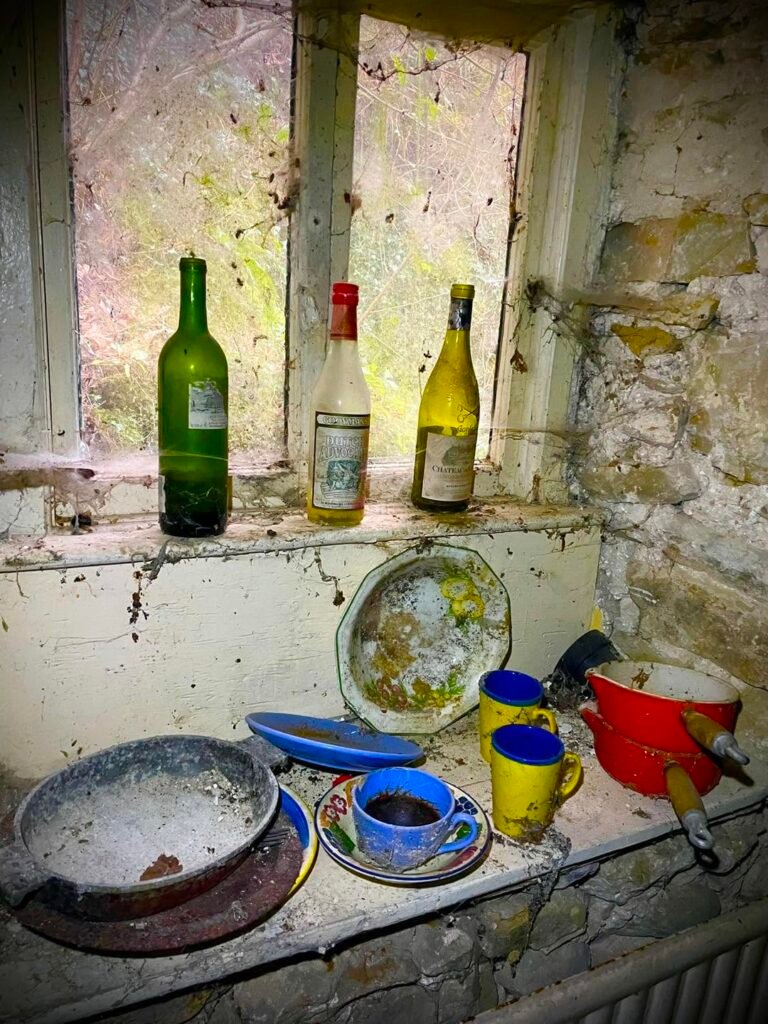
The fifth photograph is the window sill, and it is the most ordinary of the five — which is why it matters. Three bottles stand on the sill: a green wine bottle, a clear bottle with a red cap, and a yellow wine bottle. Below them, on a shelf, are a floral plate, yellow and blue mugs, a blue cup, a red enamel pan, and a dirty bowl, all of it cobwebbed, all of it dusty. This is a kitchen shelf, or the end of one, and it is exactly as it was left: the washing-up not done, the bottles not put away. It is the kind of photograph that makes the house feel recent, even though nobody knows how long it has been empty.
The vans out back
The post mentions one more thing that the five photographs do not show. Just around the back of the building, surrounded by Mother Nature, are two old vans, now completely destroyed. The post does not say what kind of vans, or how they came to be there, or whether they belonged to the house. They are reported as the post reports them, and nothing more is claimed.
The vans matter because they are the only other thing the post mentions besides the contents of the rooms, and because they fit the same pattern as everything else in the house: things that were used, and then left where they stopped. A television on a dresser. Shoes in front of a chair. A suit on a hanger. Two vans behind a bungalow. The house is not a ruin because it was destroyed. It is a ruin because it was stopped, and nobody restarted it.
The explorer’s last line about the house is a simple one: you can imagine, he writes, that once in its heyday this bungalow was stunning to live in. That is a fair thing to say about a house on a steep hill in the middle of a forest, with a garden that has since swallowed it. It is also the only judgement in the post, and it is left here as the post’s judgement.
- The exterior: a moss-covered yellow wall, an open weathered wooden door, a small green-framed window, tangled vines and brambles, exposed roof beams above. This is a close view of the wall and door — the clearest exterior among the five photos shown, not a wide shot of the whole building.
- The television: an old CRT set on a wooden dresser with open drawers, kettle, jars and small items on top, floral wallpaper, debris on the floor.
- The chair: a green upholstered armchair with a grey jacket draped over it, a newspaper on the seat, dusty old shoes on the floor in front, peeling wallpaper behind.
- The suit: a mould-covered pinstripe blazer hanging on a wardrobe, a white knitted tie draped over it, debris on the floor.
- The window sill: three bottles, a floral plate, yellow and blue mugs, a blue cup, a red enamel pan and a dirty bowl, all cobwebbed.
A house that is lived in and for sale is a different kind of place from this one: a lived-in 1902 home in Alexandria, Minnesota shows what upkeep and a price look like, where this bungalow shows what happens when upkeep stops and nobody comes back. More houses in this condition are gathered in abandoned houses and in abandoned mansions, and the site’s front page is abandoned.blog.
FAQ
Where is the Overgrown Bungalow?
The post describes it as hidden away on a steep hill in the middle of a forest, in the middle of nowhere. No place name, town or exact location is given, and none is given here.
How long has it been abandoned?
The post says the explorer is not sure how long it has been abandoned and derelict. No number is published.
Who lived there?
The post guesses, from the suit, the shoes and the chair, that a gentleman once lived here. That is a guess, not a verified fact.
What was left inside?
According to the post and the photographs: an old television and stand, an old chair, old shoes by the chair, a blazer and suit hanging over the wardrobe, and bottles, mugs, plates and pans on a window sill.
What is outside the house?
The post says there are two old vans around the back of the building, now completely destroyed. They are not shown in the five photographs here.
Why is the featured image a close-up rather than a wide shot?
The clearest exterior among the five photos shown is a close view of the outer wall and the open door. No wide exterior of the whole building was among the five photos downloaded for this article.
Can I visit it?
No visiting information is given here, and entering private property without permission is not encouraged.
Disclaimer
This article is general information only, not legal, tax, or financial advice. Rules on abandoned and private property differ by state and county; check county/local records and a local professional before acting. The account of the bungalow and who lived there is as reported in the source post and has not been independently verified.
Photos
Photos by Luke2Explore, via the original Facebook post: https://www.facebook.com/Luke2Explore/posts/the-abandoned-over-grown-bungalow-hidden-away-on-a-steep-hill-in-the-middle-of-a/818587870306903/ — 5 of the 20 photos are shown here.