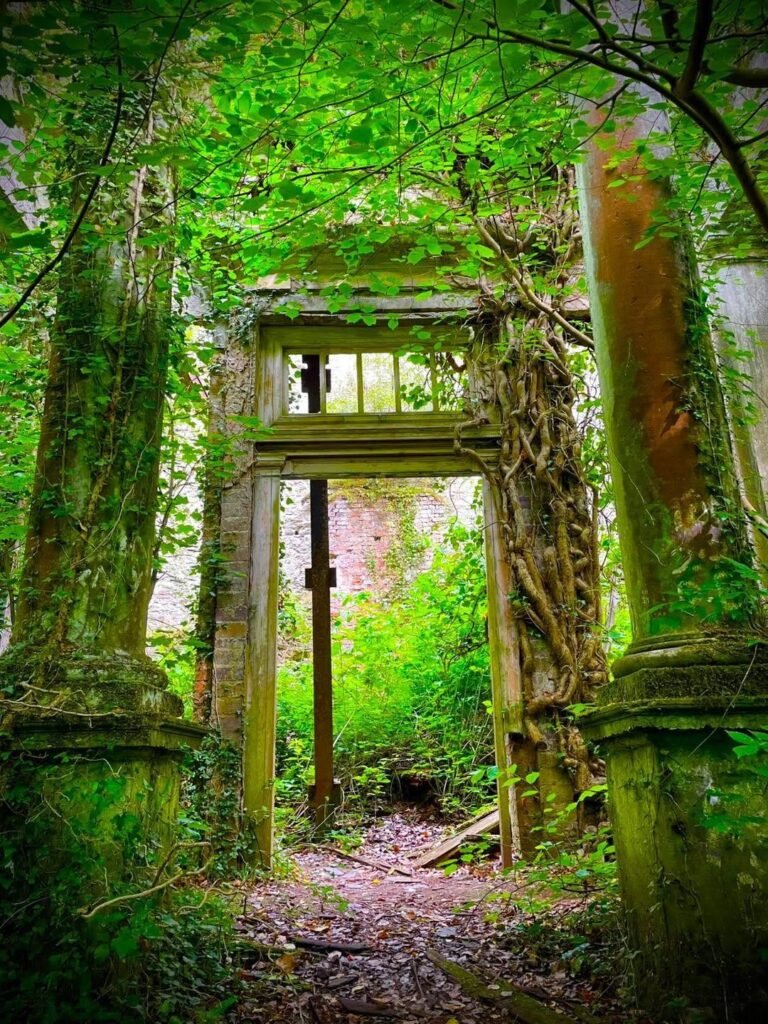
There is no roof left to photograph at Baron Hill, and that is the point. The five photographs in this article show doorways that open onto sky, stairwells that climb to nothing, and corridors that end in rubble and trees. This is not a house that was left tidy. It is a ruin, and it has been one for a long time.
The post is by Luke2Explore, dated 31 March 2026, and it carries 41 photos in total; 5 of the 41 are shown here. The post tells the history of the estate in some detail, and this article follows that account. Where the post says something is said to have happened, or gives the explorer’s own reading of events, that is stated as the post’s account, not as independently verified fact. No location beyond Wales is given, and no exact address is given here.
Four centuries in brief
The post’s history of Baron Hill runs roughly like this:
- 1612 — The original Baron Hill mansion is built by Sir Richard Bulkeley. He dies before the house is finished, and it is not completed to his specifications.
- 1618 — The Baron Hill estate and park are established as the family seat of the Bulkeley family.
- English Civil War — Colonel Thomas Bulkeley, later the 1st Viscount Bulkeley, is said to have invited King Charles I to take possession of the house and set up his court there.
- Early 1700s — The house is the seat of Richard Bulkeley, 4th Viscount Bulkeley, who maintained Jacobite sympathies.
- 1776 — The house is reconstructed by architect Samuel Wyatt in a Neo-Palladian style. The curved facade of the current ruined building, the terraces, follies and balconies date from this rebuilding. There is also an icehouse in the gardens and a lodge house.
- 1800s — The occupants remain the dominant Anglesey landowners, with estates at Llanfairfechan and elsewhere in Caernarfonshire.
- World War I — Death duties soak up the family fortune, by then the Williams-Bulkeley family, and make it impossible to keep maintaining the house. Royal Engineers are stationed there during the war.
- 1939 — At the outbreak of World War II the mansion is requisitioned by the government and used as temporary housing for Polish soldiers.
- After 1939 — The mansion is abandoned, and the post says it is still abandoned and derelict to this day.
That is a long fall for one building: from a family seat to a requisitioned billet to a ruin. The photographs show where the fall ended.
The fire the post describes
The post gives one specific reason for the ruin, and it is worth reporting carefully, because it is the post’s account and not a verified historical record. According to the post, the Polish soldiers housed at Baron Hill in 1939 found the home too cold and decided to start a fire inside the mansion so they would be moved to new housing. The fire destroyed a large part of the interior. The soldiers were removed from the house, but only as far as tents on the Baron Hill Estate grounds.
That is what the post says. It is presented here as the post’s account of the fire, not as a confirmed fact, because the post is an explorer’s write-up rather than a historical source, and the article does not invent corroboration it does not have. What the photographs do confirm is the result: a house with no roof, no floors in places, and trees growing through it.
What the five photographs actually show
| Photo | What is in it |
|---|---|
| The doorway | Ivy-covered ruined doorway between two stone columns, broken brick behind |
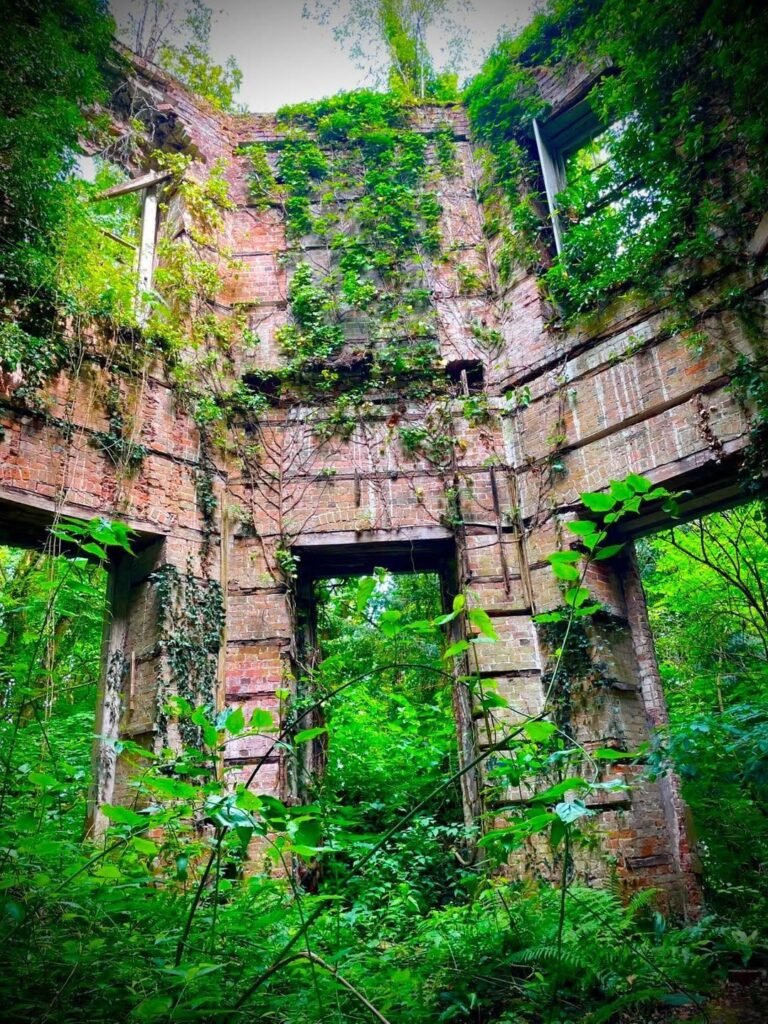
| The red-brick wall | Ivy-covered ruined wall with empty window and door openings |
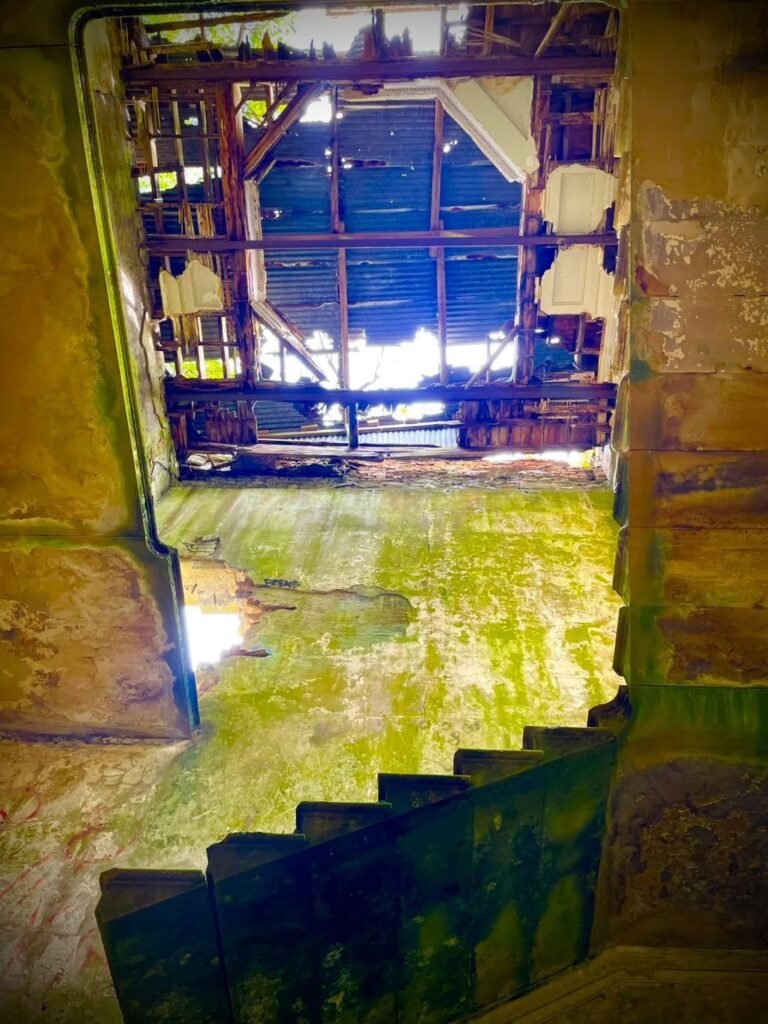
| Looking up | Ruined stairwell, collapsed roof, blue sky through the gap |
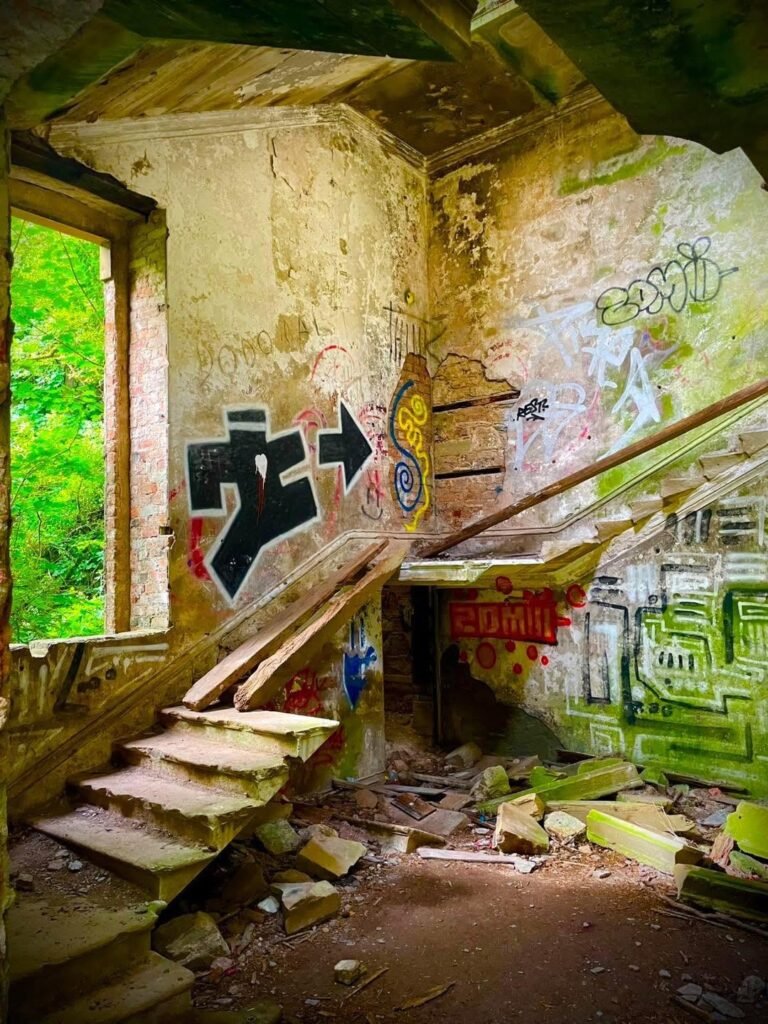
| The graffiti stairwell | Broken staircase, rubble, graffiti, trees through a window opening |
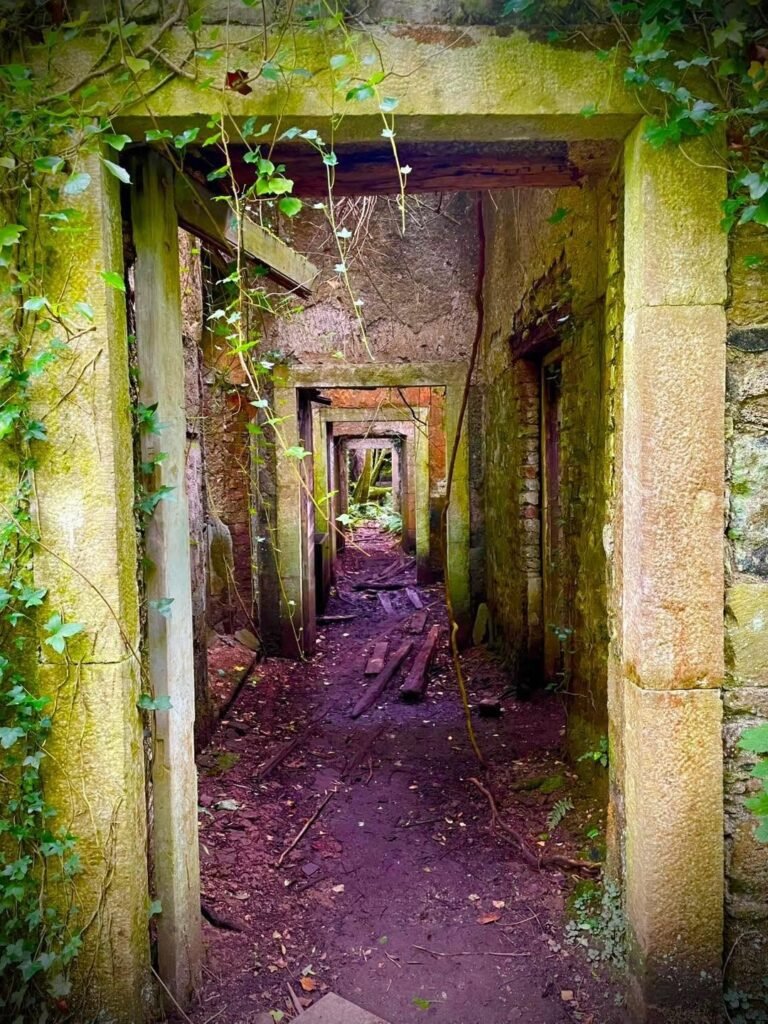
| The corridor | Mossy stone corridor of doorways receding into the ruin |
The doorway photograph is the strongest of the five, and it is the featured image for that reason. Two stone columns frame a door that leads nowhere, and the ivy has grown so thick over the top that the leaves form a roof of their own. Behind it, a broken brick wall is the only thing still standing in that part of the house.
The two stairwell photographs work as a pair. In one, you look up from the stairs through the collapsed roof to open sky. In the other, the staircase itself is broken, the walls are covered in graffiti, and a tree is visible through a window opening that has no glass and no frame left. Stairs in a ruined house are a strange thing to look at: they were built to be climbed, and now they climb to a floor that is gone.
The corridor photograph is the quietest and the strangest. A run of stone doorways recedes into the dark of the ruin, each one mossy, each one empty. It is the clearest evidence in the set that this was once a large, formal house, with rooms laid out in a sequence, and that the sequence now leads nowhere.
Why this ruin is different from the others on this site
Most of the houses on this site were left with their contents inside: furniture, papers, pianos, photographs. Baron Hill was left with nothing but its walls. The post says parts of the park are a site of special scientific interest, which is the kind of detail that usually means the land around a ruin has been left alone long enough for nature to take it back properly. The ivy in the photographs is not decoration. It is holding the walls together and pulling them apart at the same time.
The house is also different in scale. This was a country estate, not a farmhouse, and the Neo-Palladian rebuilding of 1776 gave it a curved facade, terraces, follies and balconies that a farmhouse never had. What is left of that grandeur in the photographs is the shape of the doorways and the thickness of the columns. The rest is sky.
For a contrast with a house that is lived in and on the market, see a lived-in 1902 home in Alexandria, Minnesota, where the questions are about upkeep and price rather than about what a fire and eighty years of weather do to a mansion. More ruined and empty houses are gathered in abandoned mansions, and the site’s front page is abandoned.blog.
FAQ
Where is Baron Hill?
The post places it in Wales, on Anglesey, and gives no exact address. No exact address is given here.
When was Baron Hill built?
According to the post, the original mansion was built in 1612 by Sir Richard Bulkeley, and the estate was established in 1618. The house was reconstructed in 1776 by Samuel Wyatt.
Why is it a ruin?
According to the post, the mansion was requisitioned in 1939 to house Polish soldiers, a fire destroyed a large part of the interior, and the house was abandoned afterwards. That account is as reported in the post and has not been independently verified.
Who were the Bulkeleys?
According to the post, the Bulkeley family — later Williams-Bulkeley — were the dominant Anglesey landowners in the nineteenth century, with estates at Llanfairfechan and elsewhere in Caernarfonshire.
Is Baron Hill open to visitors?
The post does not say. No visiting information is given here, and entering a ruin or private property without permission is not encouraged.
Can I visit it?
No visiting information is given here, and entering private property without permission is not encouraged.
Disclaimer
This article is general information only, not legal, tax, or financial advice. Rules on abandoned and private property differ by state and county; check county/local records and a local professional before acting. The account of the house and its history is as reported in the source post and has not been independently verified.
Photos
Photos by Luke2Explore, via the original Facebook post: https://www.facebook.com/Luke2Explore/posts/the-ruins-of-the-former-baron-hill-mansionbaron-hill-is-a-country-estate-in-wale/1404677128364638/ — 5 of the 41 photos are shown here.