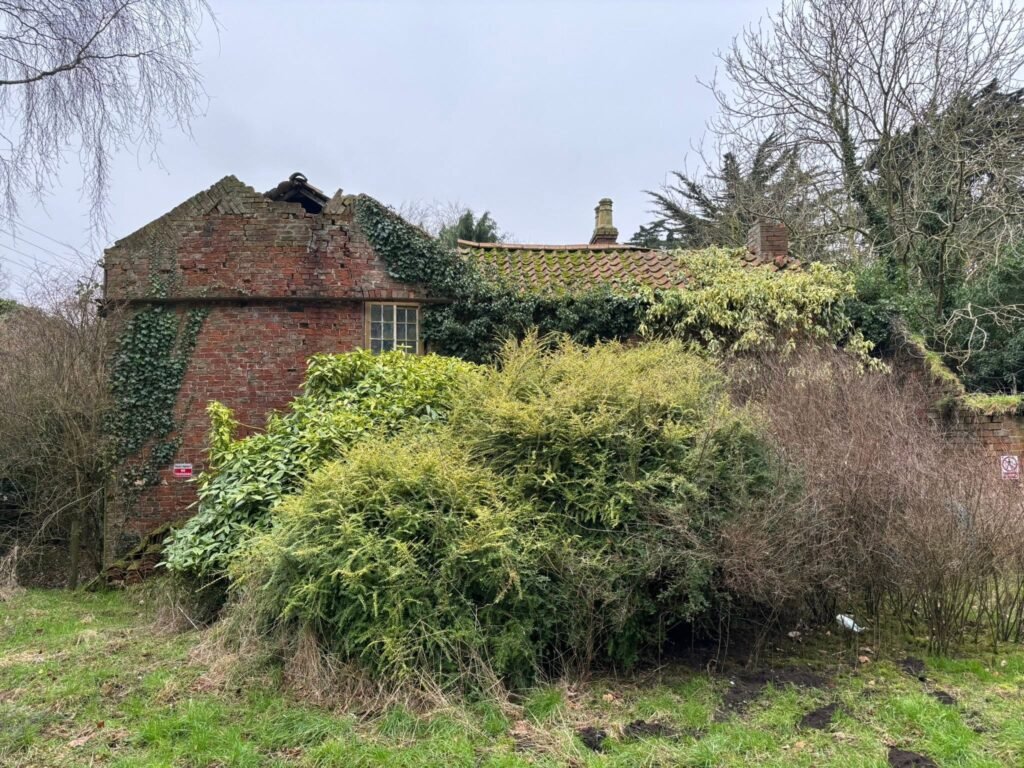
The caption is one sentence long, and it does most of the work. “The long abandoned house that sits hidden on a road in Lincolnshire definitely seen better days,” wrote Urbex Lost & Found on 8 March 2026, posting 36 photographs of a red-brick cottage that the road has very nearly swallowed. There is no history in the post, no name, no date, and no explanation of how the house came to be empty. What there is, instead, is a building in an advanced state of decay, photographed room by room, with its fireplaces, its hallway, and a five-gallon tin of corn oil still lying where it was left.
That is a thinner starting point than most of the houses on this site, and the article is honest about it. Everything that follows comes from the photographs and the few words of the caption. Where a commenter on the post has identified a detail, that is labelled as a commenter’s observation. Everything else that cannot be known from the post — the location, the age of the house, who lived there, and how long it has been empty — is marked [TO VERIFY] and left open.
A Cottage the Road Has Almost Swallowed
The first photograph is the exterior, and it is the photograph that explains the caption. The house is a small red-brick cottage with a tiled roof, two brick chimneys, and a gable end that has partly collapsed, leaving a hole in the brickwork at the top and a sag in the roofline. Ivy climbs the walls. In front of the house, dense green bushes have grown so tall that they hide the ground floor almost entirely, and bare winter trees stand behind them. A single small multi-pane window is visible through the greenery. The sky is grey, and the grass in the foreground is patchy and wet.
It is not a grand house, and that is part of its interest. The cottages that end up abandoned on country roads are usually ordinary houses, built for ordinary lives, and their decay is quieter than a mansion’s — a slipped tile here, a collapsed gable there, a garden that grows over the walls year by year until the house is hidden from the road it stands on. The caption calls it “long abandoned,” and the state of the roof and the garden supports that in a general way, but the post gives no number of years, and this article will not invent one.
Two Fireplaces, Two Different Stories
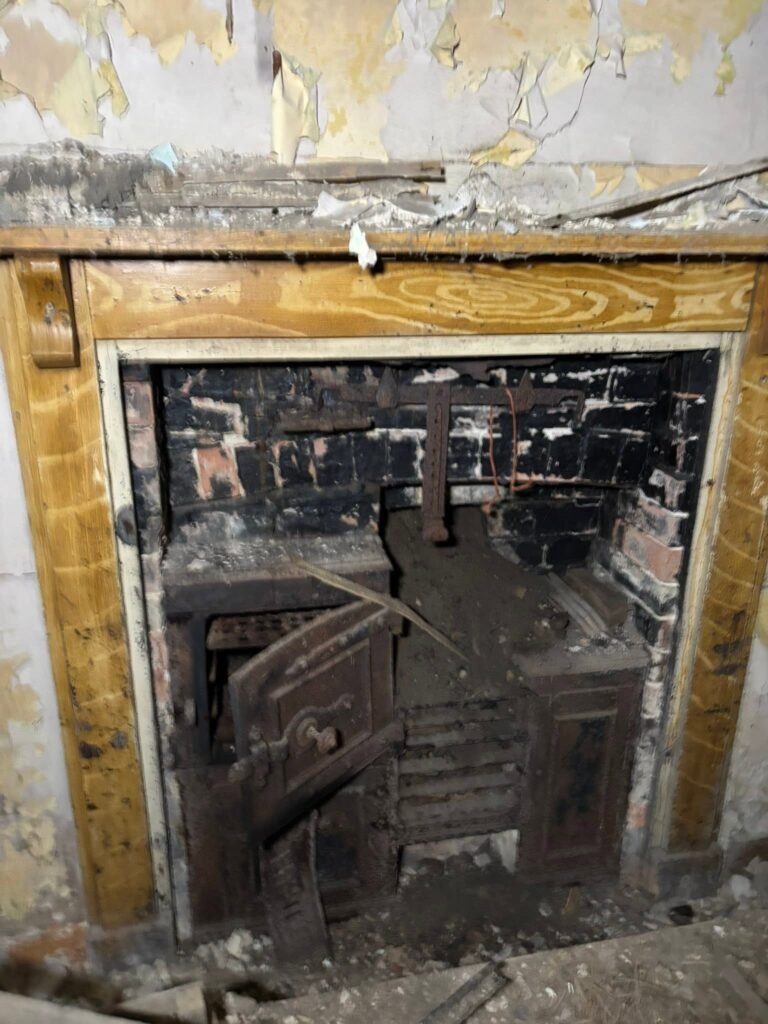
Inside, the house is defined by its fireplaces, and the post gives us two of them. The first is a blackened cast-iron range set into a wooden fireplace surround. The bricks behind it are black with soot, the wallpaper above it is yellowed and peeling, and a small rusted door hangs open on the range itself. It is the working heart of an old cottage kitchen, and it looks as though it has not been lit in a very long time.
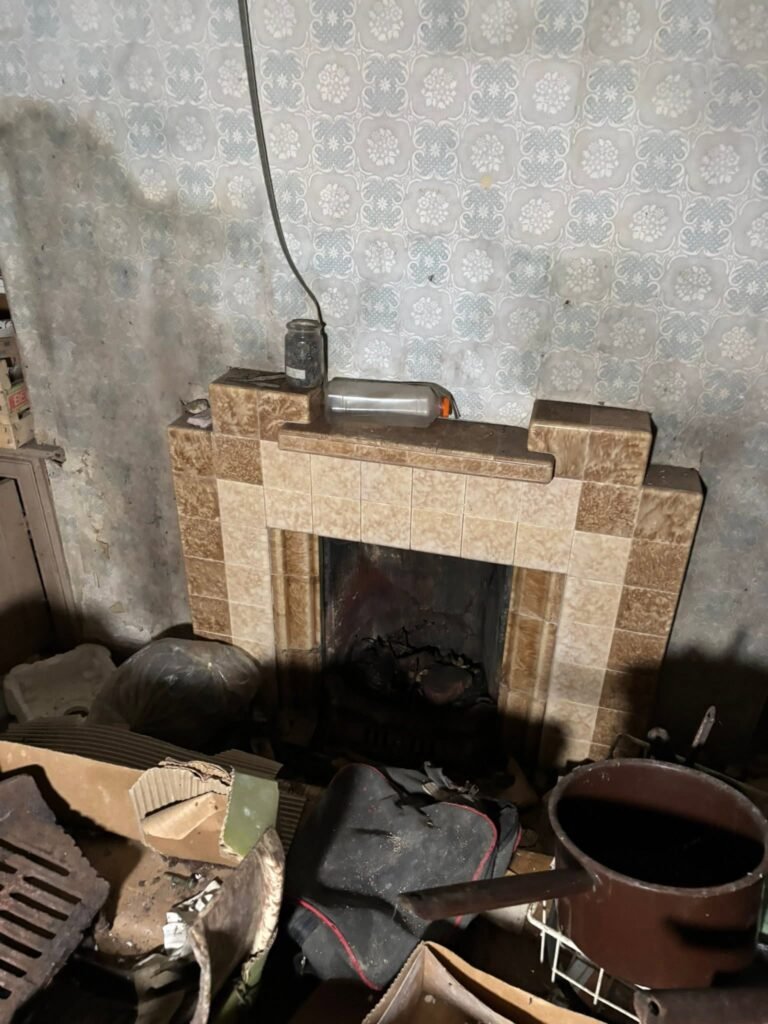
The second fireplace is a different kind of object altogether. It is tiled, with tan and brown tiles arranged in a stepped pattern around a dark opening, and a narrow mantel shelf on top. A glass jar and a plastic bottle stand on the mantel. The wallpaper behind it is a faded floral pattern, and the floor in front of it is covered in debris — cardboard, a black bag, a wire rack, and a brown saucepan. A commenter on the post called this one an art deco fireplace, which is a commenter’s description rather than a verified identification, but the stepped tilework and the geometry of the surround are consistent with the kind of fireplace put into houses between the wars. The post itself says nothing about when either fireplace was built, and neither does this article claim to know.
Between them, the two fireplaces sketch the shape of the house: a kitchen built around a range, and a living room built around a tiled fireplace. Both are still there. Neither works any more.
The Hallway and Its Patterned Floor
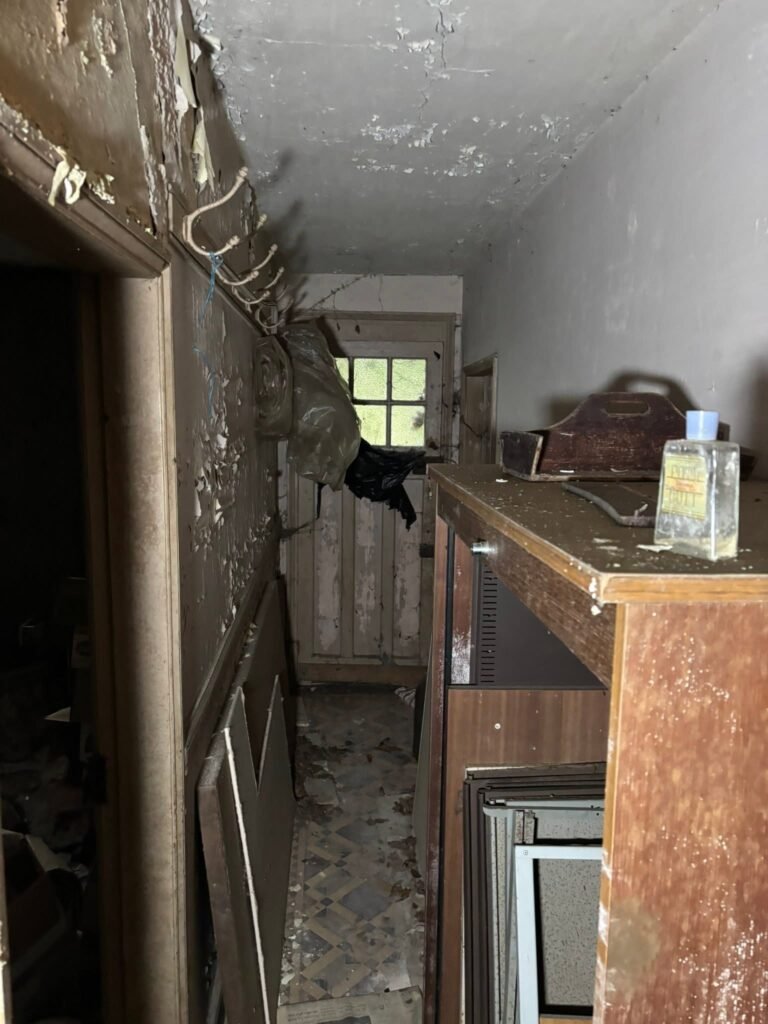
The fourth photograph is the hallway, and it is the narrowest, darkest image in the set. Peeling wallpaper lines the walls, and a row of coat hooks hangs on one side, empty. A wooden dresser stands in the foreground with a glass bottle on top of it and a rusted metal box beside it. At the end of the hall, a door with a small multi-pane window lets in a little daylight, and the floor in front of it is covered in patterned tiles — diamonds and squares in muted colours, half-hidden under debris and fallen plaster.
A commenter on the post picked out those tiles specifically, writing, “Nice Minton tiles in the hallway. Gorgeous, some nice fireplaces too.” That is a commenter’s identification, and it has not been independently verified for this article, but the tiles themselves are visible in the photograph, and they are the most decorative thing left in the hallway. If they are Minton tiles, they would be the kind of detail that once marked a house out as well built; if they are not, they are still a handsome floor in a house that has lost nearly everything else. Either way, the hallway is the part of the house that feels most like a home still — coats would have hung on those hooks, and the dresser would have held the things a household reaches for on the way out.
A Five-Gallon Tin of Corn Oil
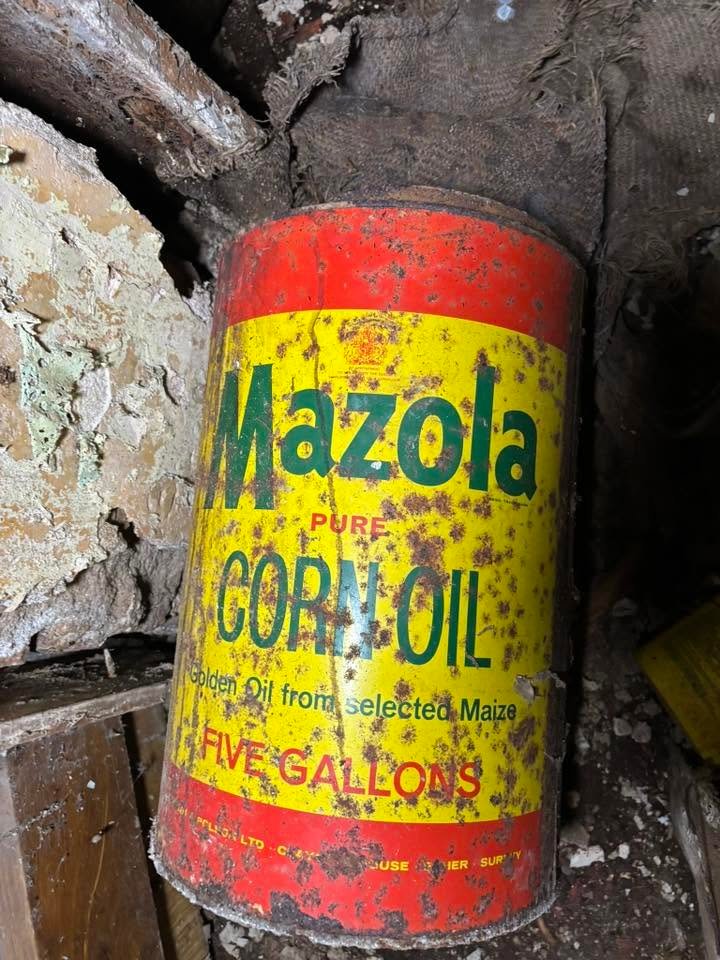
The fifth photograph is a close-up, and it is the smallest object in the set: a rust-spotted tin of Mazola Pure Corn Oil, its red and yellow label still legible, reading “Golden Oil from selected Maize” and “FIVE GALLONS.” It lies on its side among peeling paint and debris, with a piece of sacking behind it and a yellow container just out of focus at the edge of the frame.
A tin of cooking oil is not a treasure, and that is exactly why it matters. The grand objects in abandoned houses — the fireplaces, the ranges, the tiled floors — survive because they are built in. The small objects survive because nobody thought them worth taking. A five-gallon tin of corn oil is a working kitchen object, bought in bulk, used a little at a time, and left behind when the kitchen closed for good. It does not date the house — tins like this were sold for decades, and the post does not say when this one was bought — but it does date the last days of the household in a general way, to a time when cooking oil came in large tins and kitchens kept them on the floor. It is the most ordinary thing in the house, and the most telling.
What the Post Does Not Say
The list of unknowns for this house is longer than the list of knowns, and it should be stated plainly. The post does not say where in Lincolnshire the house stands — no village, no road, no landmark. It does not say when the house was built, who lived there, when it was last occupied, or how long it has been empty beyond “long abandoned.” It does not say whether the house is listed, whether it is for sale, or what will happen to it. The photographs show a cottage with a collapsed gable, two fireplaces, a hallway with patterned tiles, and a tin of corn oil. That is the whole of the evidence, and this article does not go beyond it.
That is also why the house is worth writing about. Not every abandoned house comes with a documented history. Some come with a sentence and 36 photographs, and the work is in looking carefully at what the photographs show — the gable, the range, the tiles, the tin — and refusing to fill in the rest with guesswork. If a reliable record of this cottage surfaces, the article should be updated with the source named. Until then, it stands as the post presents it: a long-abandoned house on a road in Lincolnshire, which has definitely seen better days.
Other abandoned houses on this site come with fuller histories; for a lived-in contrast, there is a 1902 Minnesota home for sale, and for grander buildings, the abandoned mansions section. Everything starts from abandoned.blog’s home page.
Frequently Asked Questions
Where in Lincolnshire is this house?
The post does not say. It describes the house only as sitting “hidden on a road in Lincolnshire,” with no village, road, or landmark given. The exact location is not public and is not published here.
How long has the house been empty?
The post calls it “long abandoned” but gives no number of years. The collapsed gable, the overgrown garden, and the state of the interiors suggest a long period, but no precise figure can be given from the source.
What is the house like inside?
The photographs show a cottage with a blackened cast-iron range, a tiled fireplace, a narrow hallway with a wooden dresser and patterned floor tiles, and debris throughout. The rooms are derelict, with peeling wallpaper and fallen plaster.
What are the Minton tiles?
A commenter on the post identified the hallway’s patterned floor tiles as Minton tiles. That identification comes from a commenter and has not been independently verified for this article. The tiles themselves — a diamond and square pattern — are visible in the hallway photograph.
Is the tiled fireplace art deco?
A commenter on the post described it as an art deco fireplace. That is the commenter’s description, not a verified identification. The stepped tilework is consistent with interwar fireplaces, but the post gives no date for it.
Is it safe to visit the house?
No. The location is not public, the house is private property, the roof and gable are damaged, and entering an abandoned building is trespassing and can be dangerous.
What happened to the people who lived there?
The post does not say. There is no information in the source about the last occupants, when they left, or why. That is [TO VERIFY].
Disclaimer
This article is based only on the Urbex Lost & Found Facebook post of 8 March 2026 and the five photographs shown here. Commenter identifications — including the Minton tiles and the art deco fireplace — are labelled as commenters’ observations, not verified facts. Location, age, ownership, and occupancy details are not stated in the source and are marked [TO VERIFY]. Do not attempt to find or enter this property. Abandoned buildings are private property, may be structurally unsafe, and entering them is trespassing.
Photos
Photos by Urbex Lost & Found, via the original Facebook post: https://www.facebook.com/UrbexLostNFound/posts/the-long-abandoned-house-that-sits-hidden-on-a-road-in-lincolnshire-definitely-s/1372897154855843/ — 5 of the 36 photos are shown here.