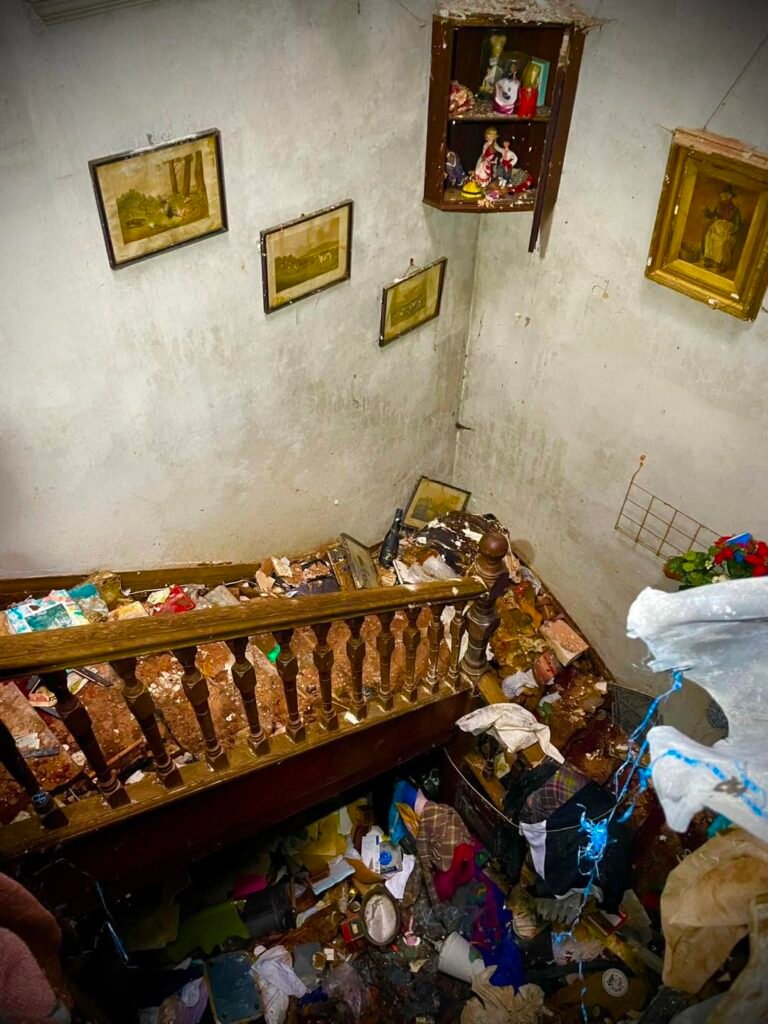
Some houses earn their nickname from a single detail. This one earned it from the people who lived there. According to the Luke2Explore post of 3 March 2025, the house belonged to a couple who were both doctors. The husband was a GP with connections to the army, and part of the house served as the village doctor’s surgery. The wife, the post says, had connections with the police and hospitals. That is the history the post gives, and it is the frame for everything in the photographs: a house that was once a place of work as well as a home, left empty for more than a decade, and — by the time the post was written — sold.
The post is the second part of Luke2Explore’s visit, and it is the part where the state of the house is hardest to look at. The first photograph, the staircase, shows rubble piled on the steps. The bedroom shows a floor covered in clothes and boxes. Commenters on the post read the mess the same way, with one writing that someone had “certainly searched that place for valuables” and another that visitors had trashed it. Those are commenters’ readings, not facts from the post, but the photographs themselves leave little doubt that the house was picked over before the explorer arrived. What survives, and what the post is really about, is the fabric of the house itself: the blue floral wallpaper, the fireplace, the crystal wall sconce, and a dressing table still holding its owner’s letters and jewellery boxes.
A House With a Medical Past
The caption is worth reading in full, because it is the only history the house has in this article. Luke2Explore writes that the house “belonged to a couple who were both dr’s,” that the husband “was a gp who had connections with the army,” and that “even part of the house served as the village drs surgery.” The wife, he writes, “had connections with the police and hospitals.” The house, he adds, “was built in the early 1900’s and has been abandoned for over a decade! (So I’ve read up on).”
Two things about that history need care. First, the parenthetical — “(So I’ve read up on)” — is the poster’s own signal that the background comes from his reading, not from documents shown in the post. Second, the post gives no names, no village, and no dates beyond “the early 1900’s” and “over a decade.” The location is not stated anywhere in the post, and this article does not try to identify it. The house is presented here as the poster presents it: a doctor couple’s home, part surgery, early twentieth century, empty for more than ten years. Everything beyond that is [TO VERIFY].
Part Two: The Staircase That Says It All
The first photograph is the one Luke2Explore chose to lead with, and it is easy to see why. Taken from above, it looks down a staircase whose wooden banister is still solid, but whose steps are buried under rubble, broken plaster, and scattered belongings. On the wall hang framed landscape pictures, slightly crooked. In the corner, a small wooden cabinet holds dolls and figurines behind a glass door, and a gold-framed portrait hangs beside it. At the foot of the stairs, the hallway floor is covered in a drift of clothes, papers, and broken things.
It is a photograph of two houses at once: the cared-for home, visible in the pictures on the wall and the cabinet of ornaments, and the abandoned one, visible in everything piled on the stairs. The banister itself is the most intact thing in the frame, dark wood with turned spindles, and it is the detail that makes the mess feel recent rather than ancient — as though the staircase was fine until someone started pulling the house apart.
The Blue Bedroom, Ransacked
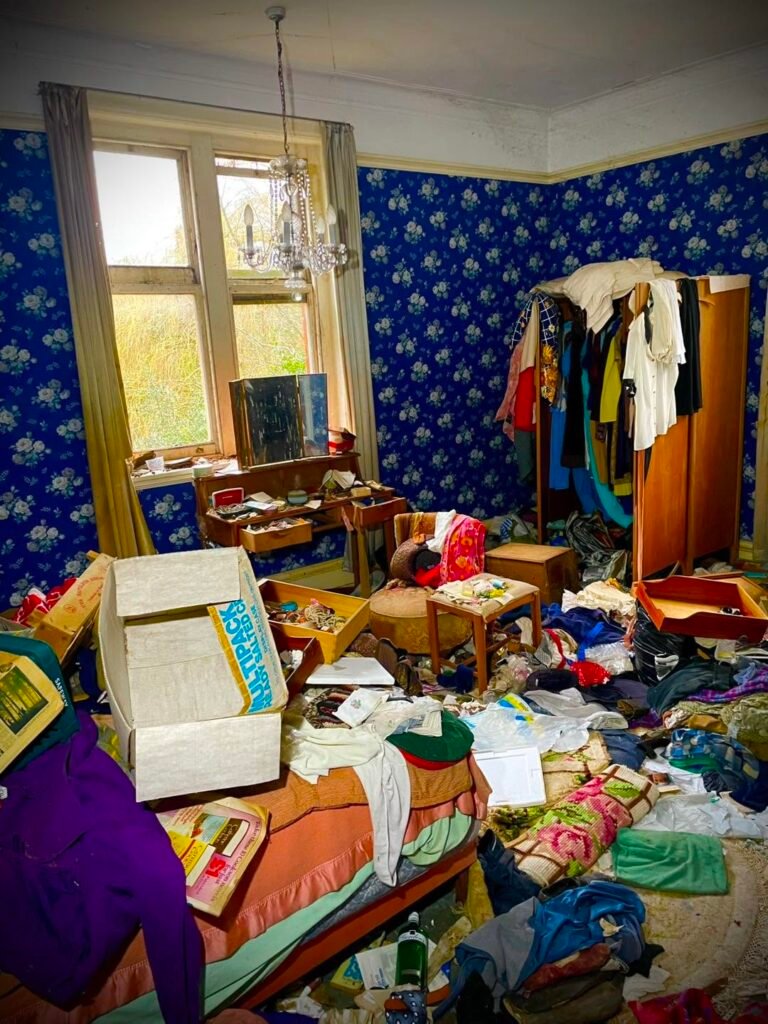
The second photograph is the most talked-about room in the post, and the wallpaper is the reason. The walls are covered in a deep-blue floral paper, white roses on a vivid blue ground, and it runs through more than one room in the house. In the bedroom it frames a bay window with pale curtains, a crystal chandelier, and a dressing table with a tri-fold mirror. An open wardrobe stands in the corner with clothes still hanging in it — shirts, jackets, and dresses crowded together.
The floor tells the rest of the story. Clothes are scattered across it in heaps, mixed with boxes, a pink bag, and drawers that have been pulled out and emptied. A cardboard box marked as a multipack sits open on the bed. Commenters on the post were blunt about it: one said someone had “certainly searched that place for valuables,” another said visitors had been “determined to make a mess,” and a third called it tragic that people “have to go in and feel the need to trash it all.” Those are opinions, but the photograph supports the first of them at least — drawers do not empty themselves, and the mess is concentrated exactly where valuables would have been kept.
The Fireplace, the Sconce and the Dressing Table
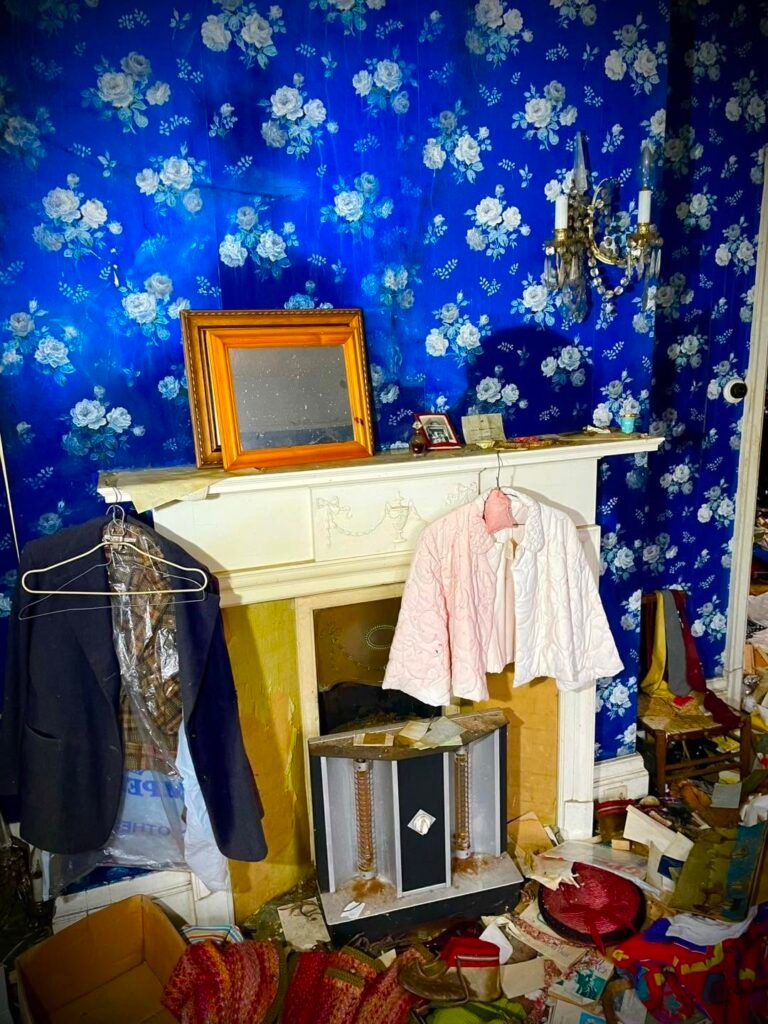
The remaining three photographs are close studies of what survived the ransacking. The fireplace is the centrepiece: a white mantel against the same blue floral wallpaper, with a gold-framed mirror above it and a small framed photograph and a card on the shelf. A pink quilted jacket and a dark suit jacket hang from the mantel on wire hangers, as though someone had hung them up to keep them clean and never came back for them. An electric heater sits in the fireplace opening, and the floor in front of it is covered in clothes, bags, and paper.
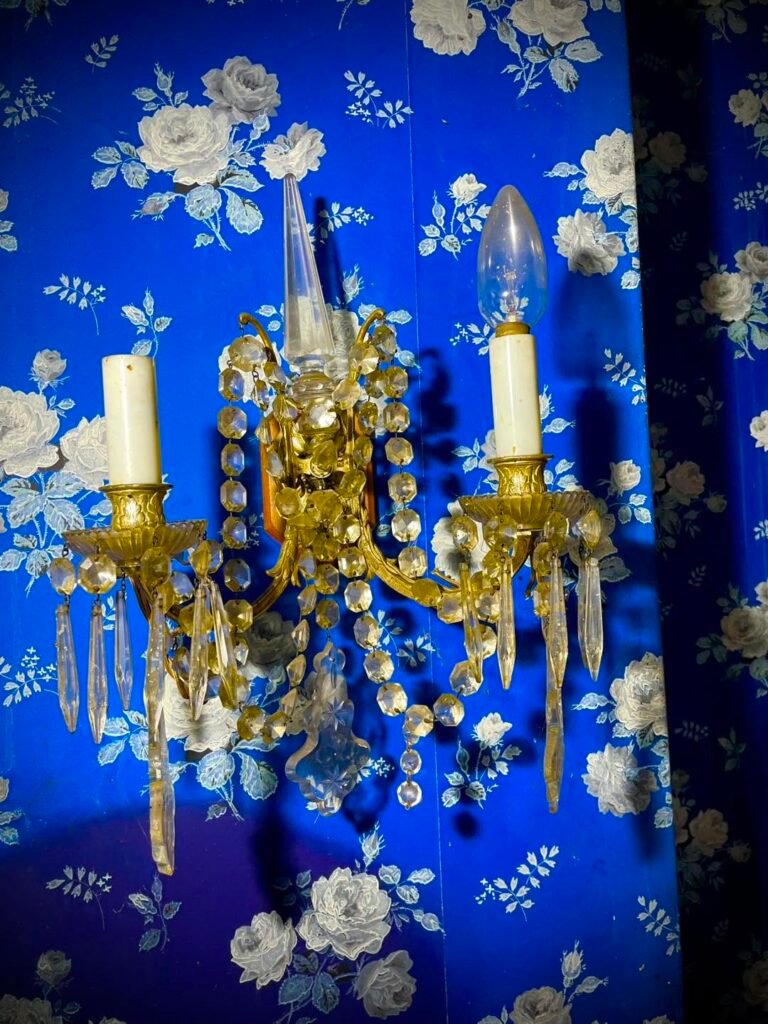
The fourth photograph is a close-up of a crystal wall sconce on the blue wallpaper — two candle arms, gold fittings, and strings of crystal drops. It is the kind of fitting that would have been expensive when it was bought, and commenters on the post picked it out too, with one calling the wallpaper “really funky” and saying she would bet it “cost a fortune.” The sconce is intact, which is more than can be said for much of the house, and it is a reminder of how grand the rooms must have looked when the wallpaper was new.
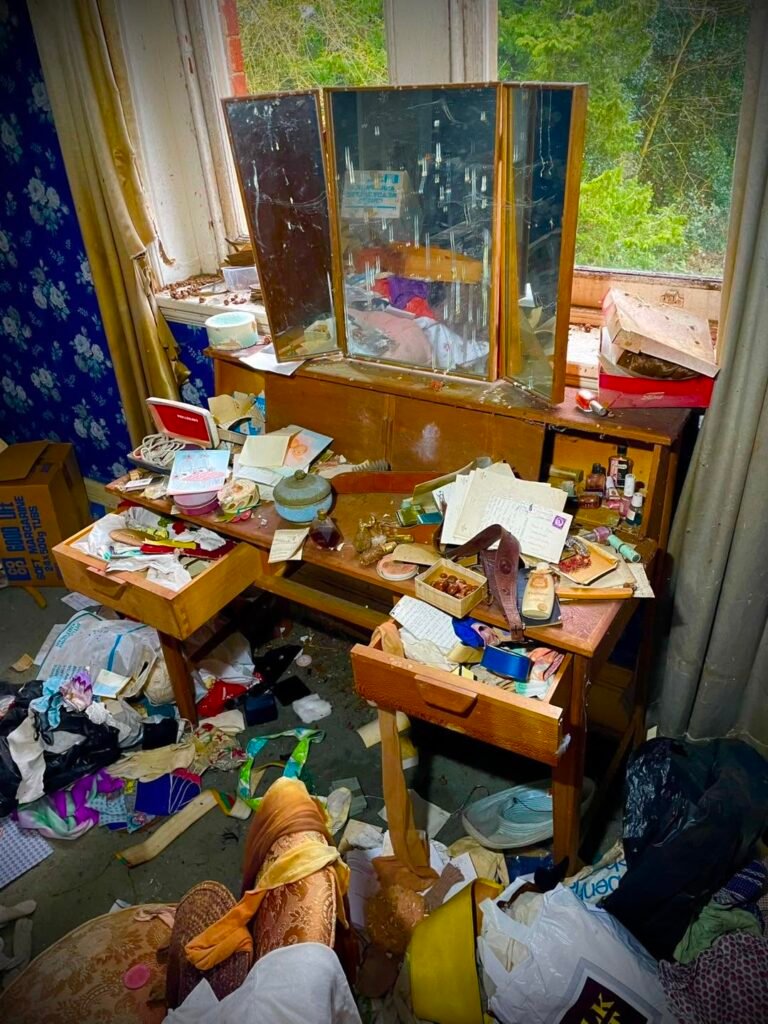
The fifth photograph returns to the dressing table, this time in close-up. The tri-fold mirror is spotted and dirty, and the drawers below it stand open. The surface is covered in letters, jewellery boxes, perfume bottles, a small blue-green trinket box, and a belt. Through the window behind it, green trees crowd close to the glass. It is the most personal photograph in the set — not a room, but a person’s things, left exactly where the searchers dropped them.
Sold for £745,000 — as the Post Reports It
The last part of the caption is the news in the post: “the home was up for auction but has now been sold for £745,000! I was lucky enough to explore this once beautiful home before it got sold.” That figure is the post’s claim, and it should be read as such. The post does not name an auction house, give a sale date, or link to a listing, so the sale cannot be independently confirmed from the source. What can be said is that Luke2Explore reports the house as sold, that he describes himself as lucky to have explored it before the sale, and that the post’s commenters took the news well — one wrote that it was “good to hear it has been sold” and hoped it would “be put to good use.”
If the sale went through at that price, it says something about the house that the photographs only hint at: underneath the rubble and the ransacking, this was a substantial early-1900s house with a surgery, a garden, and period features worth saving. The £745,000 figure is the post’s, and any reader who wants to verify it should look for the auction or sale record rather than taking the post’s word for it.
What Is Still Unverified
A short list, because it matters. The exact location of the house is not stated in the post. The names of the couple who lived there are not given. The date the house was built is given only as “the early 1900’s.” The length of time it stood empty is given only as “over a decade.” The sale price of £745,000 is the post’s claim, without a named auction house or sale date. And “Part One” of the visit is not a separate post that could be found in the sources checked for this article, so this draft covers Part Two on its own. All of those are [TO VERIFY] and should be treated as such until a reliable record is cited.
You can browse the site’s abandoned houses collection for more homes in this condition, abandoned mansions elsewhere on the site for grander empty buildings, and the 1902 Noonan house in Minnesota for a lived-in home of the same era. The site’s front page is the abandoned.blog home page.
Frequently Asked Questions
Who lived in the army doctor’s house?
According to the post, a couple who were both doctors. The husband was a GP with army connections, and part of the house served as the village doctor’s surgery. The wife had connections with the police and hospitals. No names are given in the post.
When was the house built?
The post says it “was built in the early 1900’s.” No more precise date is given, and no architectural record is cited in the post.
How long had the house been abandoned?
The post says it “has been abandoned for over a decade,” adding “(So I’ve read up on)” — the poster’s own note that this comes from his reading rather than from documents shown in the post.
Was the house really sold for £745,000?
That is the figure the post reports: “the home was up for auction but has now been sold for £745,000!” The post does not name an auction house or give a sale date, so the figure is reported here as the post’s claim, not as an independently verified sale.
What is Part One of the visit?
The post is titled “Part Two of the abandoned army doctors house,” which implies an earlier part, but no separate Part One post was found in the sources checked for this article. This draft covers Part Two only.
Why is the house so ransacked?
The post does not say. The photographs show drawers pulled out and belongings scattered, and commenters on the post suggested the house had been searched for valuables and trashed by visitors. That is the commenters’ reading of the photographs, not a fact stated in the caption.
Can I visit the house?
No. The location is not stated in the post, the house has been sold according to the post, and it is private property. Entering an abandoned building is trespassing and can be dangerous.
Disclaimer
This article is based only on the Luke2Explore Facebook post of 3 March 2025 and the five photographs shown here. The history of the house and the sale price of £745,000 are reported as the post’s claims, not as independently verified facts. Names, exact location, build date, and sale details are not stated in the source and are marked [TO VERIFY]. Do not attempt to find or enter this property. Abandoned buildings are private property, may be structurally unsafe, and entering them is trespassing.
Photos
Photos by Luke2Explore, via the original Facebook post: https://www.facebook.com/Luke2Explore/posts/part-two-of-the-abandoned-army-doctors-house-the-house-has-a-bit-of-history-to-i/1071214105044277/ — 5 of the 31 photos are shown here.