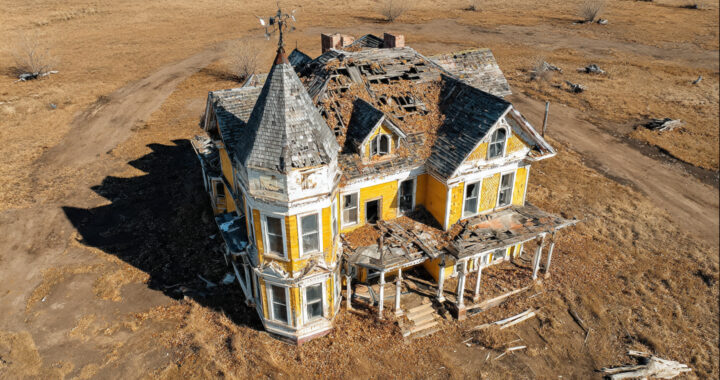
The forgotten estate no one talks about — until the tide rolls in.
Introduction: A Hotel Swallowed by the Sea
The first thing you notice is the smell.
Salt. Rust. Something old and wet, like a memory the ocean refuses to let go of.
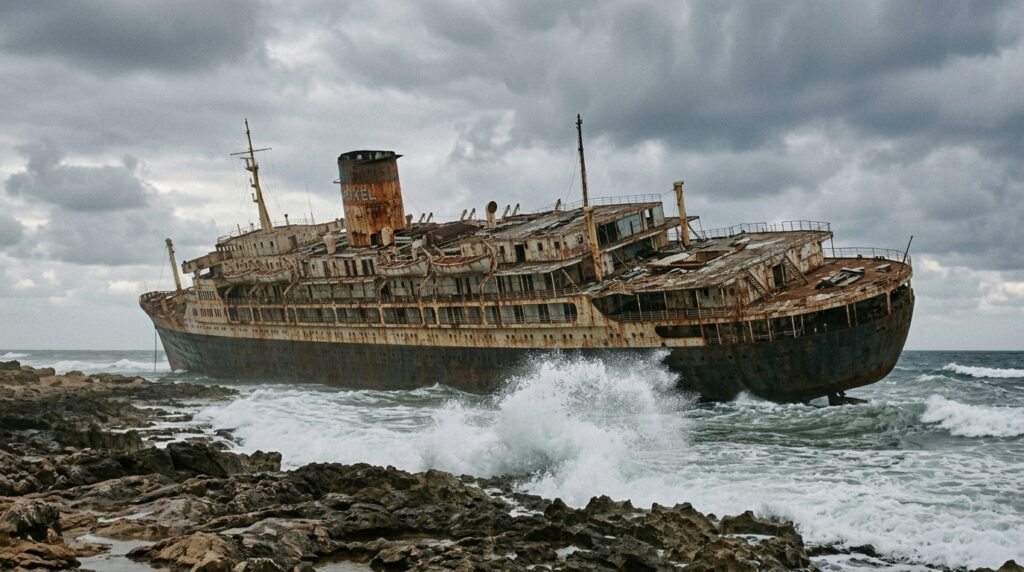
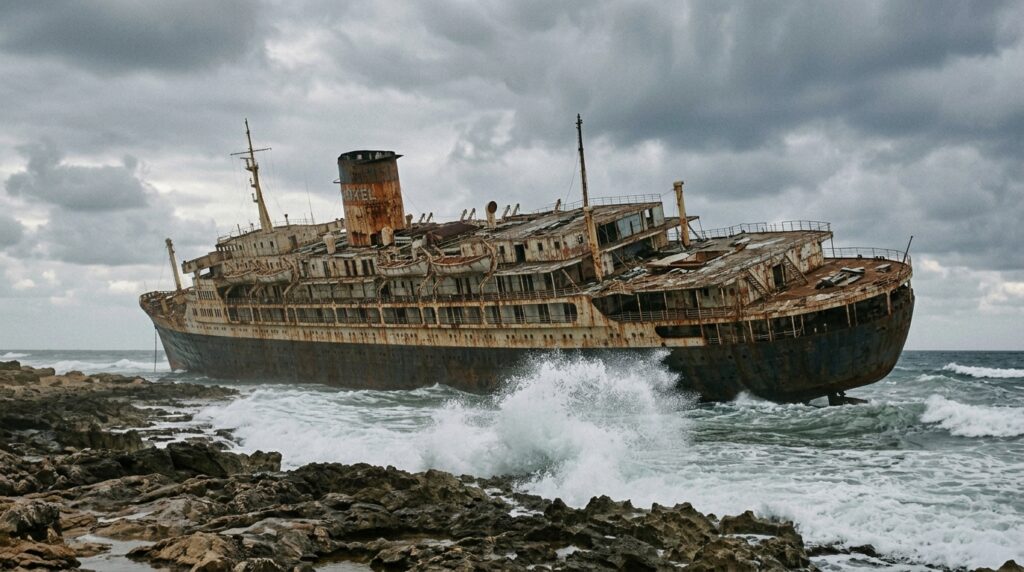
Then you see it — a hulking structure half-buried in coastal sand, walls stained dark with tide marks, windows gaping open like hollow eyes. This is the abandoned shipwreck hotel. And it isn’t just forgotten. It’s being reclaimed.
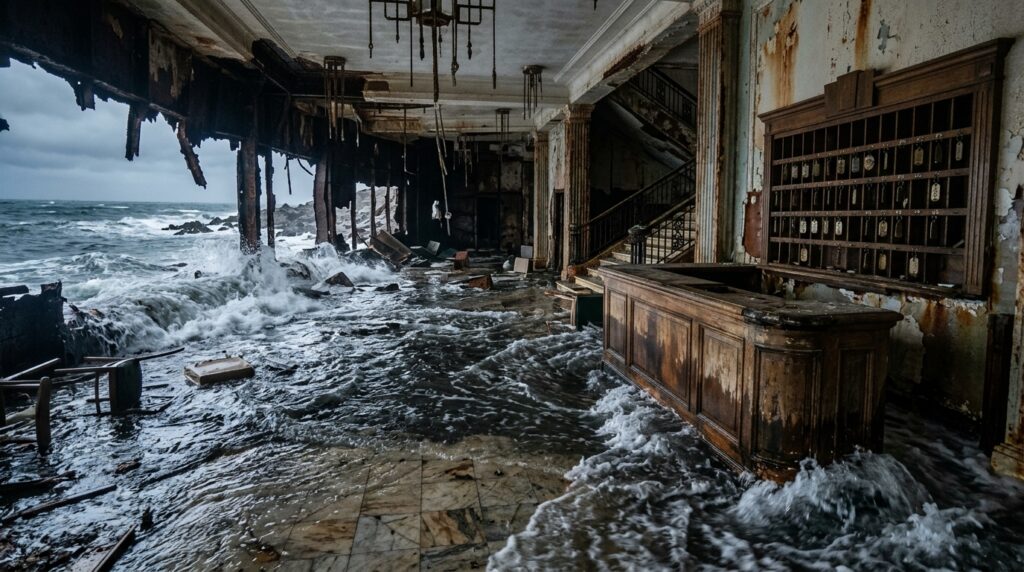
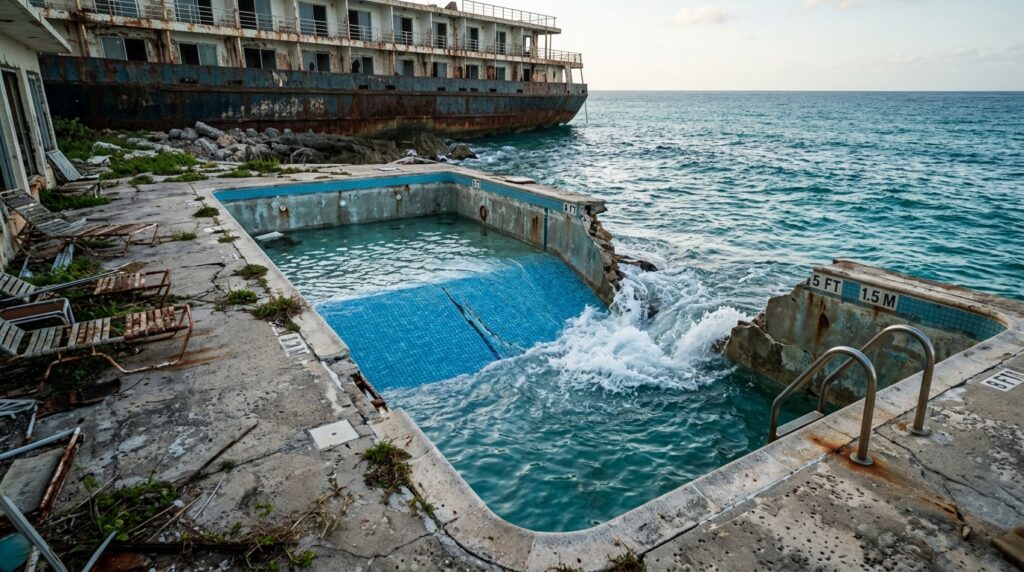
Every high tide, seawater pushes through the ground floor corridors. It fills the cracked terrazzo floors, pools in the collapsed dining room, and laps quietly against peeling wallpaper in rooms that once hosted guests. The hotel doesn’t fight it. It just… accepts.
Places like this sit at a strange crossroads between architecture and nature. Between human ambition and the indifferent power of the sea. If you’re drawn to forgotten estates, decaying grandeur, and the quiet poetry of abandonment — you already understand why stories like this matter.
This is one of them.
What Is the Abandoned Shipwreck Hotel?
A Grand Vision on a Dangerous Coast
The hotel wasn’t always a ruin.
Built during a mid-20th century coastal tourism boom, it was designed as a luxury destination — a statement of ambition on a stretch of coastline known more for storms than sunbathers. The architects drew inspiration from ocean liner aesthetics, all curved balconies, porthole windows, and sweeping promenade decks. The whole structure was meant to feel like a ship at anchor.
In its prime, it held hundreds of rooms across multiple floors. There was a rooftop terrace where guests watched sunsets. A restaurant famous for its seafood. A ballroom with a sprung floor and a view that stretched to the horizon.
For a few decades, it thrived.
But coastal hotels are always in negotiation with the sea. And eventually, the sea won.
When the Guests Stopped Coming
By the late 1980s, the hotel’s fortunes had turned. Storm damage had grown expensive to repair. Cheaper package holidays pulled tourists inland and overseas. The building’s foundations, already stressed by decades of tidal erosion, began to fail.
Engineers flagged serious structural concerns. The lower floors flooded regularly. Salt corrosion had eaten through much of the building’s iron reinforcement. Restoration would have cost more than the property was worth.
So the doors closed. The staff left. The guests never returned.
And the ocean moved in.
Exploring the Ruins: What’s Left Inside
The Lobby — Now a Tidal Pool
Step through what remains of the entrance doors and the floor shifts beneath your feet.
The original lobby floor — once polished marble — is now a patchwork of intact tiles and open voids where the subfloor has collapsed entirely. In several areas, you can see straight down into a flooded basement level, the water dark green and absolutely still.
Tidal debris lines the walls. Seaweed, driftwood, the occasional plastic buoy that somehow made it inland. Nature has colonized every horizontal surface.
The reception desk is still standing. Warped beyond function, its wood swollen and black with moisture, but standing. A few waterlogged ledgers sit in the cubby holes behind it, their pages fused into solid blocks. The ink ran long ago.
The Corridors — Silence That Moves
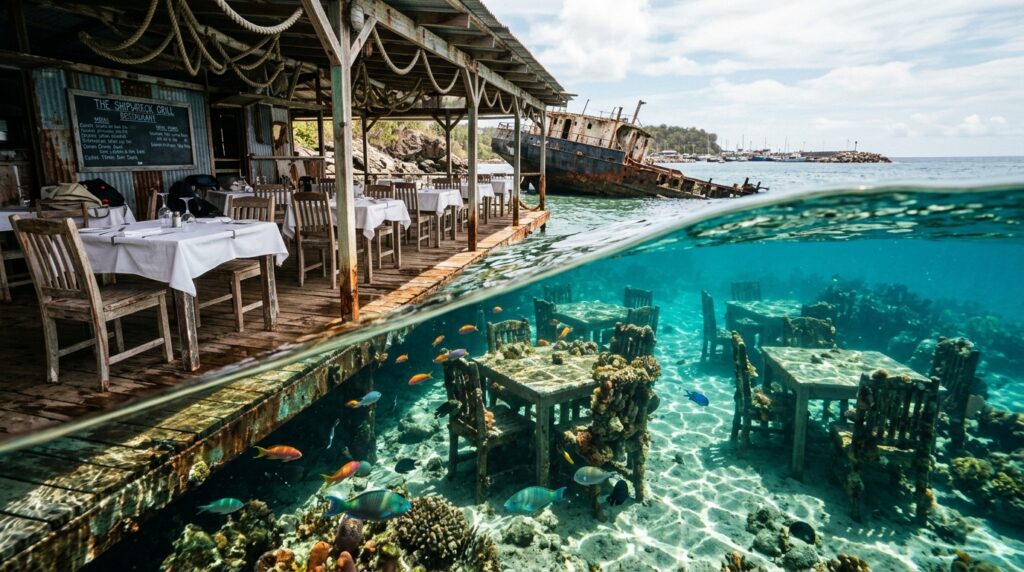
The hallways stretch away from the lobby in both directions.
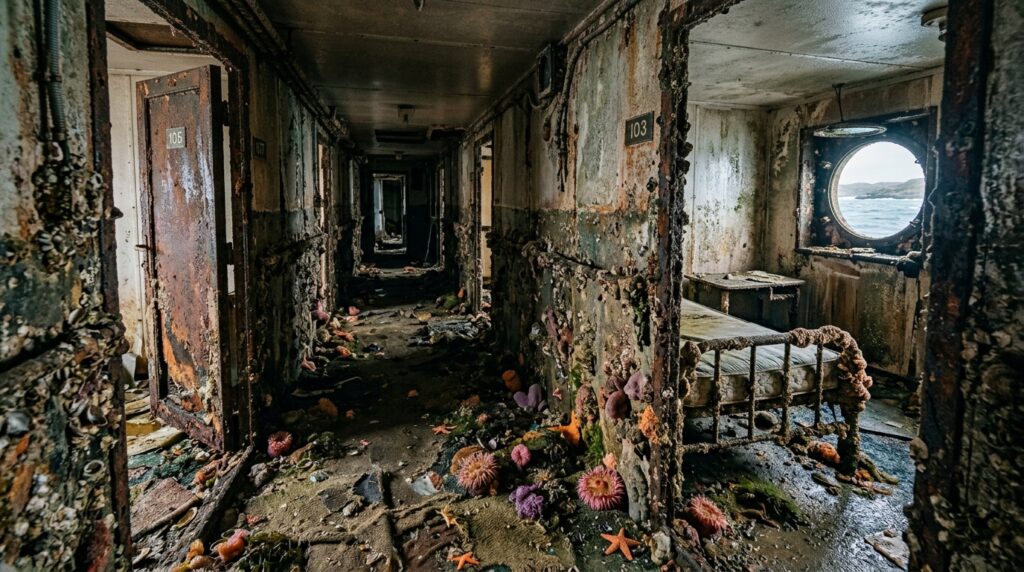
In the lower floors, walking them means wading. Even on a calm day, several centimeters of water cover the corridor floors. Your footsteps send ripples that bounce off the walls and return to you, softly, a second later. The sound is oddly intimate.
The wallpaper is extraordinary. It was once a nautical-themed print — anchors, ropes, compass roses — which feels almost too on-the-nose now. Entire strips have peeled away and hang like curtains. Where it remains attached, the pattern has bloomed with dark mold that traces its own strange geography across the walls.
Every door is open. Some are open because they’ve swollen beyond closing. Others are open because they’ve fallen entirely, leaning against the inside walls of the rooms they once guarded.
The Guest Rooms — A Life Left Behind
This is where the hotel gets personal.
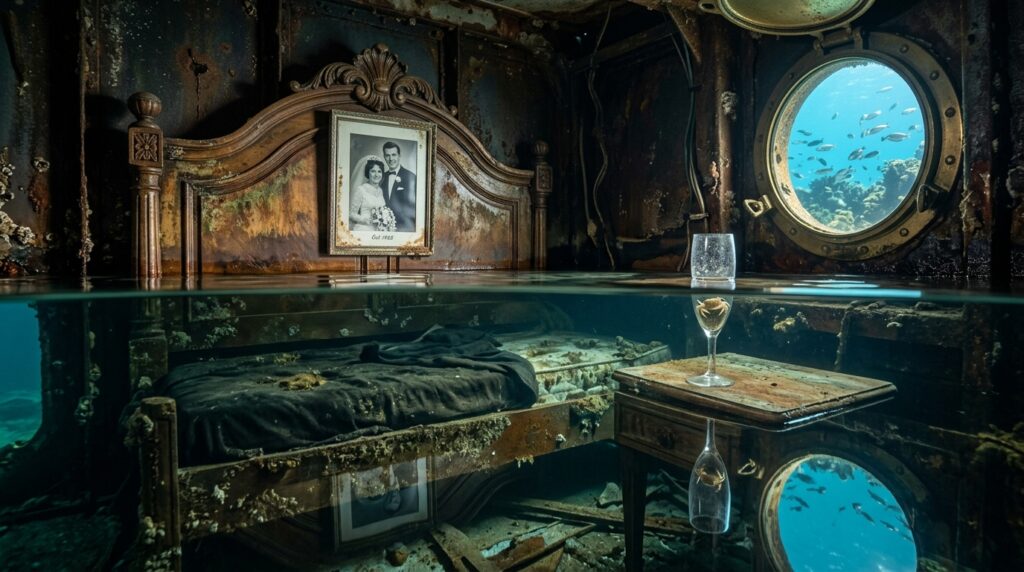
The guest rooms hold what people left when they left in a hurry — or what time simply preserved in amber. A corroded bedframe here. A collapsed wardrobe there, its contents (hangers, a single abandoned shoe, a folded towel that’s become a solid brick of mold) spilled across the floor.
In one room on the second floor, a rotary telephone sits on a nightstand as if someone just set it down. The cord has long since dissolved. The handset lies beside it. The dial is frozen mid-rotation, stuck in that last moment someone used it — or maybe stuck by rust, it’s impossible to say.
In another room, curtains still hang. Sun-bleached to near-white, torn in places, but hanging. When the wind moves through the broken window, they billow slowly inward. It looks like breathing.
The Ballroom — Grand and Ghostly
The ballroom is on the third floor, which means it’s above the tidal reach.
Here, things are drier. Dustier. The damage is from collapse and decay rather than water. Half the ceiling has come down, opening a jagged skylight to the elements. Pigeons have nested in the structural rafters above.
But the bones of the room are breathtaking.
The original light fittings — massive chandeliers designed to resemble ship’s lanterns — still hang, though they’ve shed most of their glass. The wall sconces, tarnished to black, line the room at regular intervals. The sprung floor has warped into a gentle rolling landscape, like frozen waves underfoot.
You can almost hear the music. Almost.
The History Behind the Decay
Coastal Architecture and Its Limits
Hotels like this were a phenomenon of their era. The mid-20th century saw a surge in ambitious coastal tourism infrastructure across Europe and beyond. Planners and developers, flush with post-war optimism, built boldly and often without adequate engineering studies of the coastline dynamics they were building on.
As UNESCO’s World Heritage documentation on coastal heritage sites highlights, many historic structures along active coastlines face irreversible damage without sustained conservation effort — and the political and financial will to sustain that effort rarely materializes once a building loses its commercial function.
This hotel is, sadly, a textbook case.
Why Nobody Saved It
Preservation campaigns did emerge over the years.
Local heritage groups pushed for listed building status at various points. Architectural photographers documented it. There was even, briefly, a proposal to convert the upper floors into artist residencies — keeping the lower levels as a kind of tidal art installation.
None of it came through.
The cost projections were simply too high. The structural remediation alone ran into figures that made investors balk. And once a coastal building reaches a certain point of tidal damage, standard restoration approaches stop working. You need marine engineering, specialist materials, and an ongoing maintenance budget that treats the sea as a permanent neighbor rather than a temporary inconvenience.
It never got that chance.
What Abandonment Looks Like Up Close
There’s a difference between knowing a place is decaying and being inside that decay.
Photographs flatten it. They show you the rust, the peeling paint, the broken windows. But they can’t give you the sound of water moving through a building that was never meant to be porous. The way a wave, pushing against the outer wall, translates into a deep resonant groan somewhere in the structure above you.
They can’t give you the smell — that specific combination of brine, old timber, mold, and something mineral and cold that you find only in places where the sea has made itself at home in human spaces.
Abandoned places like this are endlessly documented on Wikipedia’s overview of urban exploration as part of a broader global interest in ruins and forgotten architecture. The appeal isn’t morbid. It’s deeply human. We’re drawn to places that tell the truth about time.
And this hotel tells the truth.
Lessons from a Forgotten Estate
What These Places Teach Us
Every abandoned structure holds a lesson — usually several.
- Ambition has limits. This hotel was built to impress. It did, for a while. But the coast doesn’t care about ambition.
- Maintenance is memory. The moment upkeep stops, the clock starts. Nature is patient and relentless.
- Beauty survives decay. There is genuine, heartbreaking beauty in this place. The chandeliers, the tidal lobby, the curtains that still breathe — they’re beautiful precisely because they’ve been left alone.
- History is fragile. Once buildings like this reach a certain point, recovery becomes impossible. The window for preservation is always shorter than it seems.
For those of us who follow the world of forgotten estates and decaying architecture, places like this are a reminder of why documentation matters. Before a building disappears entirely, its story should at least survive.
That’s part of what drives the community over at Abandoned Blog — stories of forgotten places — the belief that these places deserve to be witnessed and remembered, even when they can’t be saved.
Responsible Curiosity
It needs to be said clearly: do not enter dangerous structures.
This hotel is structurally compromised. Floors have collapsed. Tidal water creates electrical hazards and unpredictable floor failures. Exploring unstable buildings puts lives at risk — yours and the lives of anyone who might need to rescue you.
The right way to engage with places like this is through documented photography, historical research, and storytelling. Follow local laws. Respect private property. Support heritage organizations that work to preserve what can still be preserved.
Curiosity is a gift. Keep it alive by staying safe.
FAQ: Abandoned Shipwreck Hotel
Q: Where exactly is the abandoned shipwreck hotel?
A: For safety and legal reasons, the specific location isn’t published here. Many coastal ruins of this type exist across Europe, South America, and Southeast Asia — areas with rapid mid-century tourism development followed by economic decline.
Q: Is it safe to visit?
A: No. The structure is not safe for entry. Tidal flooding, structural collapse, and corrosion make it genuinely dangerous. Admire it from a safe distance.
Q: Has anyone tried to restore it?
A: Multiple proposals have emerged over the decades, none funded. The cost of marine-grade structural remediation has consistently outweighed investor interest.
Q: Why do hotels get abandoned like this?
A: Usually a combination of factors — economic downturns, changing tourism patterns, rising maintenance costs, and environmental pressures. Coastal properties face the added challenge of erosion and storm damage. Once revenue stops, upkeep stops. Nature takes over fast.
Q: Are there other hotels like this?
A: Absolutely. The world is full of grand hotels that fell silent — from the Catskills resort hotels of New York to former beach resorts in Cyprus and beyond. Browse more stories of abandoned places and forgotten histories to find them.
Conclusion: The Sea Always Wins
The abandoned shipwreck hotel is many things.
It’s a ruin, yes. It’s also a monument to a specific kind of human overreach — the belief that we can build permanently on the edge of something as restless and ancient as the sea. It’s a time capsule of mid-century optimism and the chaos that followed.
But more than anything, it’s a place that asks you to slow down and pay attention.
The tidal water in the lobby isn’t a tragedy. It’s a conversation. Nature talking back to concrete and plaster and human ambition, saying: we were here before you, and we’ll be here after.
Standing in a space like this — even in photographs, even in words — has a way of rearranging your sense of scale. Your problems feel briefly, usefully small. The building’s problems feel achingly large. And the sea just keeps moving, indifferent and eternal, neither cruel nor kind.
The abandoned shipwreck hotel will continue to sink, slowly, into the coast that was always trying to claim it. One day there will be nothing left but the foundation stones, disappearing under the sand.
Until then, it’s worth remembering it existed. Worth telling the story.
Because places like this — forgotten estates at the edge of the world — are part of our history too.
Enjoyed this exploration? Read more stories of forgotten places, abandoned architecture, and hidden history at Abandoned Blog.