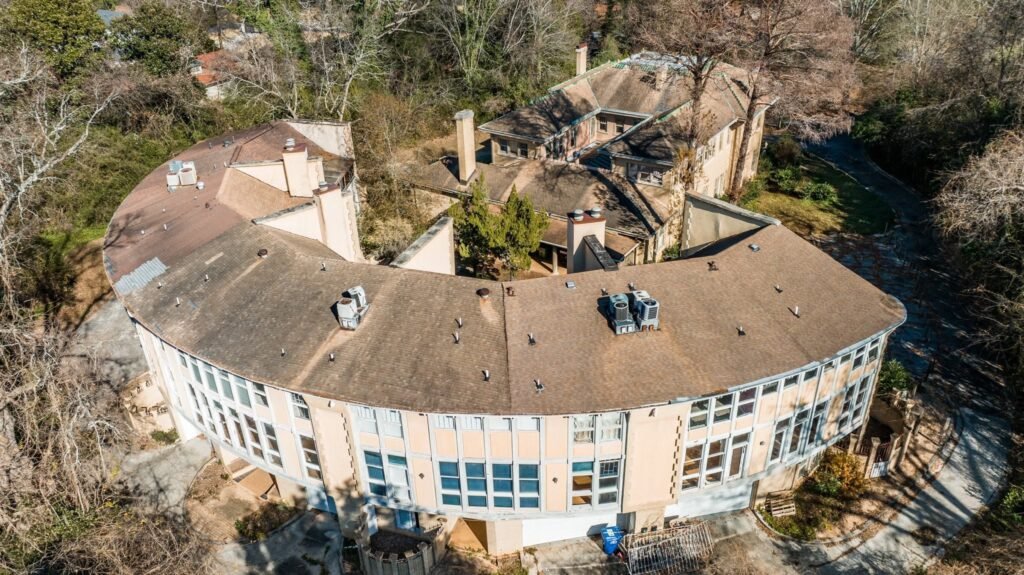
The first thing you notice in the aerial photograph is the curve. A long building sweeps around a central courtyard in a near-perfect arc, and from above it genuinely looks like a horseshoe. That single image — one of ten in a BigBankz Facebook post dated 12 March 2026 — is the entire reason this place has a nickname. Everything the post tells us fits in a few short lines: somewhere in the state of Georgia sits a $5,000,000 abandoned mansion, last owned by a wealthy artist, and it is called the horseshoe mansion because of the curved condos in the back. That is the complete public record. No town. No county. No street. No name for the artist. Just a curve of buildings, a price tag, and a mystery — the kind we file under our Abandoned Mansions archive.
What the Post Actually Confirms
Start with what is solid. The post is dated 12 March 2026 and comes from the BigBankz Facebook page. It states four facts: the property is somewhere in the state of Georgia; it is valued at $5,000,000; it is abandoned; and it was last owned by a wealthy artist. It adds one explanation for the nickname: the curved condos in the back give the property its horseshoe name.
Read that list again, because it is deliberately short. The exact location is not published in the post. The artist’s name is not published in the post. The size of the house, the acreage, the year it was built — none of that is published in the post. Whether it is for sale right now is not published in the post either. When a fact is missing here, that is not an oversight in this article; the source simply does not contain it, and inventing the gaps would turn a curiosity into a fiction.
Why “Horseshoe” Fits
Nicknames for abandoned places usually come from explorers, neighbors, or the internet. This one comes from geometry. According to the post, the property is called the horseshoe mansion due to the curved condos in the back — plural condos, arranged in a curve, sitting behind the main house. The aerial photograph backs that description up in the most direct way possible: you can see the arc for yourself.
It is rare for a nickname to be this verifiable. Most abandoned-property nicknames are stories; this one is a shape. You look down, you see the horseshoe, and the name stops being a rumor and becomes a description.
Two Photos, Two Different Stories
Only two of the post’s ten photographs are reproduced here — the rest were not accessible without signing in to Facebook — but the two we have could hardly be more different, and each one proves something different about the curved-condo claim.
Photo one is the aerial shot, and it is the evidence for the nickname. From the air, the property reads as a composition: the main structure and, behind it, the curved row of condos bending around open ground. The curve is not subtle. It dominates the frame. Instead, the photo and the caption agree with each other: the bend is in the buildings at the back, exactly where the post says it is. What the aerial cannot prove is anything about the interior — no fountain, no skylight, no sign of the artist who last owned it. It is a shape, not a story.
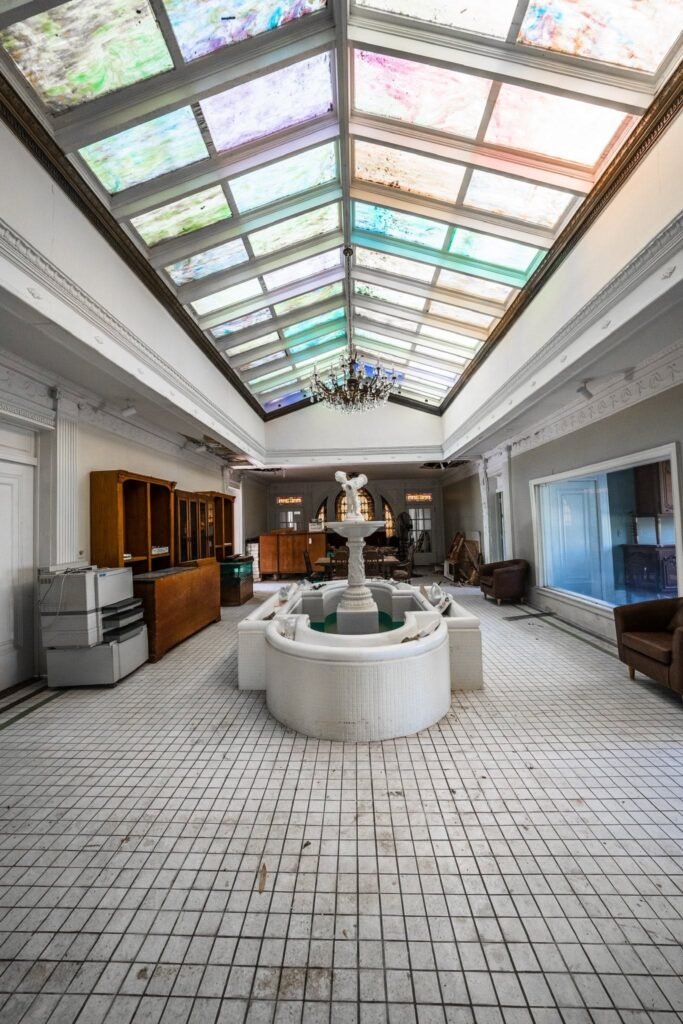
Photo two moves inside, to a grand atrium with a fountain under a stained-glass skylight. This is the evidence for the money. Nothing in this frame is cheap: the scale of the atrium, the fountain as a centerpiece, a skylight made of stained glass rather than plain panes. It tells you the $5,000,000 figure did not come from nowhere — the interior detailing belongs to a property that was expensive when it was alive. But notice what it does not show: no curve, no condos, no horseshoe. From inside the atrium, you would never guess the nickname. The two photographs need each other. The aerial proves the name; the atrium proves the value. Neither proves the rest — the artist, the abandonment, the Georgia location — and both leave the unanswered questions exactly where the post left them. More properties with this kind of half-told story are documented on Abandoned Blog, but few wear their nickname as plainly as this one.
Photos: BigBankz on Facebook — original post: https://www.facebook.com/BigBankz2/posts/somewhere-in-the-state-of-georgia-sits-this-5000000-abandoned-mansion-last-owned/122156021996955751/ (2 of the 10 photos in the original post are shown here; the rest were not accessible without signing in to Facebook).
The Artist Who Owned It Last
The post says the mansion was last owned by a wealthy artist. That is the most intriguing line in the whole post and also the most incomplete. The artist’s name is not published in the post. The kind of art — music, painting, film — is not published in the post. How long they owned it, when they left, and why it has sat empty since: none of that is published in the post.
It is tempting to fill the silence with guesses. Resist that. Until a name appears in a public record, the owner of this mansion is simply “a wealthy artist,” and that phrase is doing exactly as much work as the source allows it to do.
What Five Million Dollars Means for an Empty House
A $5,000,000 valuation on an abandoned property raises an obvious question: five million of what, exactly? The post presents the figure as the mansion’s value, but it does not publish how that number was reached — no appraisal, no listing, no tax assessment is cited. The figure is not published with a method, and the current sale status is not published in the post.
What the number does tell you, even unverified, is the scale of the loss. Whoever last held this property walked away from, or lost, an asset the poster considers worth millions. Abandoned houses at this price point tend to share a pattern: carrying costs that punish every empty month, from insurance to security to the slow decay of systems nobody is running. The fountain in the atrium photo is a small symbol of that math. A fountain needs pumps, water, maintenance. An empty fountain is a stopped clock — it tells you the moment the money stopped flowing.
Could the Horseshoe Mansion Come Back?
Every abandoned mansion article eventually asks whether the place could be saved, and the honest answer here is that the question is premature. The sale status is not published in the post. The ownership today is not published in the post. The condition beyond two photographs is not published in the post. Without those facts, talk of restoration is fantasy.
Contrast this with a lived-in house for sale, such as the 1902 Noonan home in Alexandria, Minnesota — a property with an agent, a price, and appointments. That is a house on the market, not an abandoned property, and the difference matters: one you can tour, the other you can only wonder about.
What can be said in general — and this is general information only — is that bringing back a property at this scale means dealing with county records, tax standing, title clarity, and building codes, all of which differ by state and county. Anyone seriously curious about a property like this would need to check county records and consult a local professional before acting. The mansion’s future, if it has one, starts in a records office, not in a comment section.
Frequently Asked Questions
Where in Georgia is the horseshoe mansion?
The exact location is not published in the post. The post says only “somewhere in the state of Georgia,” and this article will not guess beyond that. Publishing a guessed address for an abandoned property would be irresponsible twice over — wrong for readers, and unfair to whoever owns the land today.
Who was the wealthy artist who owned it?
The artist’s name is not published in the post. No name, no discipline, no dates of ownership appear in the source. Treat any name you see attached to this property elsewhere as unverified unless it comes with a public record.
Is the horseshoe mansion for sale?
The sale status is not published in the post. There is no listing cited, no asking price beyond the $5,000,000 figure, and no agent named. A $5,000,000 figure in a social media post is not the same thing as a property on the market.
Can I visit or explore the property?
The post does not publish an address, so there is nowhere specific to go — and that is for the best. Entering an abandoned property without the owner’s permission is trespassing in Georgia as in most states, and empty mansions carry real hazards: collapsing floors, stagnant water, no lighting. The two photographs here are the safe way to see it.
Why would a $5 million mansion sit abandoned?
The reason is not published in the post, so anything specific would be speculation. In general, high-value properties go empty for ordinary reasons: estate disputes, debt, divorce, an owner who moved on and a market that did not meet the price. The fountain with no water in the atrium photo is the visible symptom; the cause is not in the public record this article draws on.
This article is general information only. It is not legal, tax, or financial advice. Property rules, taxes, and trespass laws differ by state and county, and records change over time. If you are considering any action involving a property like this one, check the county records and speak with a local professional before acting.