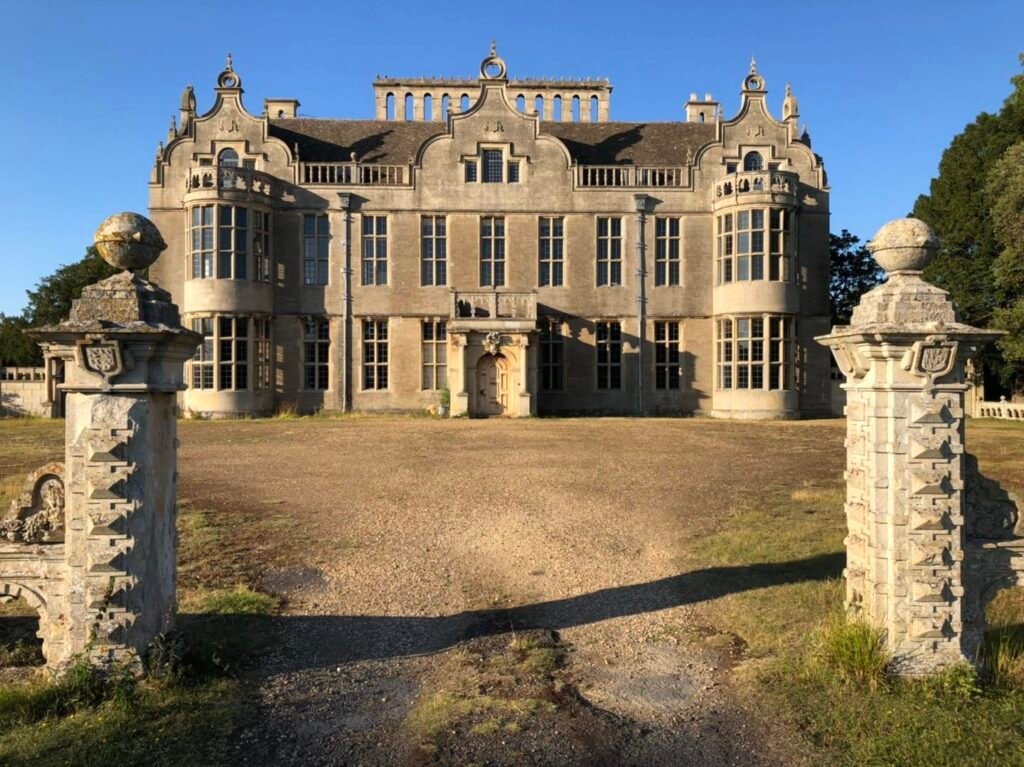
Some houses in this series have names, dates, and stories attached. This one has almost nothing — and that is what makes it interesting. The post that documents it is two sentences long. It does not name the house. It does not say where it is. It gives only a span of time: construction began in 1495 and was completed in 1740, with rooms and parts added along the way, and the manor hall has been owned by lords and wealthy people throughout the years.
The photographs do the rest of the talking. They show a house that took 245 years to build, and that now stands empty.
A house built across two and a half centuries
The post is dated 8 July 2022. Its brevity is unusual for this series, where captions usually run to several paragraphs. There is no story of a family, no fire, no sale, no reason given for why the house is empty. The two sentences are the whole written record, and they are repeated here as the post gives them.
What the dates mean, if they are right, is that this was not a house built in one campaign. A building begun in 1495 and finished in 1740 was built, added to, and rebuilt across the reigns of many monarchs, by successive owners who each left their mark. The photographs support that reading. The featured image shows a grand stone front with three shaped gables, curved bay towers on either side, tall chimneys, and stone gate piers with ball finials framing a gravel forecourt. The gables and the bay towers are Jacobean in character — early 1600s work — while the symmetry of the front and the scale of the windows belong to a later age. A house that grew over 245 years would look exactly like this: not one style, but several, layered on top of each other.
The grand hall
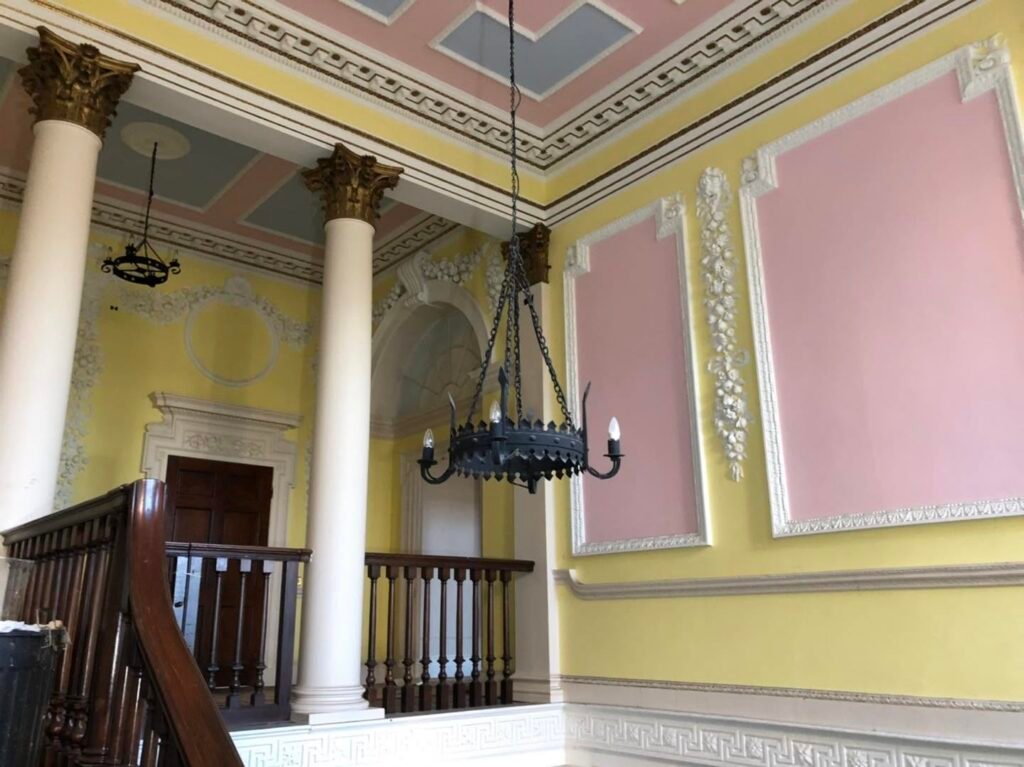
The third photograph is the finest interior in this whole day’s set. A grand hall with pale yellow walls and pink panels, ornate white plasterwork running up the walls in swags of fruit and flowers, Corinthian columns with gold capitals, a dark wooden balustrade, and a large black wrought-iron chandelier hanging under a pink-and-blue coffered ceiling. The floor is not visible in the frame, but the room does not need it. The plasterwork alone — the fruit swags, the panel mouldings, the Greek-key pattern along the base of the walls — is the work of craftsmen who were paid to make a room that would impress everyone who entered it.
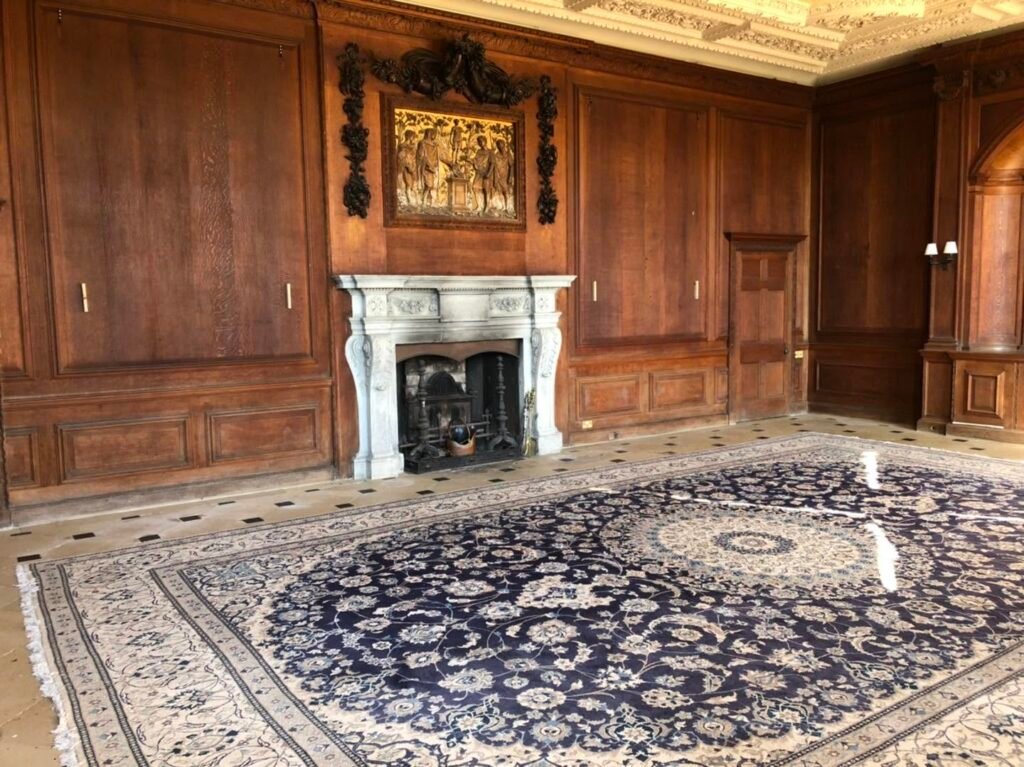
The fourth photograph is quieter but just as telling. A wood-panelled room with dark panelling on every wall, a white marble fireplace with an iron fire basket and andirons, and above the fireplace a gilt relief panel with carved figures. A large blue-and-cream patterned rug lies on a chequered stone floor. Nothing in the room is damaged. The rug is flat, the fireplace is clean, the panelling is intact. It looks less abandoned than simply unused — a room waiting for someone to come back to it.
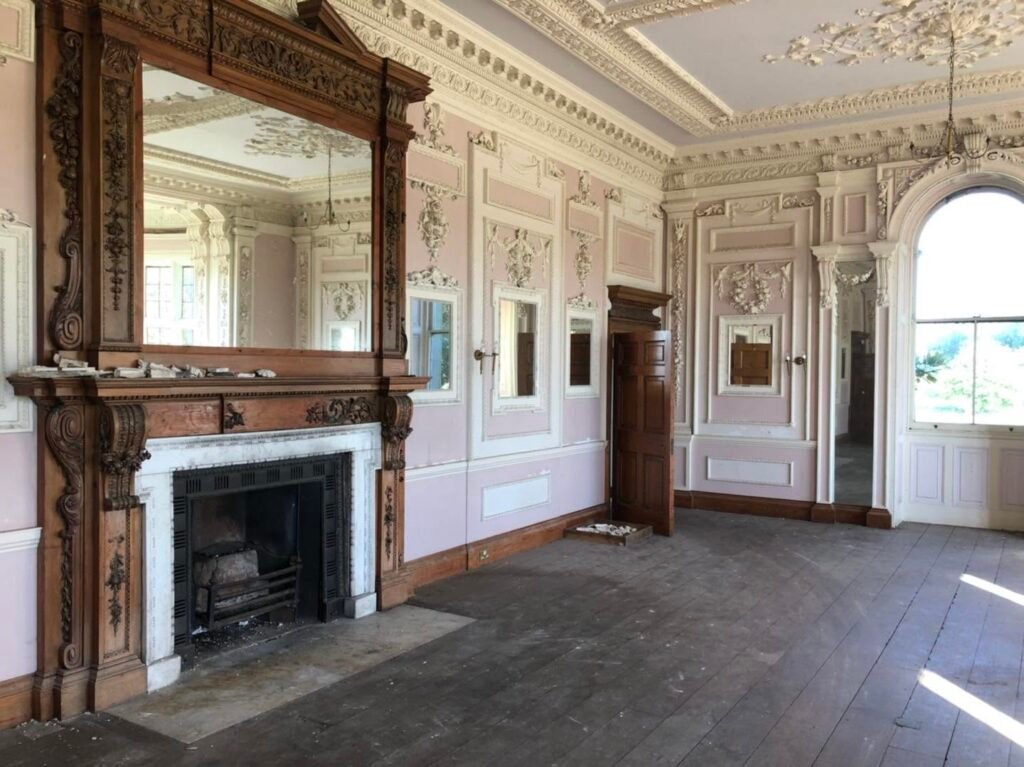
The fifth photograph is the mirrored room: a large carved wooden mirror over a marble fireplace, pink-and-white plasterwork walls, an ornate ceiling, a tall arched window, a bare wooden floor, and an open door leading somewhere the photograph does not show. The mirror is the largest single object in any of the five photographs, and it is still hanging straight.
What the outside says
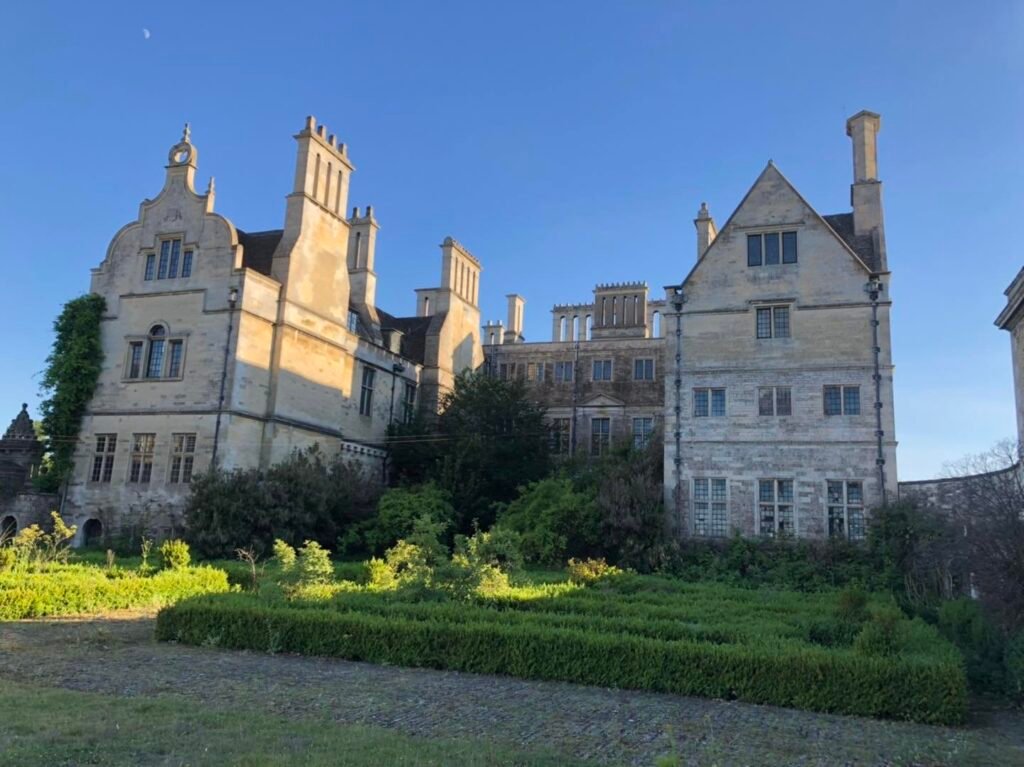
The second photograph shows the side of the house in evening light: the same shaped gables and tall chimneys, weathered stone, broken windows, and an overgrown formal garden with trimmed hedges that have not been trimmed in a long time. The garden is the clearest sign of abandonment in the whole set. Inside, the rooms are clean and intact. Outside, the hedges have gone wild and the windows are broken. A house can be empty for a long time before its interiors start to fail, especially a stone house with a sound roof — but the garden fails first, and this garden has failed.
That contrast is worth holding on to. The houses in this series are usually photographed at the point where the inside has already collapsed: ceilings down, floors covered in debris, furniture rotting. This house is photographed earlier in that process, or later in a different one. Its rooms are still beautiful. Its plasterwork is still crisp. Its fireplaces are still standing. What has gone is the life around it — the garden, the windows, the people.
What is not known
Almost everything else. The house has no name in the post, so none is given here. No location, no county, no village. No owner, past or present, beyond “lords and wealthy people”. No date for when it was last lived in, no reason for why it was left, no listing status, no price. The 1495–1740 dates are the post’s own figures, and they are repeated as the post’s figures, not as verified history — a house begun in 1495 would have started as a Tudor building, and the Jacobean front in the photographs belongs to a later phase, which is consistent with a house added to over centuries, but the exact dates would need the listing record to confirm.
A house that is lived in and for sale is a different kind of place from this one, and the difference is worth seeing side by side: a lived-in 1902 home in Alexandria, Minnesota shows what upkeep and a price look like, where this house shows what happens when a grand building simply stops being used. More houses in this condition are gathered in abandoned mansions and in abandoned houses, and the site’s front page is abandoned.blog.
FAQ
Where is this manor hall?
No location is given in the post, and none is given here.
What is it called?
The post does not name the house, so no name is given here.
When was it built?
According to the post, construction began in 1495 and was completed in 1740, with rooms and parts added over that time.
Who owned it?
According to the post, it has been owned by lords and wealthy people throughout the years. No names are given.
Why is it abandoned?
The post does not say, and no reason is given here.
Is it listed or for sale?
No listing status or price is given in the post, and none is claimed here — [TO VERIFY].
Can I visit it?
No visiting information is given here, and entering private property without permission is not encouraged.
Disclaimer
This article is general information only, not legal, tax, or financial advice. Rules on abandoned and private property differ by state and county; check county/local records and a local professional before acting. The account of the house and its construction dates is as reported in the source post and has not been independently verified.
Photos
Photos by Luke2Explore, via the original Facebook post: https://www.facebook.com/Luke2Explore/posts/the-beautiful-abandoned-manor-hallmansion-the-building-started-construction-in-1/409437341218243/ — 5 of the 25 photos are shown here.