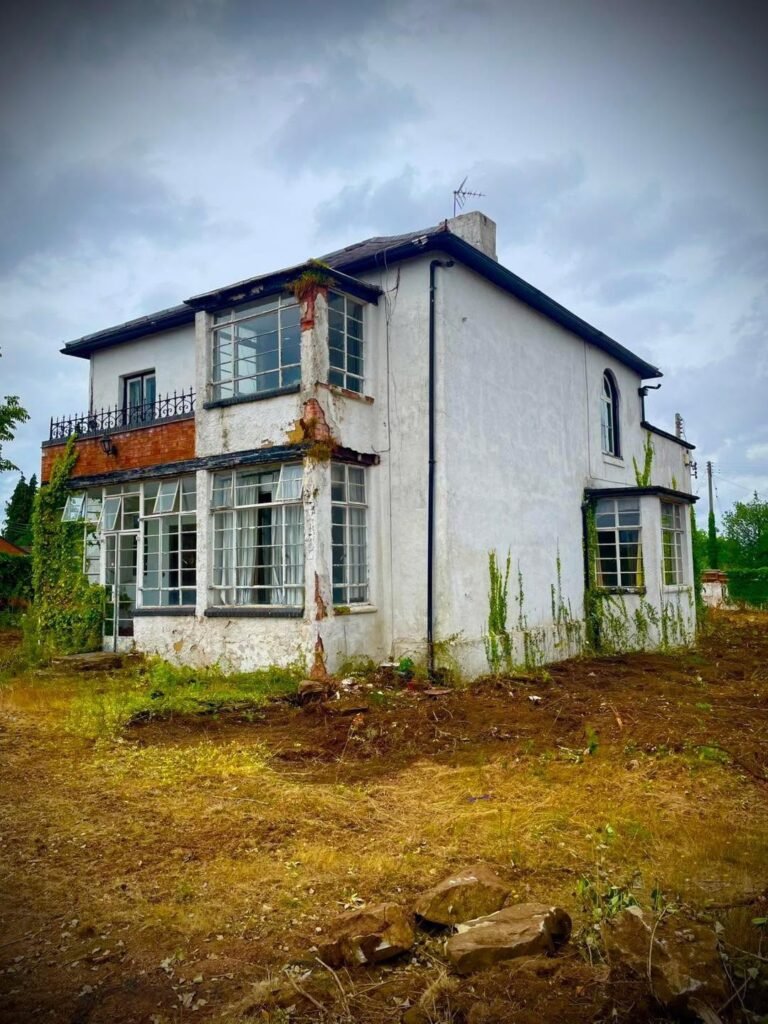
The first thing the photographs say about this house is scale. A balcony runs across a wide white front, and the grounds stretch out around it. This was not a cottage that happened to grow old. It was a residence built to impress, and the countryside around it still gives it room to do so — even now, with its paint failing and its rooms half empty.
The Luke2Explore post that photographed the house describes it as grand, derelict, and partly cleared. Only a few rooms, the post says, still hold the remnants of the past, with a small time capsule left behind. That combination — a big house, mostly emptied, with a few rooms still full — is what makes this explore different from a house stripped bare or a house frozen whole. It is neither. It is in between.
A house part-cleared, not part-lived-in
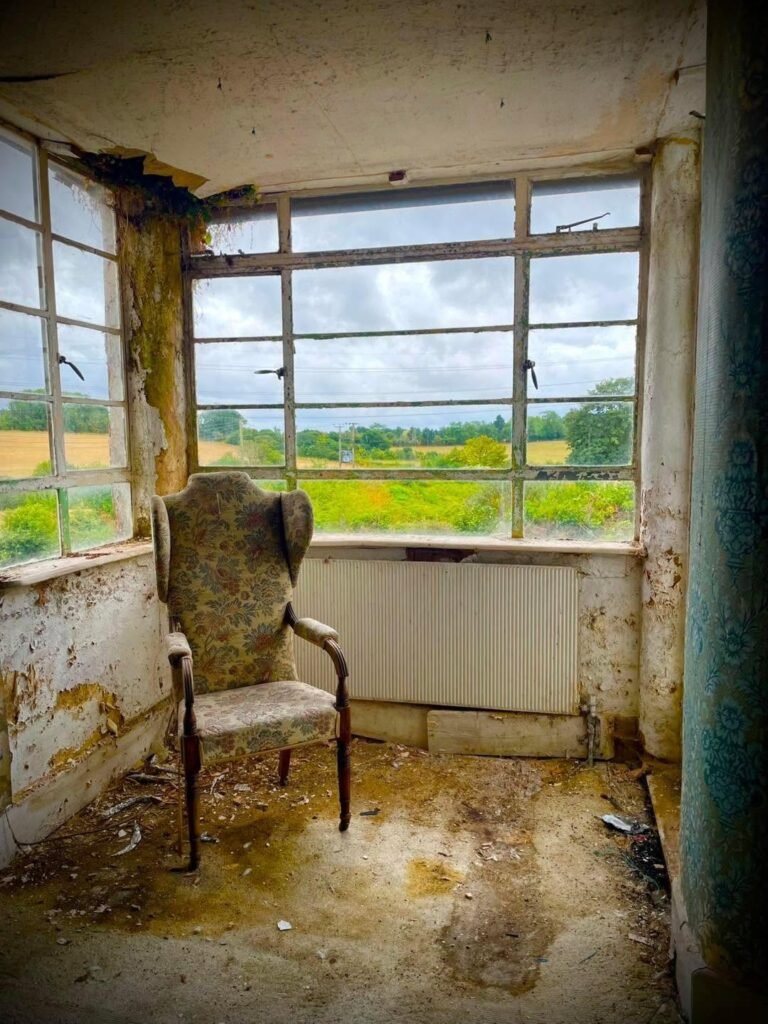
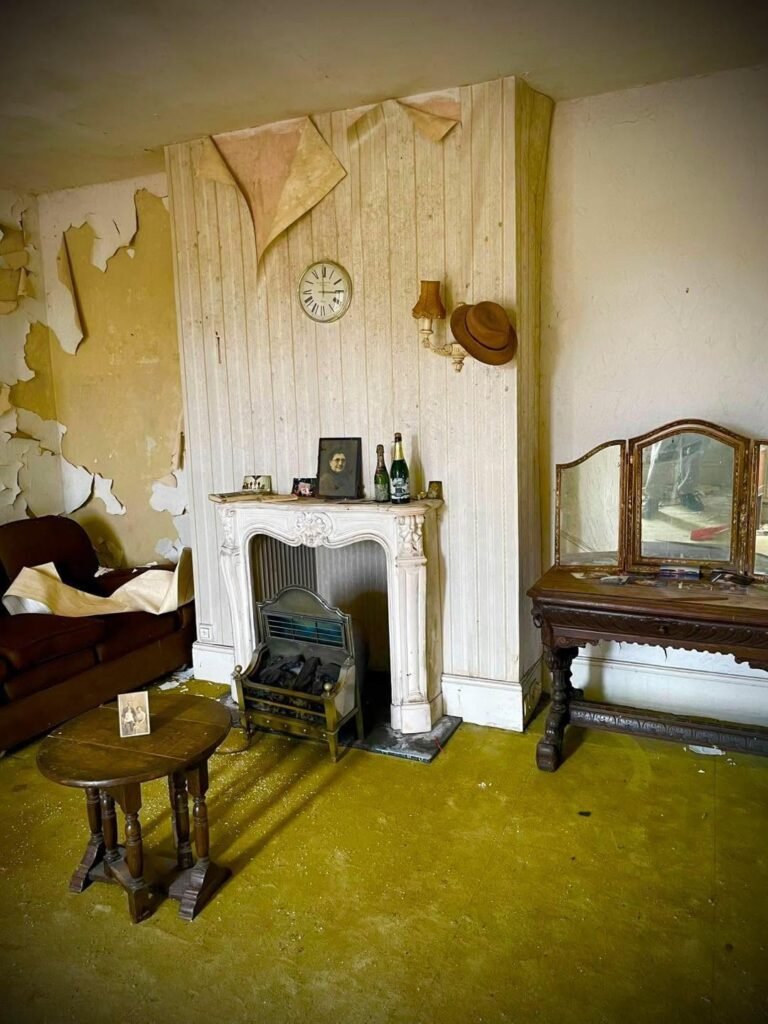
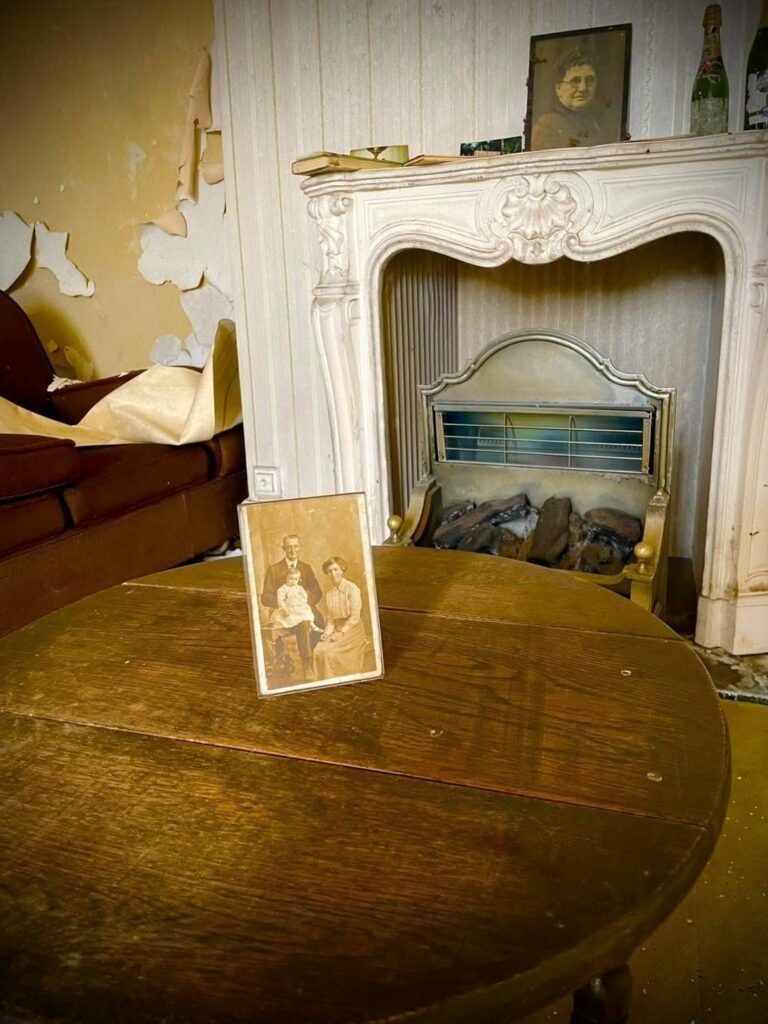
Clearing is a word worth pausing on. A house that has been lived in until yesterday looks lived in. A house that has been cleared looks like someone made decisions about it. Here, according to the post, some areas have been partially cleared while a few rooms remain filled. The photographs bear that out in their own way: one room holds a worn armchair beside large broken windows looking out over fields, another holds a fireplace against peeling patterned wallpaper, a third holds an ornate fireplace and a round wooden table with a framed photograph on it.
None of that tells us who cleared what, or why. No clearance sale, no family statement, and no owner is named in the post, and none is named here. The post’s only location detail is “countryside” — no county, town, or address is given, and none is added here. What can be said is that the remaining rooms read as fragments rather than a full household: a chair, a fireplace, a photograph, a table. A time capsule in the small sense — a few things left where they were — rather than a whole life preserved room by room.
The peeling rooms: what decay is actually doing
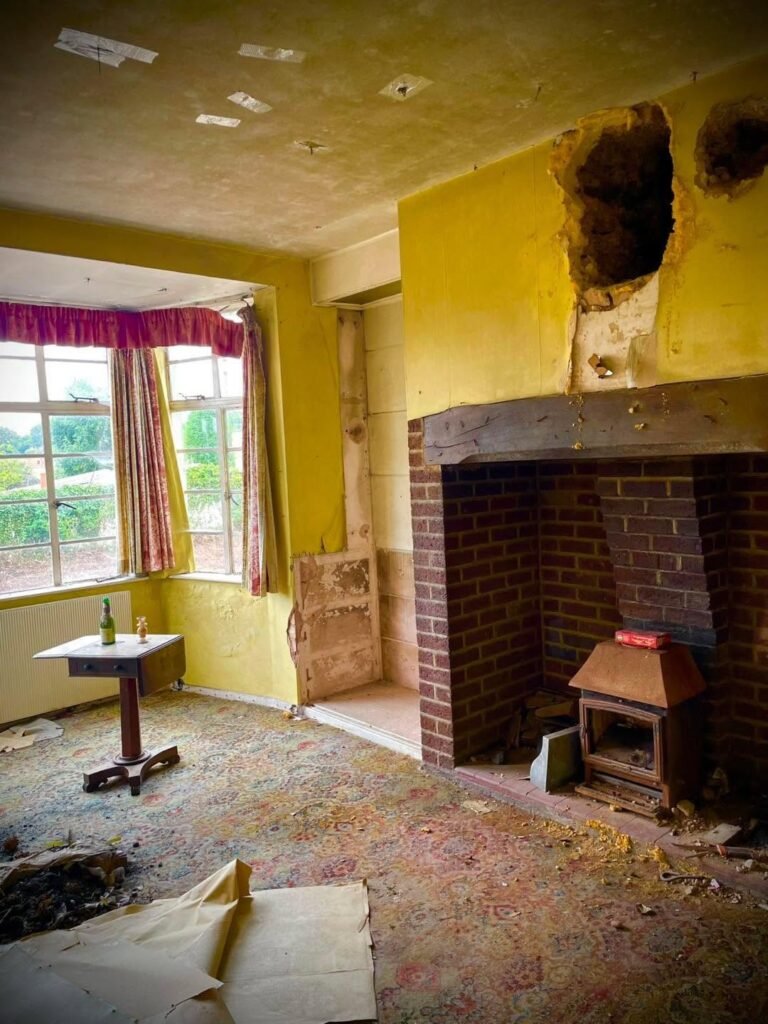
Three of the five photographs are fireplace rooms, and that repetition is itself informative. In a grand house, fireplaces were focal points, and here they have become the most durable survivors. Wallpaper dangles beside them, walls peel, and in one yellow-walled room pink curtains still hang at a window. The decay is not uniform: paint and paper fail first, plaster and brickwork follow, and the heavy masonry features — fireplaces, the balcony structure — outlast the decoration around them.
That pattern gives a useful rule of thumb for reading any derelict house, and it is the original check this article offers: start with what is structural, then what is decorative, then what is movable. Structural survival tells you about the building. Decorative failure tells you about time and weather. Movable things — a chair, a framed photograph — tell you about the last people to make choices in the house, but only in the loosest sense. A photograph left on a table does not tell you who left it or when, and this article does not guess.
Rumour, grounds, and a possible ending
The post mentions rumours about something once found at the property, and is explicit that it had nothing to do with the family who once lived there. That distinction is kept here in full: a rumour reported by the post, with no names, no dates, and no evidence offered, and an explicit separation from the former family. Nothing further can be verified from the post, and nothing further is claimed.
The grounds carry their own, quieter story. The post describes the garden grounds as flattened, as if prepared for demolition of the house and a new use for the land. “As if” is doing important work there: it is an impression from the state of the ground, not a planning notice. No demolition permission, date, or future use is stated in the post, and none is stated here. If the house is demolished, the balcony and the fireplaces in these photographs will be its record. If it is not, the photographs are a record of a house waiting between uses. Either way, the record is worth keeping precisely because it does not overclaim.
For contrast, a lived-in historic house offered for sale is a different category altogether from a derelict property like this one — see this 1902 home in Alexandria, Minnesota, where the question is price and condition, not survival.
FAQ
Where is the old white house?
The post says only that it stands in the countryside. No town, county, or address is given in the post or here.
How many rooms are still furnished?
Only a few, according to the post. Some areas have been partially cleared, and a small time capsule remains in a few rooms. No room-by-room inventory is given.
What does the time capsule consist of?
The post does not itemise it. The photographs show scattered faded photographs and a small number of remaining furnishings, such as an armchair and a framed photograph on a table.
Was anything illegal found at the house?
The post reports rumours on that point and states they had nothing to do with the family who once lived there. No evidence, names, or dates are offered, and this article repeats the rumour only on that basis.
Is the house going to be demolished?
Not confirmed. The post says the grounds look flattened, as if ready for demolition and a new use for the land. No permission or date is stated.
Can I visit it?
No visiting information is given here, and entering private property without permission is not encouraged.
Disclaimer
This article is general information only, not legal, tax, or financial advice. Rules on abandoned and private property differ by state and county; check county/local records and a local professional before acting.
Photos
Photos by Luke2Explore, via the original Facebook post: https://www.facebook.com/Luke2Explore/posts/abandoned-old-white-housenestled-in-a-country-side-is-this-grand-house-that-has-/1414607020704982/ — 5 of the 26 photos are shown here.