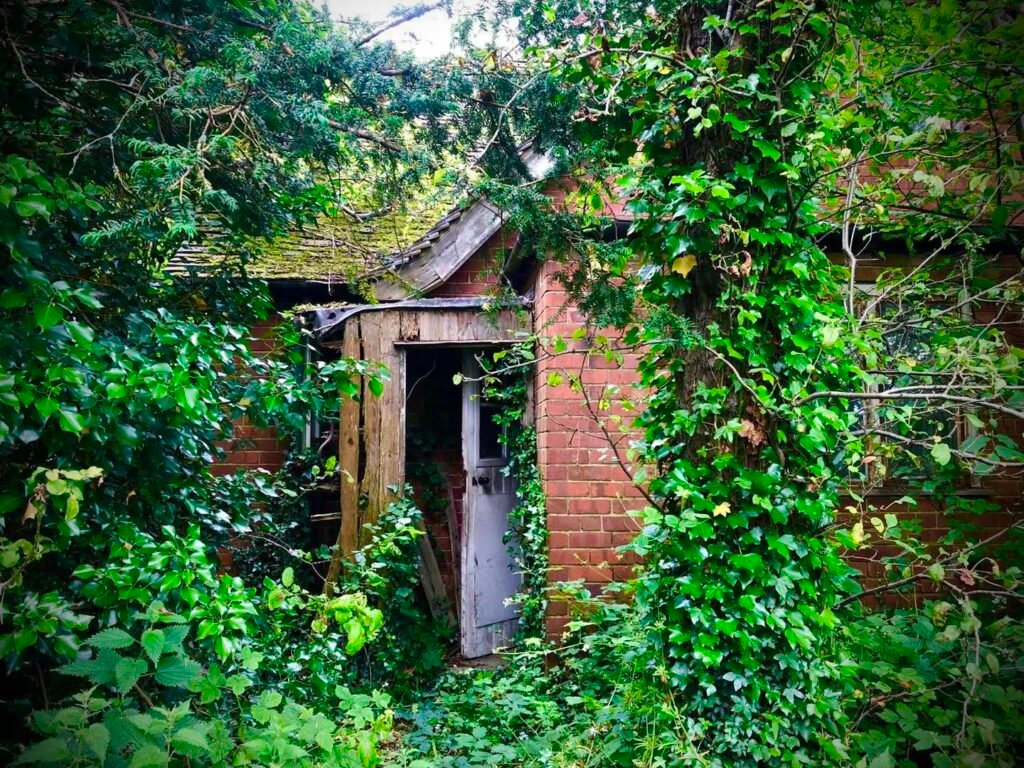
The explorer calls it the House of Cobwebs, or the Poison House, and he went back to it. That is the detail that sets this post apart: it is a revisit. He had been there a few years before, and when he returned, he says, it was still the same — the personal belongings still left behind, the rooms still full of the same old things.
The post was published in June 2026. It says the house is believed to have been abandoned for over 20 years, after its owner passed away, and the family never returned. Everything in this article comes from that post and from the five photographs shown here. No address is given, and the owner’s name is not given.
Outside and inside, twenty years apart
The featured photograph is the outside of the house, and it is hard to tell where the garden ends and the building begins. A small red-brick cottage is almost completely covered in green ivy. The roof is mossy, the wooden porch is weathered, and the pale front door stands open. A tree trunk beside the house is wrapped in ivy too.
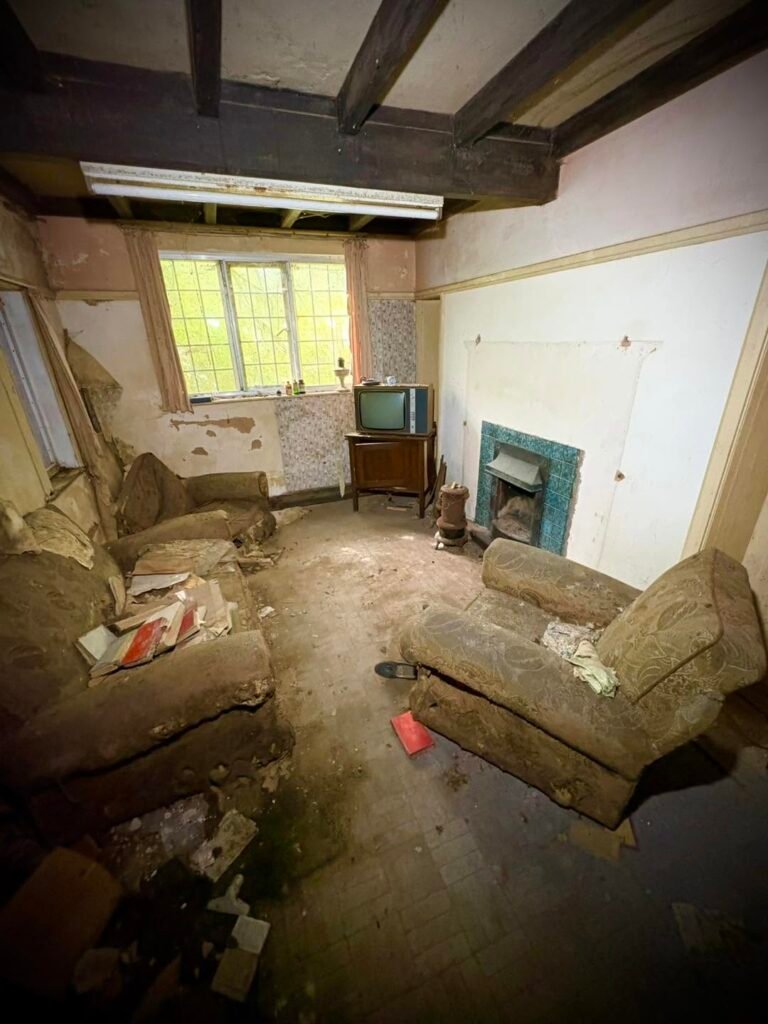
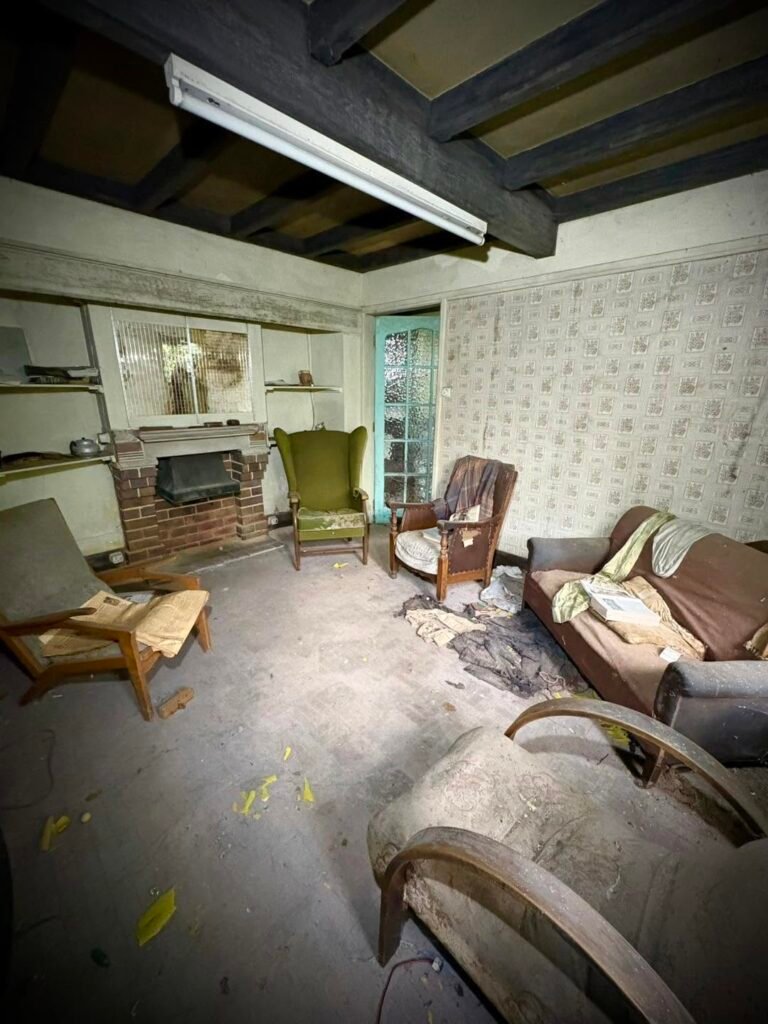
Inside, the decay is different in kind but the same in scale. The photographs show a living room with filthy patterned armchairs and a sofa, an old CRT television on a wooden stand under a window, a small tiled fireplace, peeling wallpaper, exposed ceiling beams and debris on the floor. From another angle, the same room shows a brick fireplace with a black insert, a green wingback armchair, another armchair with a cloth draped over it, and a brown sofa piled with cloth and books.
| Outside | Inside | |
|---|---|---|
| What has taken over | Ivy, moss and overgrowth — the cottage is nearly hidden | Cobwebs, mould and damp — every room shows decades of neglect |
| What still stands | Red-brick walls, the porch, the open door | The fireplaces, the armchairs, the televisions |
| What the photographs show most clearly | Nature closing in around the building | Personal belongings left exactly where they were |
| What has changed since the first visit | Nothing the explorer remarks on | Nothing — he says it is still the same |
The post’s own words are simple: the house is “covered in cobwebs and mould” and “there’s not a room in the house that doesn’t have the signs of decades of neglect”. The photographs back that up without exaggeration. This is not a house that was cleared out and then decayed. It is a house that was walked away from, with everything still in it.
The medicines on the sill
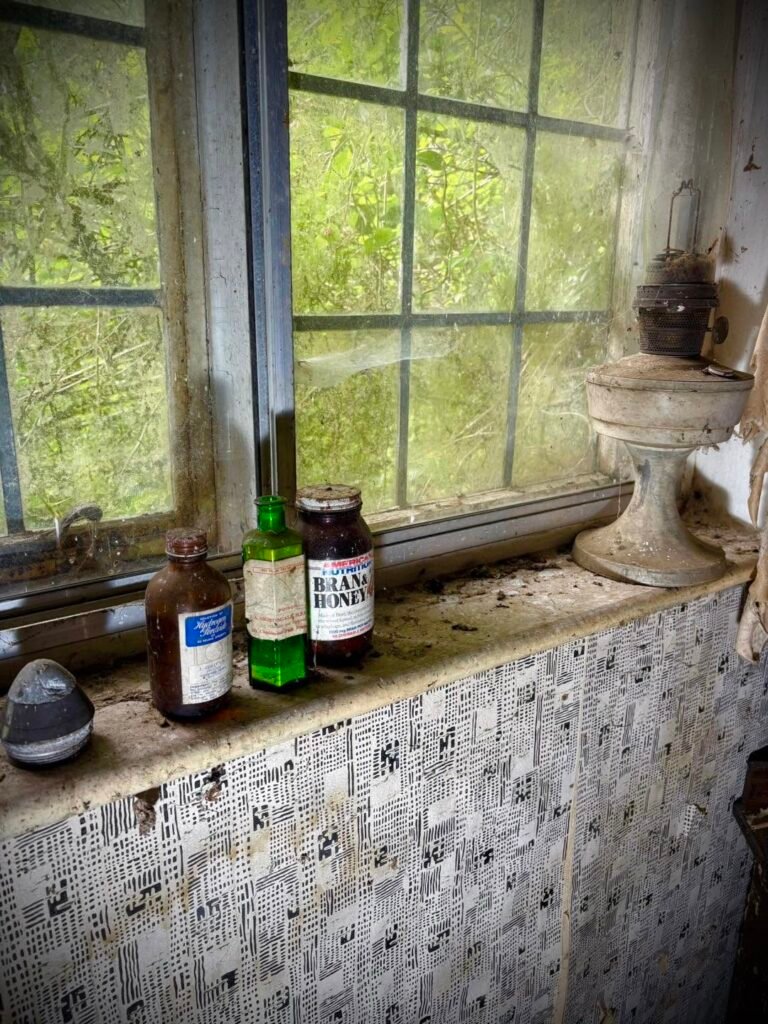
The photograph that gives the house its second name is the third one. On a windowsill, dusty old medicine bottles stand in a row, with a green glass bottle and a jar labelled “BRAN & HONEY” beside them, and a large old oil lamp at the end of the sill. Cobwebs hang around them, and green foliage shows through the multi-paned window behind.
The post does not explain why the house is also called the Poison House. It only says there is “a lot of retro stuff left behind, like old medicines, old tv’s and much more”. The medicine bottles are the most likely reason for the name, but that is a guess, and it is stated here as one. What the photograph proves is narrower and stranger: the medicines were never thrown away, never collected, never moved. They sat on the sill while the house emptied around them.
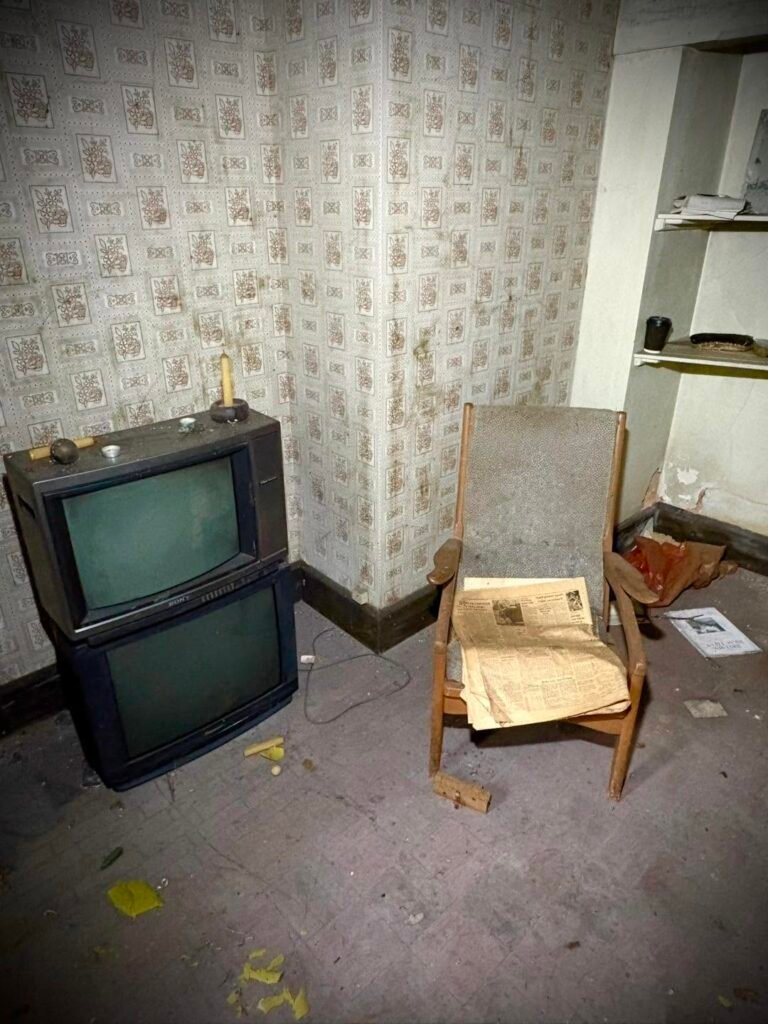
There is a second photograph of the old televisions too — two CRT sets stacked in a corner, the top one a Sony, with a wooden armchair beside them holding an old newspaper on its seat, and open shelves on the wall with a cup and papers. The house kept its screens long after the programmes stopped.
Why a revisit matters
Most abandoned-house posts are a single visit. A revisit says something a first visit cannot: that nobody came back in between. The explorer says he revisited the house after a few years and found it “still the same, with all the personal belongings left behind”. That is a small sentence with a long shadow. Somebody died, the post says, the family never returned, and in the years since, the only person to walk through the door was a stranger with a camera.
The post says the house is believed to have been abandoned for over 20 years. That is the explorer’s belief, not a verified date, and the article repeats it as such. No date for the owner’s death is given, and no family name is given.
For a contrast with a house that is lived in and on the market, see a lived-in 1902 home in Alexandria, Minnesota, where the questions are about upkeep and price rather than about what a closed house leaves behind. More houses in this condition are gathered in abandoned houses and in abandoned mansions, and the site’s front page is abandoned.blog.
FAQ
Where is the House of Cobwebs?
No location is given in the post, and none is given here.
Why is it also called the Poison House?
The post uses both names but does not explain the second one. The old medicine bottles on the windowsill are the visible link, but that is a guess, not a stated fact.
How long has it been empty?
The post says it is believed to have been abandoned for over 20 years, after its owner passed away and the family never returned. That is the post’s estimate, not a verified date.
What is still inside?
Old medicine bottles, two CRT televisions, armchairs and a sofa, a tiled fireplace, a newspaper, books, cups and papers, among other things — as shown in the five photographs here.
Was the explorer there before?
Yes. The post says he revisited the house after a few years and found it still the same, with all the personal belongings left behind.
Can I visit it?
No visiting information is given here, and entering private property without permission is not encouraged.
Disclaimer
This article is general information only, not legal, tax, or financial advice. Rules on abandoned and private property differ by state and county; check county/local records and a local professional before acting.
Photos
Photos by Luke2Explore, via the original Facebook post: https://www.facebook.com/Luke2Explore/posts/the-abandoned-house-of-cobwebspoison-house-revisitedhidden-in-over-grow-lays-thi/1459434436222240/ — 5 of the 39 photos are shown here.