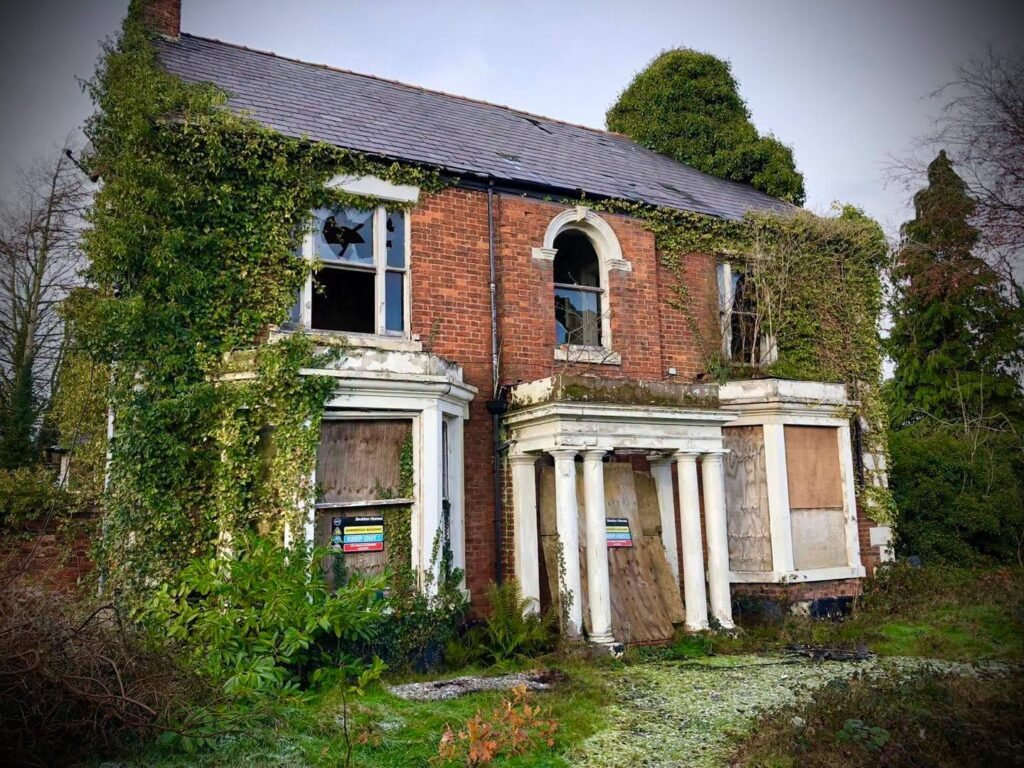
The Lonely Victorian House Nature Is Taking Back
This house was grand once. The post that published these photographs says so, and the photographs still show it: red brick, bay windows, a pillared portico entrance, two storeys of Victorian confidence. Now it lies empty, heavily overgrown by ivy, with decay, mould and cobwebs everywhere you look. The explorer calls it the Lonely House. The name fits. It is a big house, on its own, being slowly taken apart by the weather and the garden.
The post’s guess is that the house has been left abandoned since 2000. That is the explorer’s estimate, stated as a guess in the post, and it is repeated here as one. Everything else in this article comes from that post and from the five photographs shown here.
A portico with the door boarded up
The featured photograph is the outside of the house, and it is a study in contrast. The white pillared portico still stands, formal and symmetrical, but the door behind it is boarded up, a leaning board against the entrance, and the bay windows on either side are boarded too. Above, a first-floor window is broken, and ivy climbs the red brick from the ground to the slate roof.
The house would have been grand in its heyday, the post says. The portico, the bays, the tall windows and the brickwork all say the same thing. But grandeur needs maintenance, and this house has had none for a long time. The garden is overgrown, the boards are up, and the ivy is doing what ivy does when nobody cuts it back: covering everything it can reach.
Inside: the staircase and the rooms it leads to
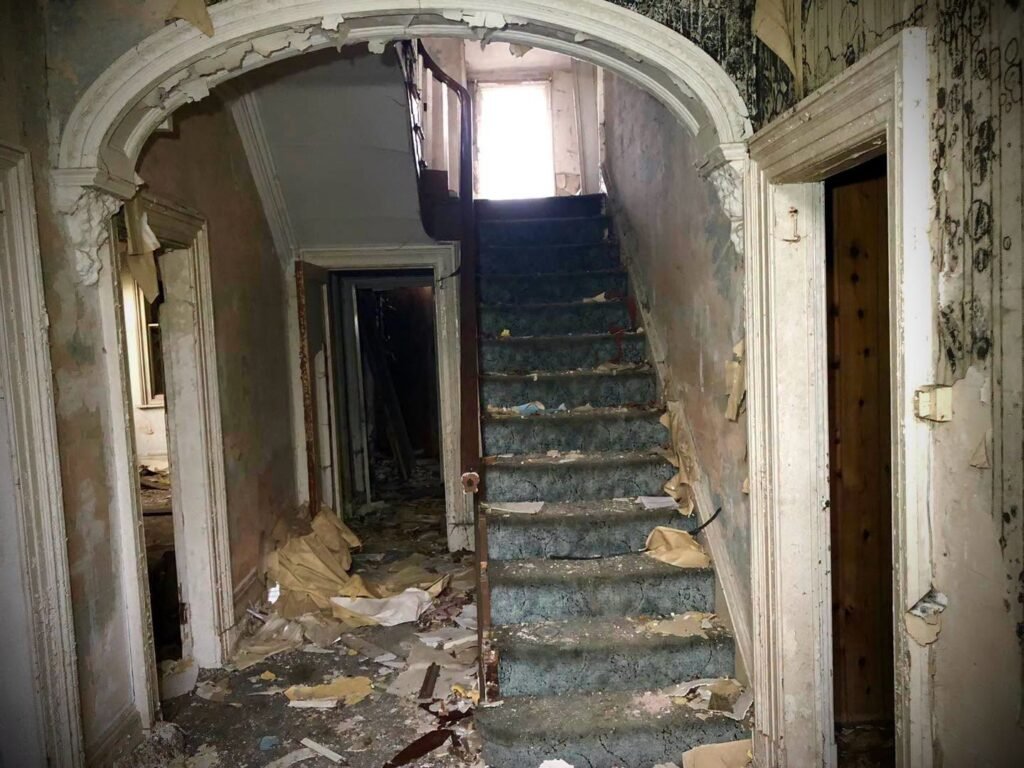
The second photograph is the entrance hall, and it is the most architectural of the set. A staircase with worn blue carpet climbs through an ornate plaster arch, the carpet covered in debris, the wallpaper peeling, the walls mould-stained, a doorway opening into a dark room and a wooden door standing on the right. The arch is still beautiful. The plasterwork around it is still crisp. The decay is in everything else.
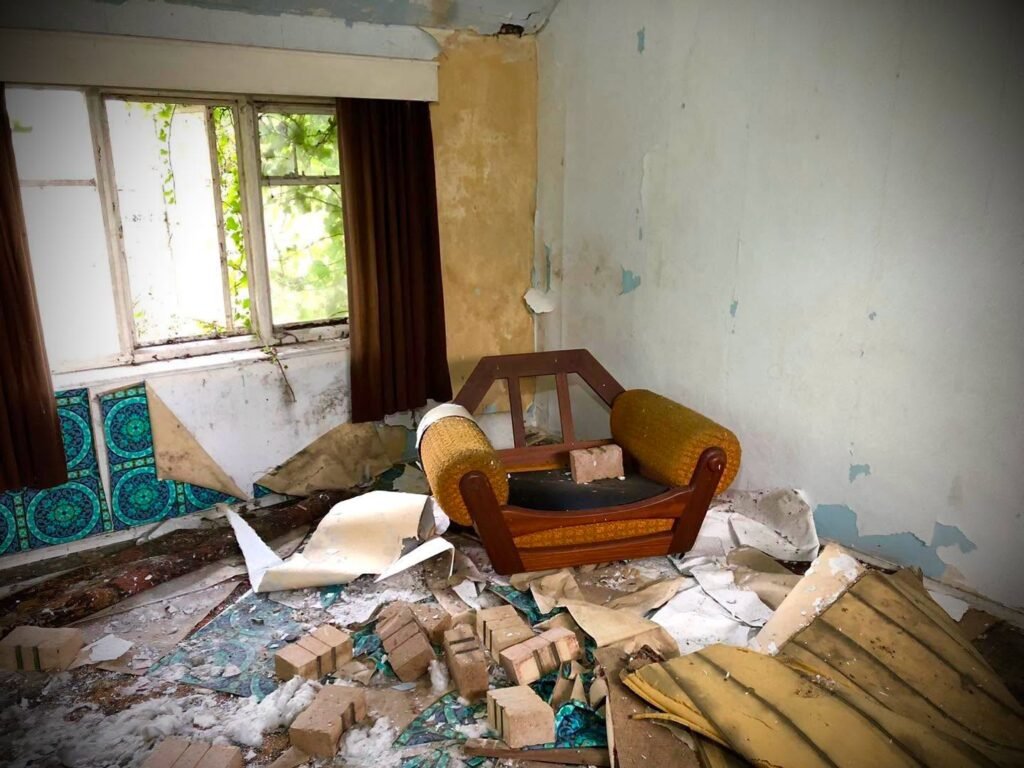
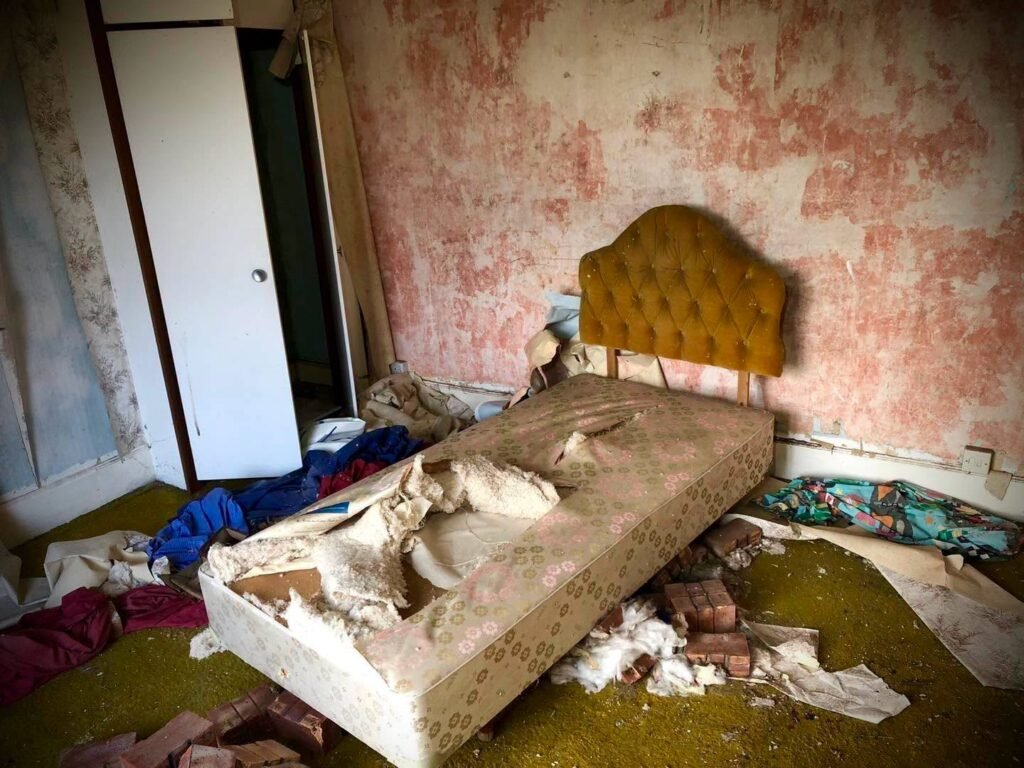
The other two room photographs show what happens to a house when it is left to the elements for years. One bedroom has an overturned mustard-yellow armchair with a brick on its seat, peeling wallpaper, a window with brown curtains and ivy growing through it, teal patterned tiles, and rubble and fallen plaster on the floor. Another bedroom has a torn mattress, its stuffing bursting out, on a mustard buttoned headboard, peeling pink wallpaper, an open white wardrobe, and clothes and bricks scattered on a green carpet.
These are not time-capsule rooms. The post says so directly: this one is not much of a time capsule, but more a case of how nature can take over a once-lived-in building. The furniture is broken, the plaster is falling, the plants are coming in through the windows. The house is being dismantled from the inside by damp and growth, and from the outside by ivy.
The magazines that date the emptiness
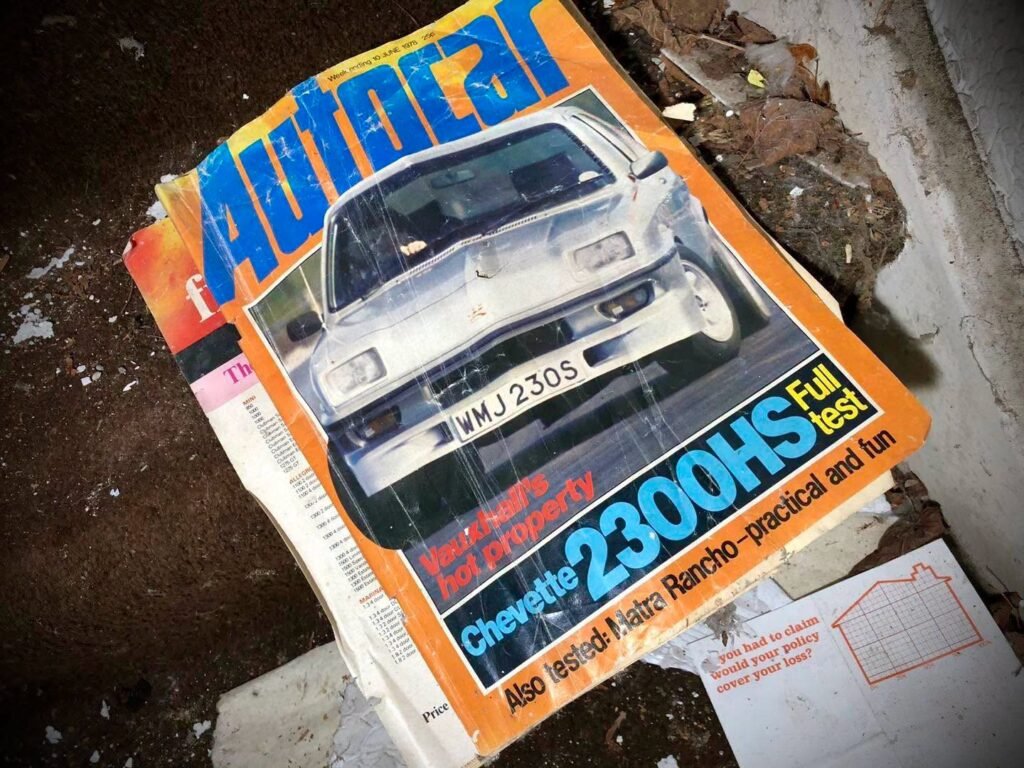
The fourth photograph is the one that gives the house its timeline. A damp, torn copy of Autocar magazine lies on a filthy floor, dated to the week ending 10 June 1978, priced 25p, its cover showing a silver Vauxhall Chevette 2300 HS under the words “Vauxhall’s hot property”, with “Full test” and “Matra Rancho — practical and fun” alongside.
The post says books and magazines lie around the house, some dating back from the 1970s up to 2000. The Autocar is the 1970s end of that range, visible in the photograph. The 2000 end is the explorer’s guess for when the house was last lived in: the magazines stop, the curtains stay at the windows, the settee sits in the lounge with the carpet pulled back from the floorboards, and nobody comes back.
It is a modest kind of evidence — a magazine on a floor — but it is the only dating evidence the post offers, and it is honest evidence. The house was lived in through the 1970s, and something in it was still being read around 2000. After that, the ivy took over.
Not a time capsule — a reclamation
The post draws the distinction itself, and it is worth keeping. Some abandoned houses are time capsules: rooms left as they were, dust on the furniture, the past preserved. This one is the other kind: a house being reclaimed. The bushes grow through the bedroom window. The carpet is pulled back from the floorboards. The wallpaper peels, the plaster falls, the mould spreads, and the ivy climbs.
There is a beauty in it, the post says, but a different kind of derelict beauty — not the beauty of a preserved past, but the beauty of nature taking back a building that was once lived in. The photographs show exactly that: a grand house, still standing, still recognisable, and already half garden.
For a contrast with a house that is lived in and on the market, see a lived-in 1902 home in Alexandria, Minnesota, where the questions are about upkeep and price rather than about what a closed house leaves behind. More houses in this condition are gathered in abandoned houses and in abandoned mansions, and the site’s front page is abandoned.blog.
FAQ
Where is the lonely Victorian house?
No location is given in the post, and none is given here.
How long has it been empty?
The explorer guesses it has been left abandoned since 2000. That is his estimate, not a verified date.
What proves the house was lived in until around 2000?
Books and magazines lie around the house, dating from the 1970s up to 2000, according to the post. A copy of Autocar magazine dated 10 June 1978 is visible in one of the photographs here.
What condition is the house in?
Decay, mould and cobwebs everywhere, peeling wallpaper, curtains still at the windows, broken furniture, bushes growing through a bedroom window, and ivy covering the outside — as shown in the five photographs here.
Why is it not called a time capsule?
The post says it is not much of a time capsule, but more a case of nature reclaiming a once-lived-in building. The furniture is broken and scattered, not preserved as it was left.
What does the outside look like?
A traditional Victorian-era red-brick house with bay windows and a white pillared portico entrance, heavily overgrown by ivy, with boarded bay windows and a broken first-floor window.
Can I visit it?
No visiting information is given here, and entering private property without permission is not encouraged.
Disclaimer
This article is general information only, not legal, tax, or financial advice. Rules on abandoned and private property differ by state and county; check county/local records and a local professional before acting.
Photos
Photos by Luke2Explore, via the original Facebook post: https://www.facebook.com/Luke2Explore/posts/the-abandoned-lonely-house-covered-in-overgrownthis-traditional-victorian-era-re/1526901559475527/ — 5 of the 23 photos are shown here.