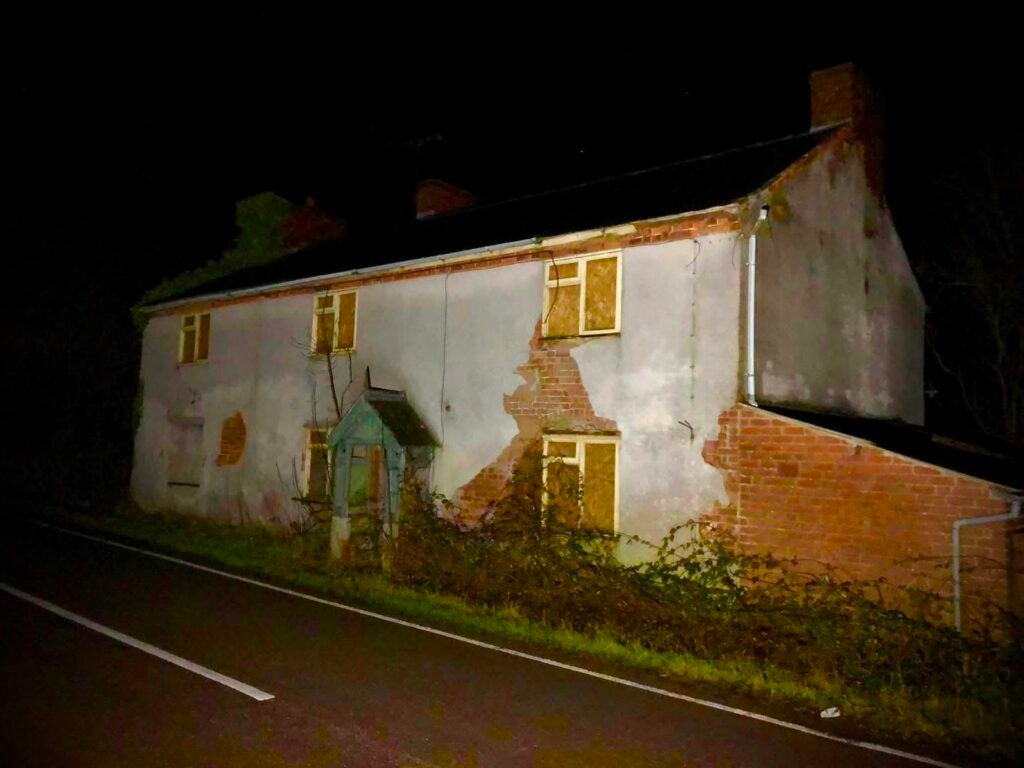
The first photograph in this set was taken at night, from the road, and that single fact changes everything about it. Most abandoned houses on this site are photographed in daylight, from the garden, with the sky behind them. This farmhouse is photographed in the dark, lit by a torch or a camera flash, its white render peeling away to show the red brick underneath, its windows boarded, a small green porch standing in front of a door nobody uses any more. The road runs along the bottom of the frame, and the house sits just beyond it, close enough to touch, far enough to be forgotten.
This is the old farm house Luke2Explore posted on 15 January 2025, as a throwback to an explore “a couple of years ago”. The post is short — it says the place “would have looked lovely back in its day”, that it holds a time capsule inside “like time had stood still”, and that it is a shame to see “another old building go to derelict”. The post carries 18 photos in total; 5 of the 18 are shown here. Everything in this article comes from that post and from the five photographs. No location is given, and none is given here. This is a different farmhouse from the other farmhouse published today — a different building, photographed at night, with different rooms inside.
A house photographed after dark
Night changes what a photograph can show, and what it cannot. The exterior photograph shows the shape of the house clearly enough: two storeys, white render, a pitched roof, a brick chimney, a lean-to of red brick on the right-hand side. But the dark hides the garden, hides the land around it, hides whatever the house looks like from any other angle. Only the front is lit, and only the front is known.
That is worth saying plainly, because the rest of this article is built on four interior photographs, and those were taken inside, in the light, on a different visit from the night shot — or at least at a different time of day. The post does not say when the interior photographs were taken. It calls the whole thing a throwback to an explore a couple of years before January 2025. The night exterior is the photograph the explorer chose to lead with, and it sets the tone: this is a house you drive past, not a house you walk up to in daylight.
The piano that anchors the room
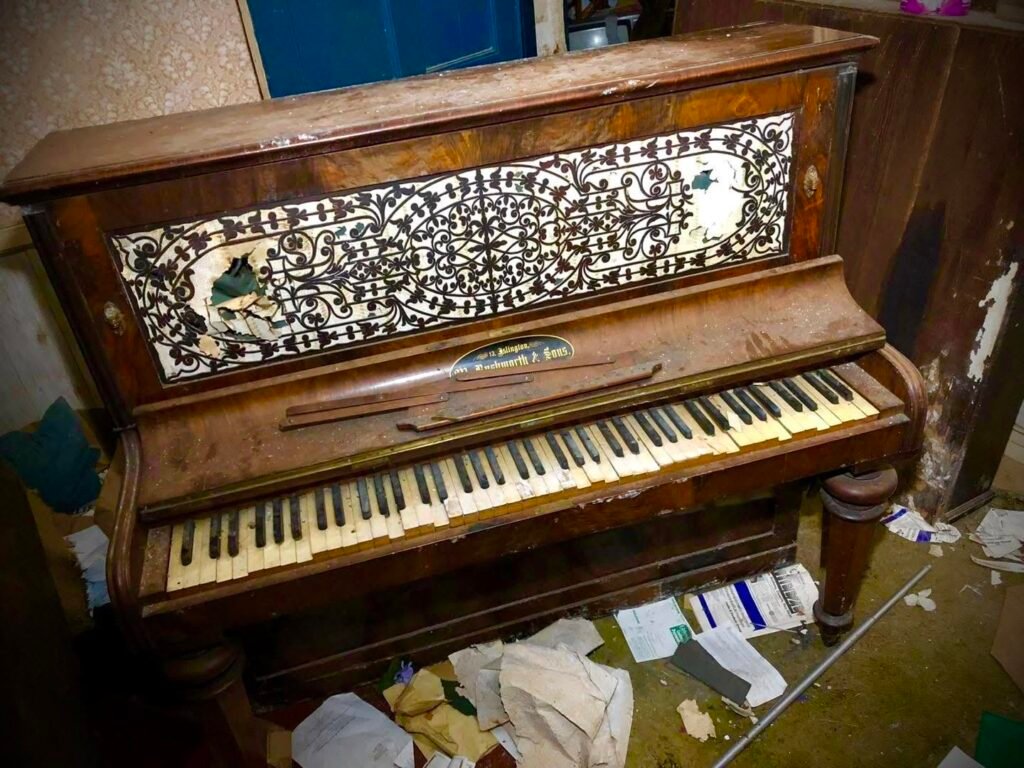
The strongest interior photograph is the piano. It is an upright, dusty, with an ornate inlaid panel across its front and yellowed keys, a wooden plank laid across those keys, and scattered papers on the floor around it. The wallpaper behind it is peeling. A maker’s name is visible on the fallboard, but it is not clear enough to read with certainty, and no name is claimed here.
A piano is the heaviest piece of furniture in most houses, and it is usually the last thing to go. It stays because moving it takes effort, and because nobody quite knows what to do with it. Here it stayed, and the dust settled on it, and the keys yellowed, and a plank ended up across them — put there by someone, for some reason, and never taken away. The piano is the anchor of the room in the same way it would have been the anchor of the household: the thing the room was arranged around, still in place after everything else has gone.
Paper trails: a VAT certificate and a wine bottle
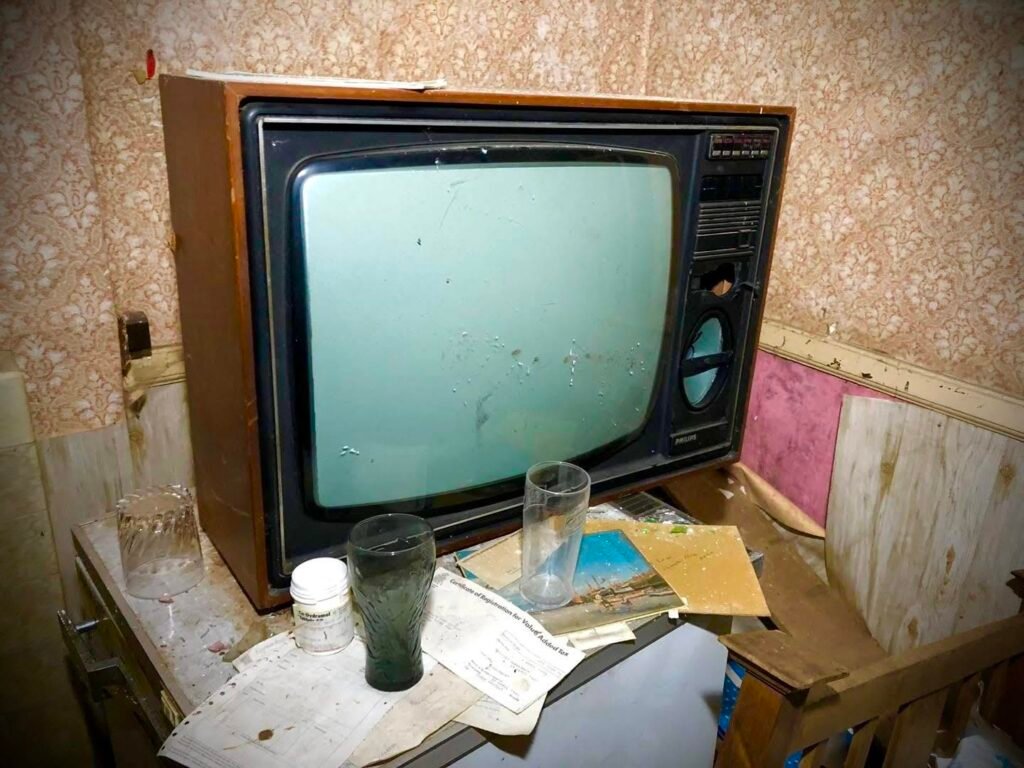
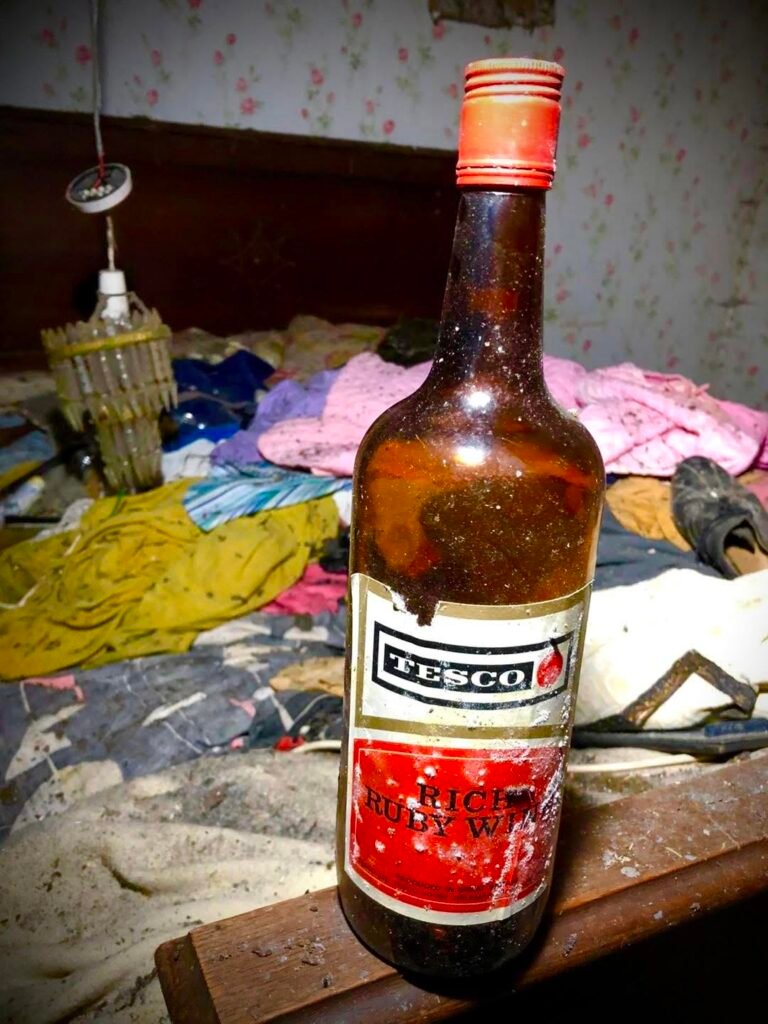
The other three interior photographs are all, in different ways, about paper. On top of the old Philips CRT television sit glasses, a pill bottle and a stack of papers, and one of them is a “Certificate of Registration for Value Added Tax”, with postcards tucked below the cabinet. On the floor by the piano lie more scattered papers. And the last photograph is a close-up of a dusty old Tesco “Rich Ruby Wine” bottle, with a pile of discarded clothes and fabric behind it and a dusty chandelier hanging above.
None of these things is valuable. A VAT certificate, a wine bottle, a pill bottle, a pair of glasses — these are the small, boring, everyday objects of a life, and they are the things that survive in an abandoned house precisely because nobody thought them worth taking. The wine bottle is the most evocative of the set, not because wine is romantic, but because it is so ordinary: a supermarket bottle, bought, drunk or half-drunk, left on a surface, and still there years later with the dust on it.
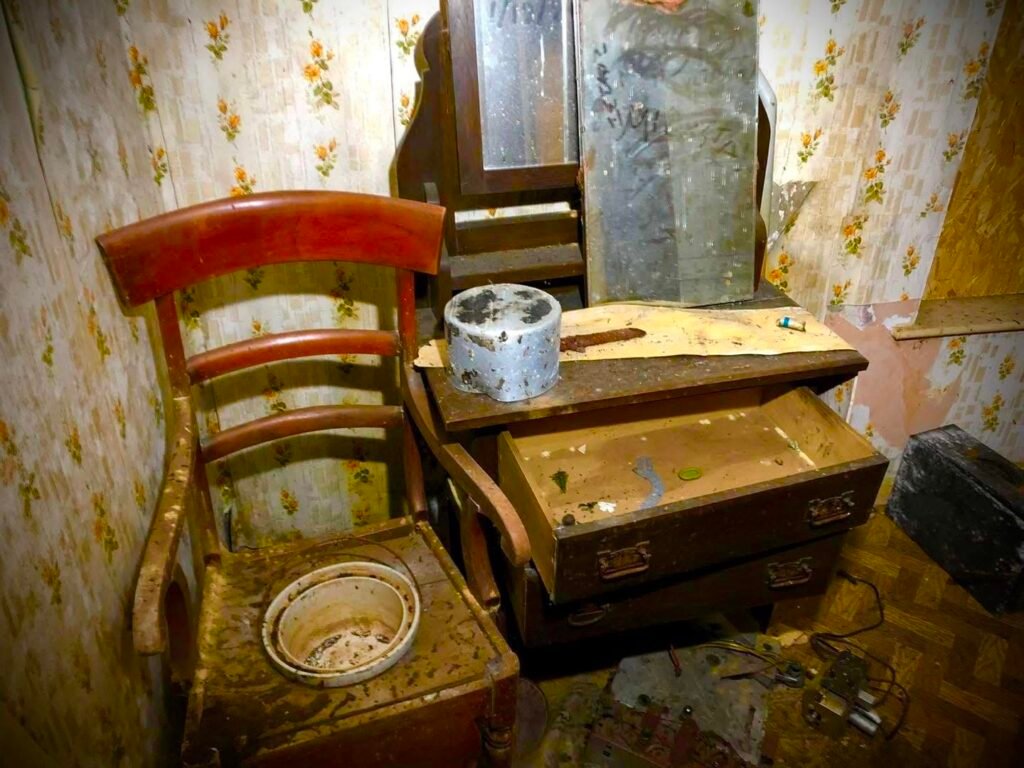
The red wooden chair in the fourth photograph belongs in the same register. It has a dirty bowl sitting on it, and behind it stands a chest of drawers and dressing table with a drawer hanging open, a metal pot on top and a mirror behind it. Somebody ate from that bowl. Somebody opened that drawer. The room is not a museum. It is a house where people did ordinary things, and then stopped.
What the post does not say
The post is one of the shortest in this series, and it leaves almost everything out. It does not say who lived in the farmhouse, or when they left, or why. It does not say when the explore happened, beyond “a couple of years ago” from January 2025. It does not say how long the house has been derelict. It says the place would have looked lovely in its day, and that it is a shame to see it go to derelict, and that is all.
That is enough, just about, for an article — because the five photographs carry the rest. The night exterior says the house stands by a road, boarded and peeling. The piano says the house was once furnished properly. The television and the papers say it was lived in until recently enough for a VAT certificate and a supermarket wine bottle to still be there. And the dust on everything says that whatever happened, it happened a while ago, and nobody has been back since.
For a contrast with a house that is lived in and on the market, see a lived-in 1902 home in Alexandria, Minnesota, where the rooms are clear and the questions are about upkeep and price. More houses in this condition are gathered in abandoned houses, and the site’s front page is abandoned.blog.
FAQ
Where is this farmhouse?
The post does not give a location. No exact address is given here. The exterior photograph shows it standing beside a road.
Who lived there?
The post does not say. No names are given.
When was it explored?
The post, dated 15 January 2025, describes the explore as “a couple of years ago”. No exact date is given.
What is inside?
According to the photographs: a dusty upright piano, an old Philips CRT television, a chest of drawers with an open drawer, a red chair with a bowl on it, and a Tesco Rich Ruby Wine bottle among discarded clothes.
Is this the same farmhouse as the other one published today?
No. This is a different building — white-rendered, photographed at night beside a road, with different rooms inside — from the red-brick three-storey farmhouse published today.
Can I visit it?
No visiting information is given here, and entering private property without permission is not encouraged.
Disclaimer
This article is general information only, not legal, tax, or financial advice. Rules on abandoned and private property differ by state and county; check county/local records and a local professional before acting. The account of the house and its former occupants is as reported in the source post and has not been independently verified.
Photos
Photos by Luke2Explore, via the original Facebook post: https://www.facebook.com/Luke2Explore/posts/throw-back-to-this-abandoned-old-farm-house-we-explored-a-couple-of-years-ago-th/1035949751904046/ — 5 of the 18 photos are shown here.