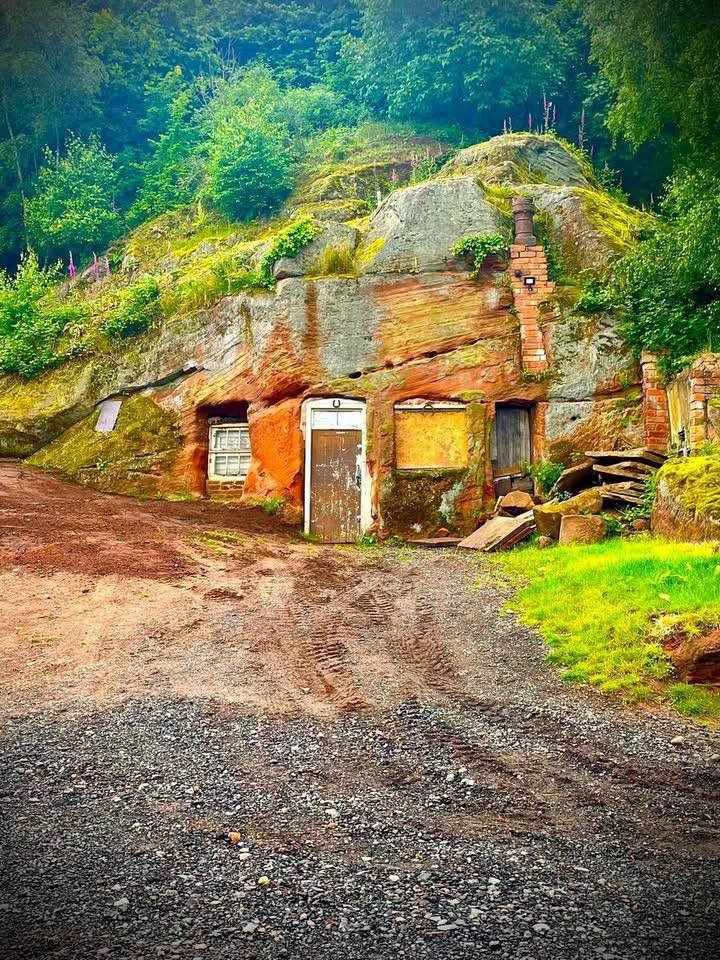
Most abandoned houses in this series are houses that were built and then left. This one is different: it was not built so much as dug. The rock cut cave house — also known as the Hobbit’s House — is a home cut into a red sandstone cliff, with rooms inside the rock itself. The photographs show a front door set into the cliff face, windows cut into stone, and a brick chimney rising from the rock above. It looks like a house and a cave at the same time, because it is both.
The post that documents it is short, and its central claim is a large one: these caves, with a house built inside them, are said to date back 700 years. That is the post’s wording — “said to date back” — and it is repeated here as a claim from the post, not as a verified date. Everything in this article comes from that post and from the five photographs shown here. No location is given beyond the photographs themselves, and no owner, sale or demolition is mentioned.
A house inside a cliff
The first photograph is the one that explains the place. A steep face of red and orange sandstone rises out of a gravel track, covered at the top with green trees and ferns. Cut into the rock at ground level are a front door — weathered, grey-brown, with a small fanlight above it — a small boarded window, and a narrow window with white panes. To the right of the door, a brick chimney climbs the rock face, with a small black fitting on it. Loose slabs of stone lie to one side. The rock is not a backdrop to the house. The rock is the house.
The post adds context that the photographs cannot show. There are other rock cave houses nearby, it says, which have been turned into lived-in properties — real homes people live in or stay in — and which have featured on Channel 4’s Grand Designs. That is the post’s claim, and it is worth pausing on, because it changes how this place should be read. The cave house in these photographs is abandoned, but the idea of living in a cave house is not abandoned at all. Other people have taken similar caves and made them into homes. This one was left behind.
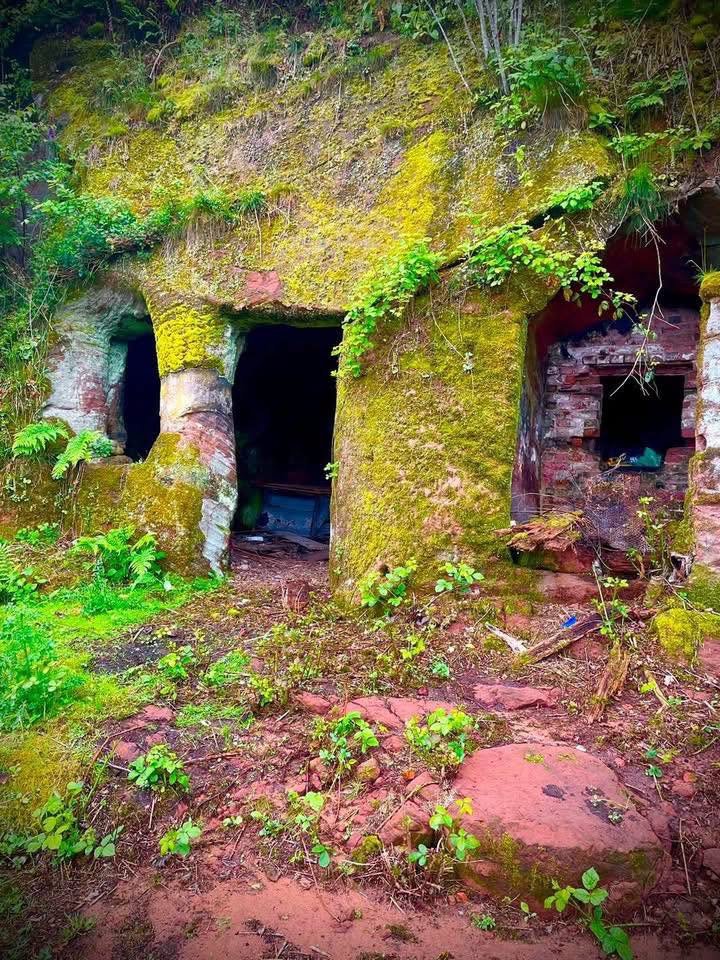
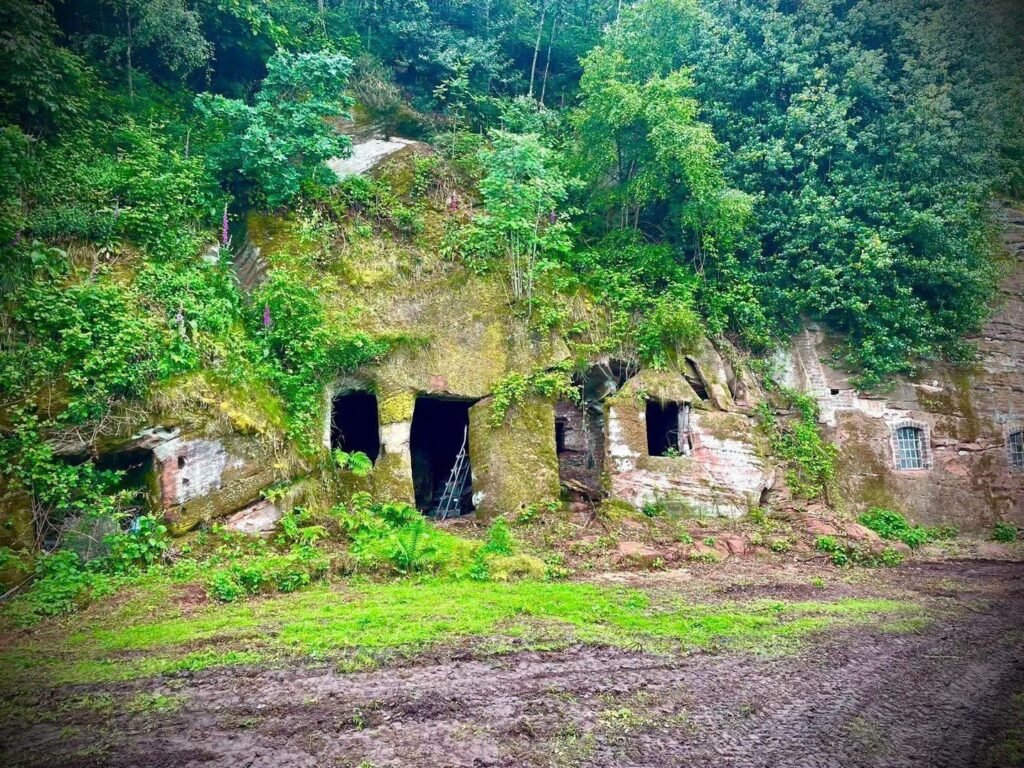
The second photograph moves closer to the rock. Moss-covered openings gape in the green stone: a dark doorway, a round-arched opening, a window hole framed in brick. Ferns grow at the base, and the ground is red earth scattered with fallen stone. There is no door in these openings. They are open to the weather, and the weather has been coming in for a long time.
Inside the rock
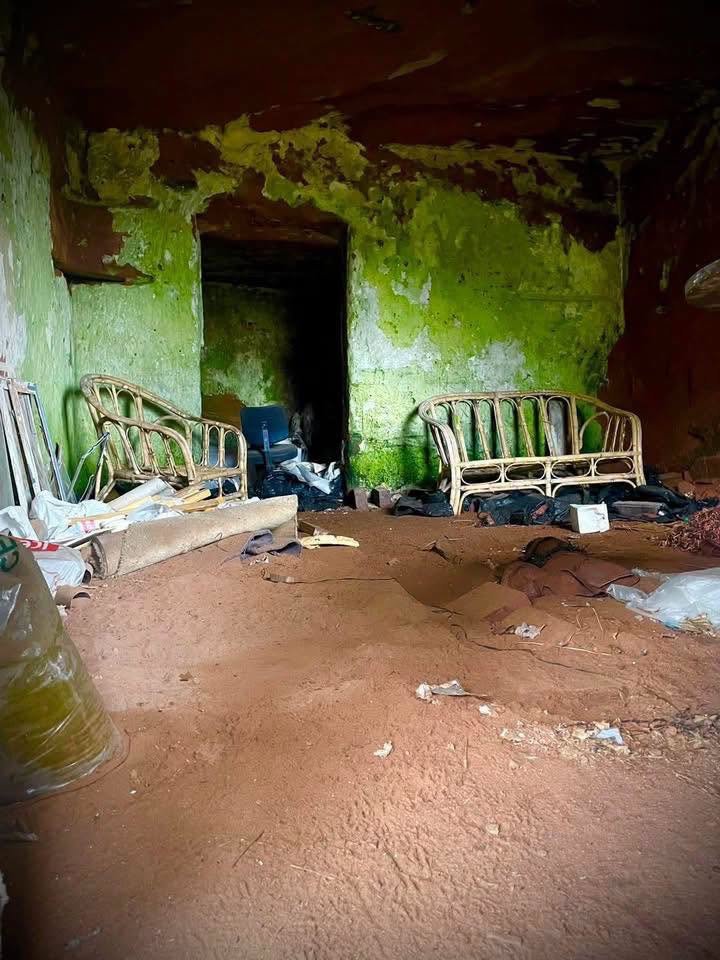
The third photograph is the inside of the main cave room, and it is stranger than the outside. The walls are green — not painted green, but covered in a thick growth of green algae or moss that climbs the rock in patches, with the red stone showing through underneath. The floor is bare red sand, the same colour as the cliff outside, scattered with rubbish: plastic bags, a rolled carpet, a white box, torn fabric. Against the back wall stand two wicker chairs — a small armchair and a two-seater settee — pale and skeletal, their cane still holding its shape. A doorway in the back wall leads deeper into the dark. Somebody furnished this room. Somebody sat in those chairs, in a room with no windows except the openings in the rock, on a floor of sand.
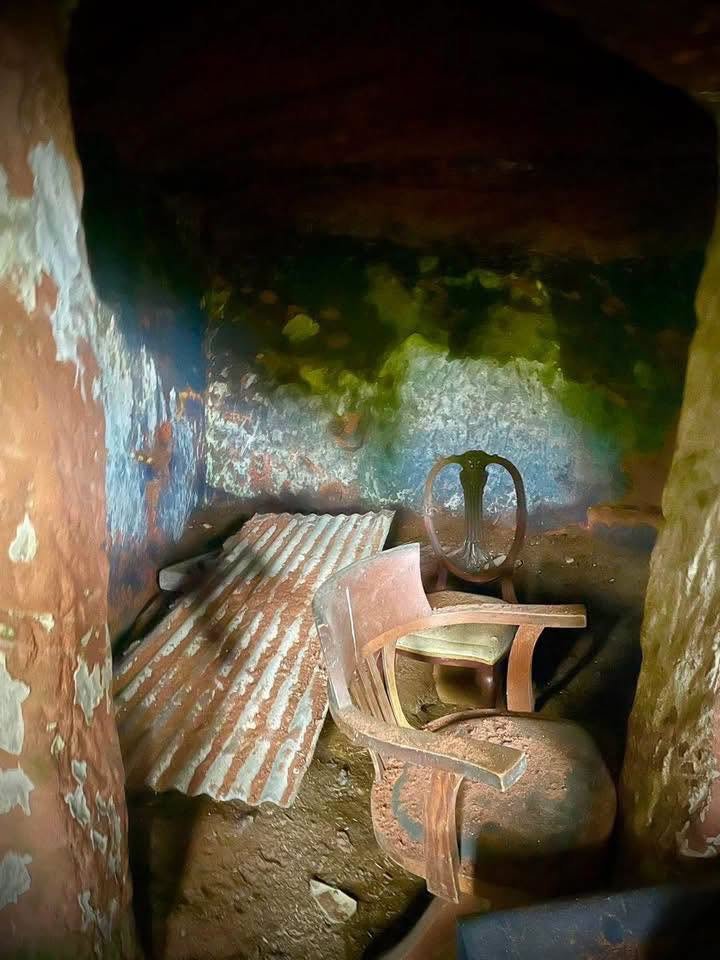
The fourth photograph is a smaller, darker cave room. Two old wooden chairs sit in it — one with a curved back, one with arms, both coated in red dust — and a sheet of corrugated metal leans against the wall. The walls here are streaked white and green, and the ceiling is lost in shadow. It is a room that was never finished, or a room that was finished a very long time ago and has been coming undone ever since.
The fifth photograph pulls back to show the whole cliff again, wider this time. Several dark openings run along the base of the rock, half-hidden by ferns and brambles. A ladder leans into one of them. To the right, a small window with white panes is set into a bricked section of the cliff. The ground in front is mud and grass. The trees above are thick and green. The place looks less like a house and more like a hillside that happens to have doors in it.
What 700 years would mean — and what it does not prove
A date of 700 years is a serious claim, and it deserves to be handled carefully. The post says the caves are “said to” date back that far. It does not say who said it, or what evidence supports it, and no document, survey or listing is quoted. It is entirely possible that people have lived in and worked this rock for centuries — rock-cut dwellings are an old tradition in sandstone country, and the post itself notes that other cave houses nearby are lived in today. It is also possible that the 700-year figure is a local story that has grown with the telling. This article does not settle that. It reports the claim, attributes it to the post, and leaves it there.
What the photographs do establish is simpler and more solid. They show a set of rock-cut rooms that were once fitted out as a home — doors, windows, a chimney, chairs, a carpet — and that have since been left open to damp, algae and the weather. The wicker chairs are the clearest evidence of domestic life: nobody puts a settee in a cave by accident. Somebody lived here, or at least spent time here, in rooms cut out of the hillside.
There is also a useful contrast hiding in the post. The other cave houses, the ones on television, were saved by being turned into something people wanted to live in. This one was not. The difference between a cave house that survives and one that rots is not the rock. It is whether somebody keeps the water out.
- The cliff face: red sandstone, doors and windows cut into the rock, brick chimney.
- The openings: moss-covered, doorless, open to the weather.
- The main room: green algae walls, wicker chairs, red-sand floor, scattered rubbish.
- The small room: two dusty wooden chairs, corrugated sheet, shadowed ceiling.
- The wider site: several openings along the cliff base, ladder, bricked window, thick woodland above.
For a house that is lived in and on the market, see a lived-in 1902 home in Alexandria, Minnesota, where the questions are about upkeep and price rather than about a home carved out of a cliff. More houses in this condition are gathered in abandoned houses and in abandoned mansions, and the site’s front page is abandoned.blog.
FAQ
Where is the Rock Cut Cave House?
No location is given in the post, and none is given here.
How old is it?
The post says the caves are said to date back 700 years. That is the post’s claim and has not been independently verified here.
Why is it called the Hobbit’s House?
The post calls it the Hobbit’s House as an alternative name, presumably because the small doors and windows cut into a hillside resemble a hobbit dwelling. The post does not explain the name further.
Are other cave houses lived in?
According to the post, other rock cave houses nearby have been turned into lived-in and stay-in properties and have featured on Channel 4’s Grand Designs. That is the post’s claim.
What is still inside?
According to the photographs: wicker chairs, old wooden chairs, a rolled carpet, and scattered rubbish, in rooms with algae-covered walls and red-sand floors.
Can I visit it?
No visiting information is given here, and entering private property without permission is not encouraged.
Disclaimer
This article is general information only, not legal, tax, or financial advice. Rules on abandoned and private property differ by state and county; check county/local records and a local professional before acting. The account of the cave house and its age is as reported in the source post and has not been independently verified.
Photos
Photos by Luke2Explore, via the original Facebook post: https://www.facebook.com/Luke2Explore/posts/-the-rock-cut-cave-house-also-known-as-the-hobbits-housethese-caves-that-have-a-/1578511034314579/ — 5 of the 10 photos are shown here.