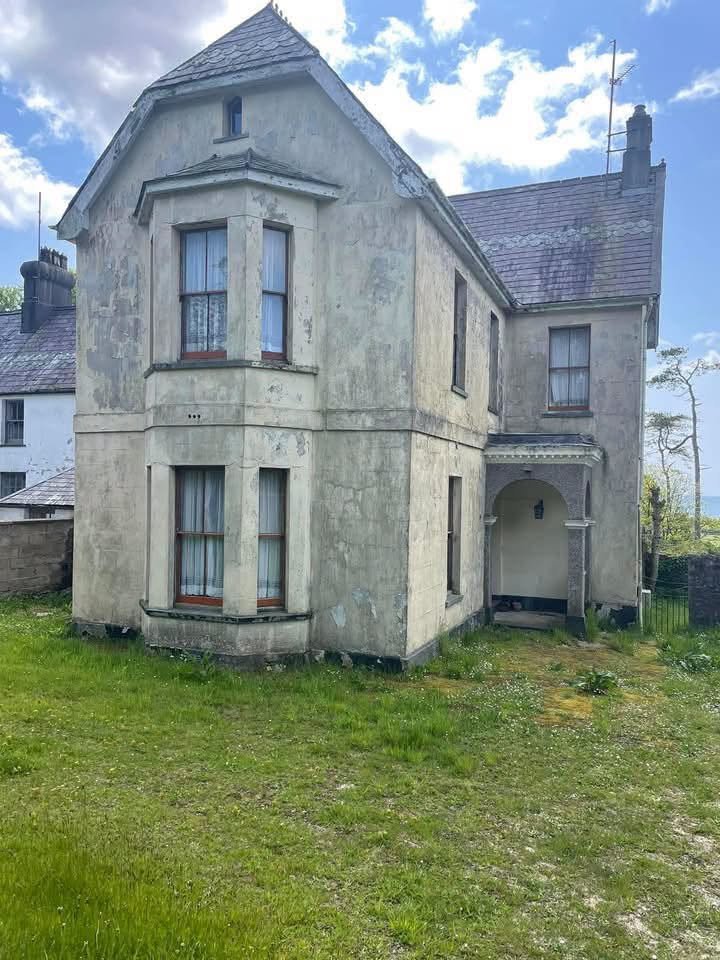
Every other article on this site starts with a caption and a set of photographs. This one starts with almost nothing. On 20 November 2026, Urbex Lost & Found posted a single photograph of a house, with a caption of two words and a winking emoji: “I loved this place.” That is the entire source. One photograph. No house name, no location, no history, no dates, no second angle.
It would be easy to skip a post like this. But the photograph itself is worth looking at properly, because it shows how much a single image of an abandoned house can hold — and where it stops. This article is written from that one photograph alone, and it says plainly where the photograph runs out.
The House in the Photograph
The house is a two-storey building in pale, weathered render, its paint peeling in patches across the front. Its most striking feature is a two-storey bay window on the left, glazed on both floors, with white-framed sashes and lace curtains still hanging behind the glass. The roof is slate, steep-pitched, with a chimney stack at the far end and a television aerial still fixed to the ridge. To the right of the bay sits an arched porch, its opening dark, with a small wall light beside it.
The house stands in long grass, uncut and patchy, with a low stone wall and an iron gate at the right edge of the frame. A neighbouring white house is visible at the far left, its roof and upper windows just in shot. The sky above is blue with scattered cloud. The render is stained and flaking, the window frames are weathered, and the garden has clearly not been tended in a long time — but the roofline is straight, the windows are intact, and the building reads as neglected rather than ruined.
That is everything the photograph shows. It does not show the inside of the house. It does not show the back, the other side, or the garden beyond the gate. It does not show when the photograph was taken, beyond the date of the post, and it does not show who lived there or when they left.
What One Photograph Can Tell You
A single exterior photograph can still say a few honest things. The bay window, built across two floors, marks the house as a product of a particular period of domestic building — the kind of feature added to give a front room more light and a view up and down the street. The slate roof and the rendered walls are ordinary materials for a house of its type, and the aerial on the ridge is a small reminder that the house was occupied in the television age. The lace curtains behind the bay window glass are the most personal detail in the frame: somebody chose them, hung them, and left them there.
The condition of the house says something too, though less than it seems to. Peeling render and long grass mean the house has not been maintained, and the dark porch suggests the door has not been opened in a while. But an uncut lawn and flaking paint do not prove a house is empty, and this article does not claim they do. All the photograph proves is that, on the day it was taken, the house looked uncared for from the front.
What It Cannot Tell You
Everything else is [TO VERIFY], and the list is long. The location is not given in the caption, and the photograph contains no street name, no house number, and no landmark that would place it. The age of the house, the names of the people who lived there, when it was last occupied, why it was left, and whether it is still standing now are all unknown. The post’s single photograph is the whole of the evidence, and no amount of looking at it will produce a history.
The comments under the post do not help. One commenter called the house “Father Ted’s house”, and others asked where the rest of the photographs were. A nickname in a comment is not a fact about the house — it is a joke, or a guess, or a reference to a television show — and this article does not repeat it as though it were the house’s name. The post has only one photograph, and the commenters noticed that before anyone else did.
Why Publish a Post With One Photo?
It is a fair question, and the answer is that the photograph is real, the house is real, and the limits of the evidence are themselves worth recording. Not every abandoned house comes with a full set of photographs and a detailed caption. Some come as a single image and two words. Publishing it as it is — one photograph, honestly described, with everything unknown marked as unknown — is more truthful than leaving it out, and more truthful than inventing a story to fill the gaps.
Readers should not expect more from this article than the photograph gives. There is no interior to describe, no history to recount, and no sale to report. What there is: a weathered bay-window house, standing in long grass under a blue sky, photographed once by someone who loved the place, and posted with two words. That is the whole article, and the whole of what is known.
What We Know, and What We Don’t
Here is the full list of what the post actually establishes. On 20 November 2026, Urbex Lost & Found posted one photograph of a two-storey house with a two-storey bay window, a slate roof, and an arched porch, standing in overgrown grass. The caption read “I loved this place”. That is all.
Everything else is [TO VERIFY]: the location, the age of the house, who lived there, when it was last occupied, how long it has stood empty, and what will happen to it. The post gives no agent, no price, no sale status, and no owner name, so none of those appear here. Do not attempt to find or enter this property. Abandoned buildings are private property, may be structurally unsafe, and entering them is trespassing.
More houses left in this state are gathered in abandoned houses, and grander empty homes in abandoned mansions. For the opposite end of the scale — a house that is lived in and on the market — see a 1902 home in Alexandria, Minnesota, and the front page of the site is abandoned.blog.
Frequently Asked Questions
Where is this bay-window house?
The post does not say. The photograph shows no street name, house number, or landmark, and the exact location is not public.
What is the house called?
The post gives it no name. A commenter called it “Father Ted’s house”, but that is a commenter’s nickname, not a fact, and this article does not use it as the house’s name.
Why is there only one photograph?
The original post contains only one photograph. There are no interior shots and no other angles in the source.
When was the house last lived in?
Unknown. The post gives no date for the photograph beyond the posting date of 20 November 2026, and nothing in the image dates the last occupancy.
Is the house still standing?
The photograph, posted 20 November 2026, shows the house standing with its roofline straight and its windows intact. Its current condition beyond the date of the post is [TO VERIFY].
Can I visit the house?
No. The location is not public, the house is private property, and entering an abandoned building is trespassing and can be dangerous. This article is not a guide to finding or entering it.
Disclaimer
This article is based only on the Urbex Lost & Found Facebook post of 20 November 2026 and the single photograph in that post. The nickname used by a commenter is not treated as the house’s name. Location, age, ownership, occupancy, and sale details are not stated in the source and are marked [TO VERIFY]. Do not attempt to find or enter this property. Abandoned buildings are private property, may be structurally unsafe, and entering them is trespassing.
Photos
Photo by Urbex Lost & Found, via the original Facebook post: https://www.facebook.com/UrbexLostNFound/posts/pfbid022VvzH8PP25rXhZPJthJS88KJ7xGx4Wf2pBNknMDJtTw7Buq9Jo4u2Nuc8S4Ur8kMl — 1 of the 1 photo is shown here.