Some abandoned houses are empty. Some are smashed. This one is neither. Hidden away deep in Anglesey, in Wales, sits what Urbex Lost & Found called “this stunning old time capsule, with everything left behind” when the post went up on 21 November 2026. The caption is short — barely two lines — and it gives no name, no history, and no date for when the house was last lived in. What it gives instead is the claim that places like this are rare, and the five photographs in the post back that up.
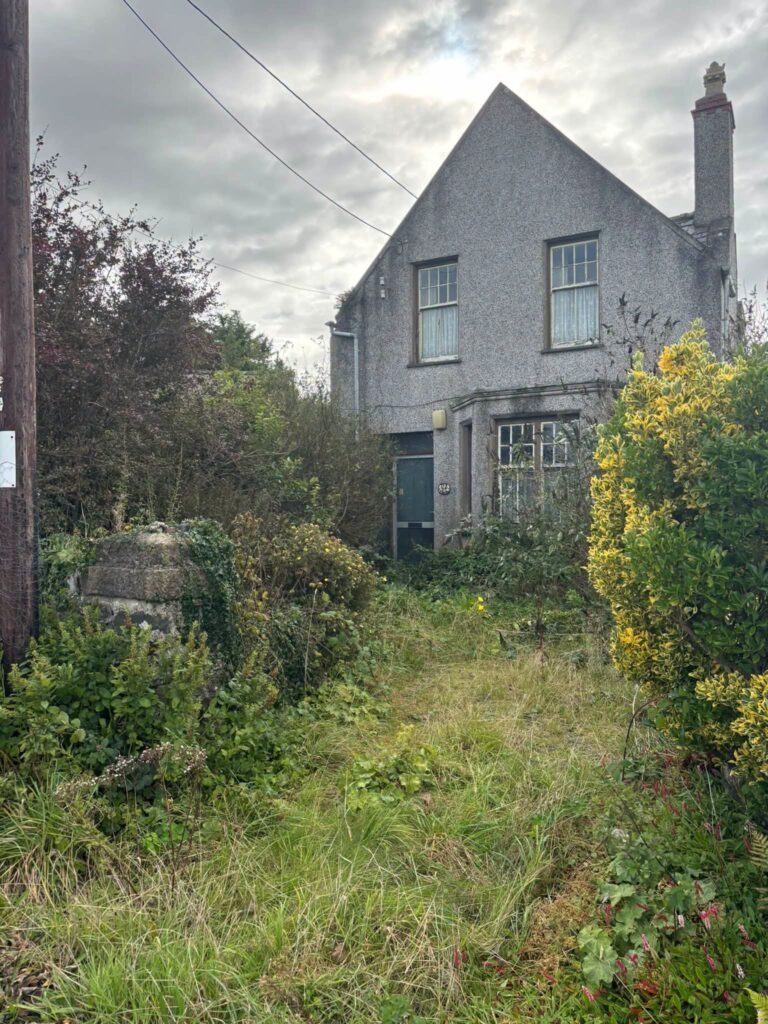
The house is a grey pebbledash two-storey building with a steep gable, its garden grown wild around it. Inside, the rooms are not stripped or wrecked. They are full: shelves of china, a dresser crowded with ornaments, a range cooker still loaded with bottles and boxes, a hallway cabinet with its glass doors still shut. It is the kind of house where the last person out seems to have expected to come back, and then never did.
That is the whole of what the post establishes. There is no name for the house, no former owner, no year built, and no reason given for why it was left. Everything else about it is [TO VERIFY], and this article does not fill those gaps with guesses.
The House in the Overgrowth
The only exterior photograph sets the scene without giving anything away. The house stands behind long grass and overgrown bushes, its pebbledash walls grey under a cloudy sky. Two sash windows with white curtains look out from the upper floor, and a bay window sits at ground level beside a dark front door. A chimney rises at the far end, and a telegraph pole stands at the edge of the frame. A low stone wall, half-hidden by ivy, marks where the garden begins.
There is no street name, no house number readable in the photograph, and no neighbouring house in the frame. The post says only that the house is “deep in Anglesey”, which is an island county off the north-west coast of Wales — and that is as precise as the source gets. The exact location is not public, and this article does not publish one.
A Dresser That Tells the Household’s Story
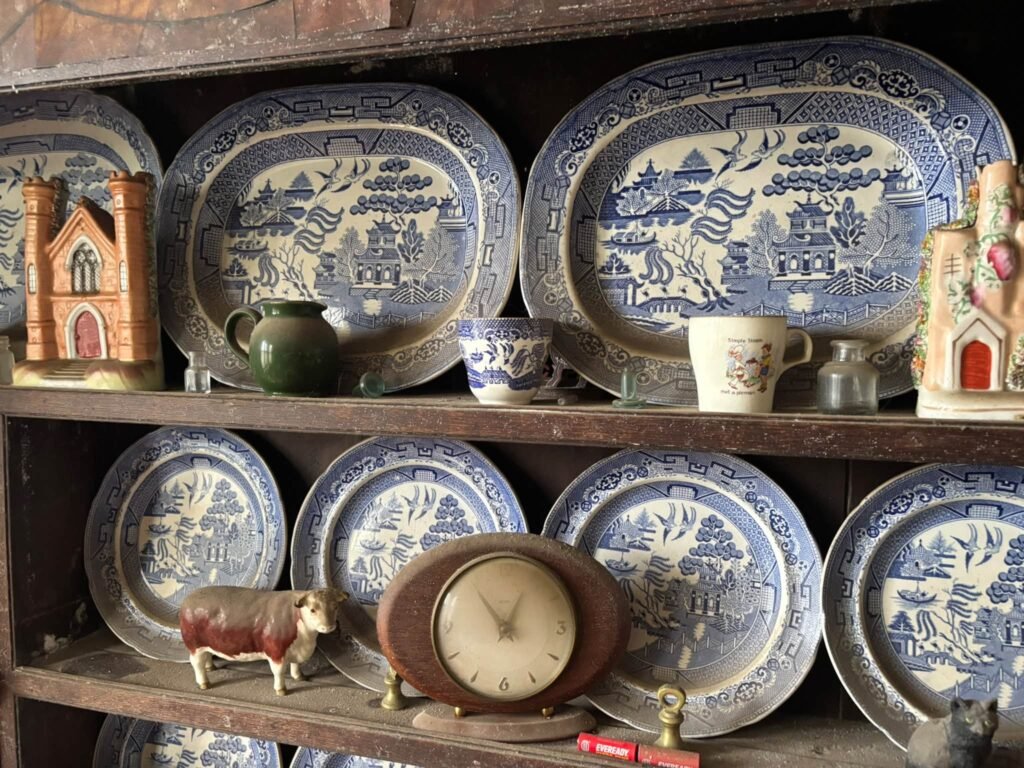
The most revealing photographs in the set are the two of the dresser. A dresser is a household’s display case, and this one is crowded with a lifetime of collecting. The close-up shows blue-and-white Willow-pattern plates and platters standing in rows, their pagoda-and-bridge pattern unmistakable. Between them sit ceramic cottage figurines, a green jug, a small mug with “Simple Simon met a pieman” printed on it, and an oval wooden clock whose hands have stopped at five past eleven.
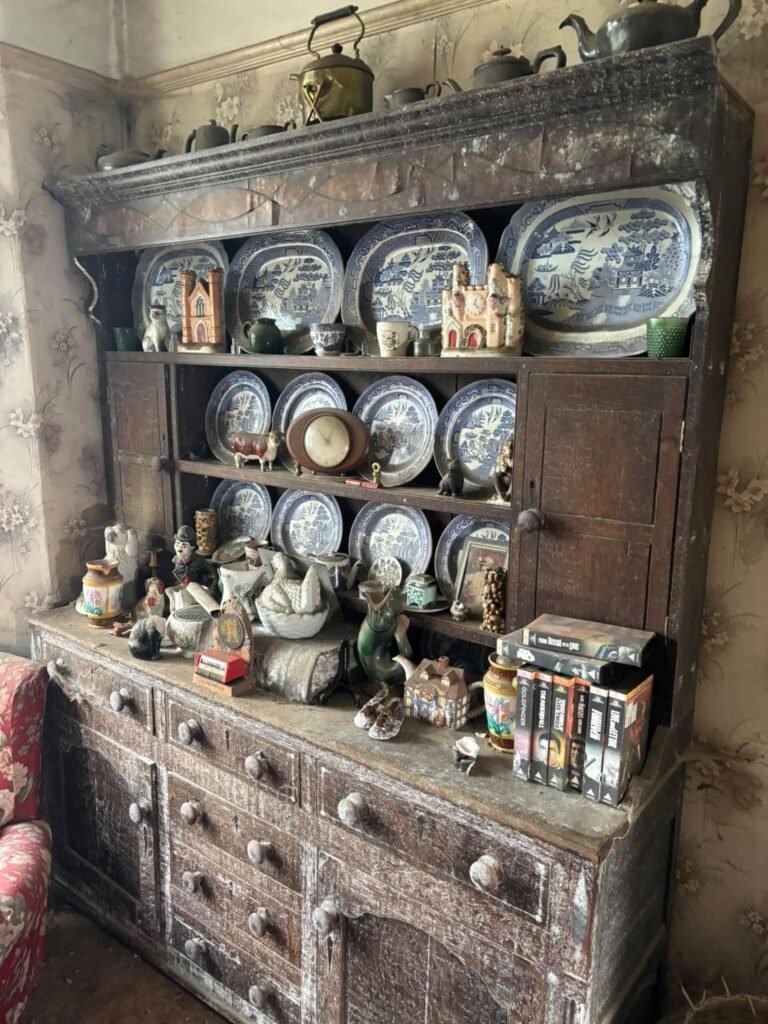
The wider view shows the whole piece: a tall dark-wood dresser with drawers and cupboards, teapots and kettles lined up along the top, and the lower shelves filled with more plates, a model bull, a small black cat figurine, and a stack of James Bond books and videos on the lower right — Goldfinger, Thunderball, and other titles with their spines facing out. On the dresser top sit a hen-shaped dish, a green fish jug, a cottage-shaped teapot, and a Charlie Chaplin figurine. A red floral armchair is just visible at the edge of the frame.
What the dresser shows is a home that was lived in properly and for a long time. Willow-pattern china is not bought in a single trip; it accumulates over decades. The James Bond videos sit beside the china without irony, the way things do in a real house. Nothing in the photographs is staged for the camera. The dust on the shelves is the dust of years, and the plates are still standing where they were put.
The Kitchen: A Range Cooker Still Loaded
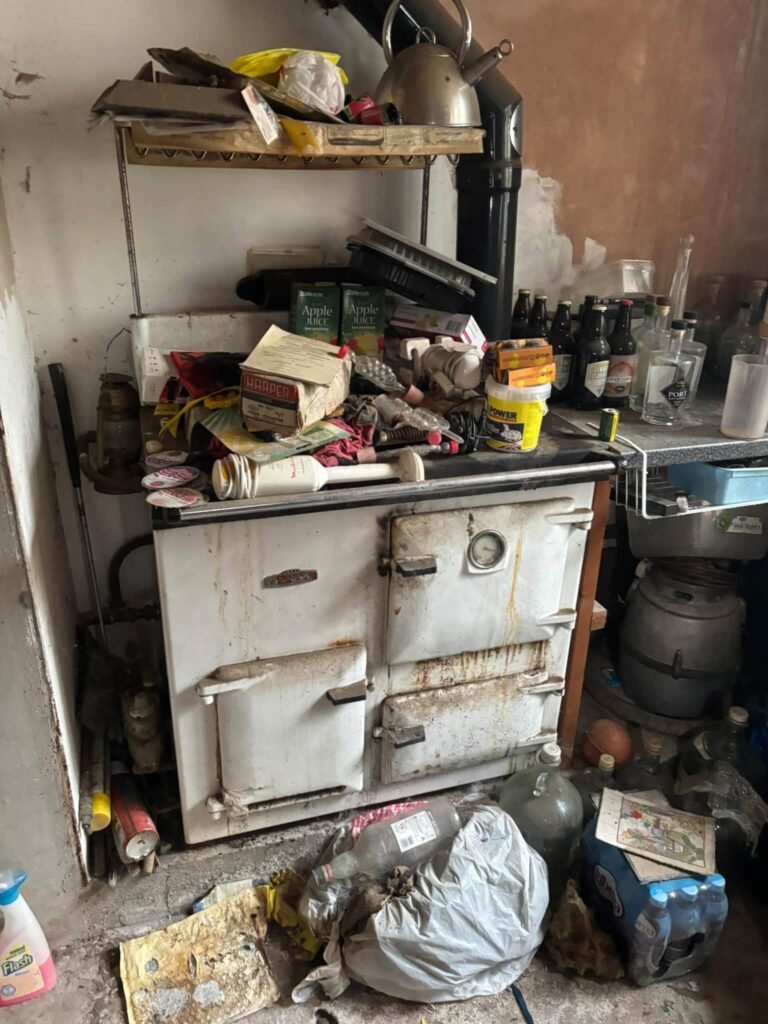
The kitchen photograph is the messiest of the five, and the most telling. An old white range cooker — the kind with a thermometer set into its door — is buried under the clutter of a working kitchen: apple-juice cartons, bottles, a kettle on the top shelf, a box marked Harper, a hand blender, a yellow tub, and a jumble of packets and tins. Dark beer bottles line the surface to the right, next to a bottle marked Port. A milk churn stands on the floor beside the cooker, and demijohns and carrier bags crowd the floor around it.
It is worth saying plainly what this photograph does not show. It does not show when the cooker was last lit, or when the food and drink on it were bought. The apple-juice cartons and the bottled water on the floor could be years old, and the dust on everything says they are. The kitchen is not a snapshot of a single day; it is the accumulation of a household that stopped, and then nobody cleared it.
The Hallway, Waiting
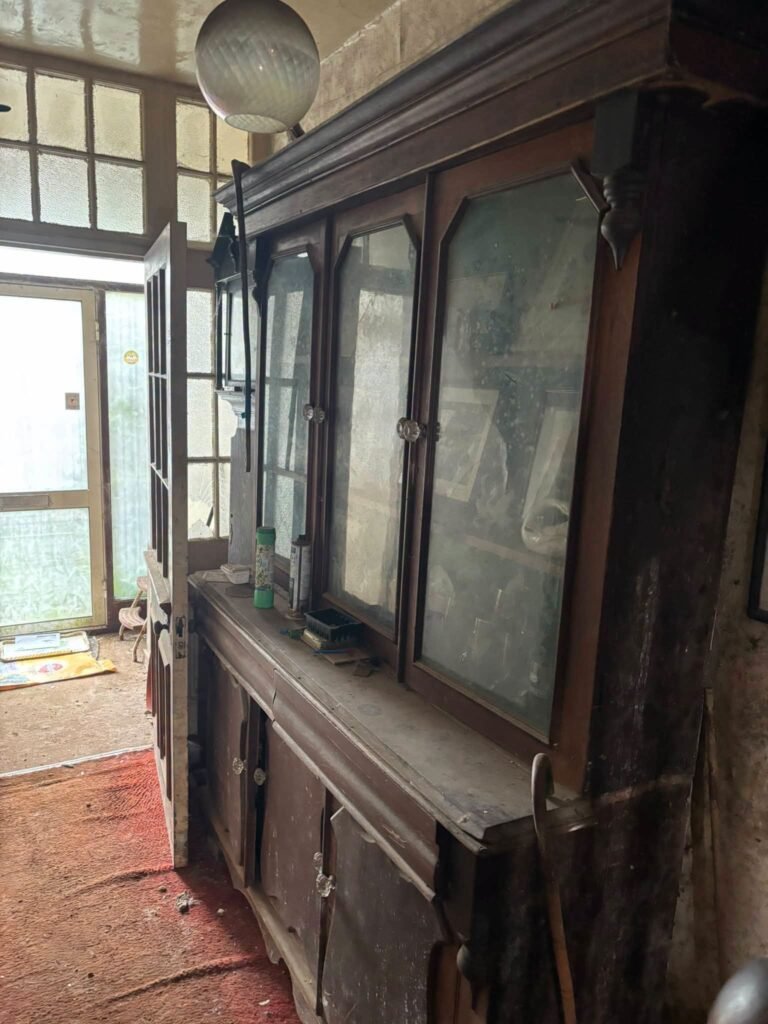
The last photograph is the quietest. A hallway with a red carpet runs toward a glazed front door, light coming through the glass panes. Against the wall stands a tall dark-wood cabinet with glass doors, its contents dim behind dusty glass. A globe ceiling light hangs above it, a walking stick leans against the cabinet, and a small table by the door holds a green canister and a spray bottle. One of the glass panes in the inner door is cracked.
Hallways are the rooms nobody photographs on purpose, which is why this one feels honest. It is the space between the front door and the rest of the house, and it still holds the small things of daily coming and going: the stick, the carpet, the light. The door at the end of it is closed, and the garden beyond it is overgrown.
Why So Little Is Known, and Why That Matters
It would be easy to invent a story for this house — a family, a date, a reason. The post gives none of those, and the photographs cannot supply them. There is no calendar visible in these five photographs, no letter with a legible date, no name on a wall. The post’s 78 photographs may hold more detail, but only five are shown here, and this article is written from those five and the caption alone.
That restraint is the point. A time capsule house is interesting precisely because it is unexplained. The Willow-pattern plates, the James Bond videos, the range cooker, the milk churn — each of them is a real object in a real room, and each of them belonged to someone whose name the post does not give. Naming that person, or guessing why they left, would turn a genuine record into fiction.
What We Know, and What We Don’t
Here is the full list of what the post actually establishes. The house stands in Anglesey, Wales. It is a grey pebbledash two-storey house with a steep gable. Urbex Lost & Found posted it on 21 November 2026, calling it a time capsule with everything left behind. Its rooms still hold a Willow-pattern dresser, a range cooker, a hallway cabinet, and the clutter of a lived-in home. That is all.
Everything else is [TO VERIFY]: the exact location, the age of the house, who lived there, when it was last occupied, how long it has stood empty, and what will happen to it. The post gives no agent, no price, no sale status, and no owner name, so none of those appear here. Do not attempt to find or enter this property. Abandoned buildings are private property, may be structurally unsafe, and entering them is trespassing.
This is a different house from the other Welsh time-capsule homes already covered on this site. It is the Anglesey house posted by Urbex Lost & Found, not the Welsh manor, the Welsh countryside time-capsule house, or any of the Luke2Explore houses. Its post URL is different, its photographs are different, and its pebbledash exterior is its own.
More houses left in this state are gathered in abandoned houses, and grander empty homes in abandoned mansions. For the opposite end of the scale — a house that is lived in and on the market — see a 1902 home in Alexandria, Minnesota, and the front page of the site is abandoned.blog.
Frequently Asked Questions
Where is this house in Anglesey?
The post says only that it is hidden away deep in Anglesey, Wales. No town, road, or address is given, and the exact location is not public.
When was the house last lived in?
The post does not say. There is no date visible in these five photographs, and no occupancy date is given in the caption.
What is inside the house?
A tall dresser filled with Willow-pattern china, ceramic figurines, and James Bond books and videos; an old white range cooker cluttered with bottles and food cartons; a milk churn; and a hallway with a glass-fronted cabinet, a globe light, and a red carpet. The five photographs here are 5 of the 78 in the original post.
Is this the same house as the other Welsh time-capsule houses on this site?
No. This is a different house — the Anglesey house posted by Urbex Lost & Found on 21 November 2026, with a grey pebbledash exterior. It is not the Welsh manor or any of the other Welsh houses already covered.
Who lived there?
The post does not say. No name, and no personal detail beyond the objects in the photographs, is given.
Can I visit the house?
No. The location is not public, the house is private property, and entering an abandoned building is trespassing and can be dangerous. This article is not a guide to finding or entering it.
Is the house for sale?
The post gives no sale status, agent, or price. Nothing in the source suggests it is on the market.
Disclaimer
This article is based only on the Urbex Lost & Found Facebook post of 21 November 2026 and the five photographs in that post shown here. Location, age, ownership, occupancy, and sale details are not stated in the source and are marked [TO VERIFY]. Do not attempt to find or enter this property. Abandoned buildings are private property, may be structurally unsafe, and entering them is trespassing.
Photos
Photos by Urbex Lost & Found, via the original Facebook post: https://www.facebook.com/UrbexLostNFound/posts/pfbid02a4QG2oroajaW53Mveq2LugjS9PduGDRh8cciLbWHQQvrj4JZknWN9HWGhUmEwtwPl — 5 of the 78 photos are shown here.