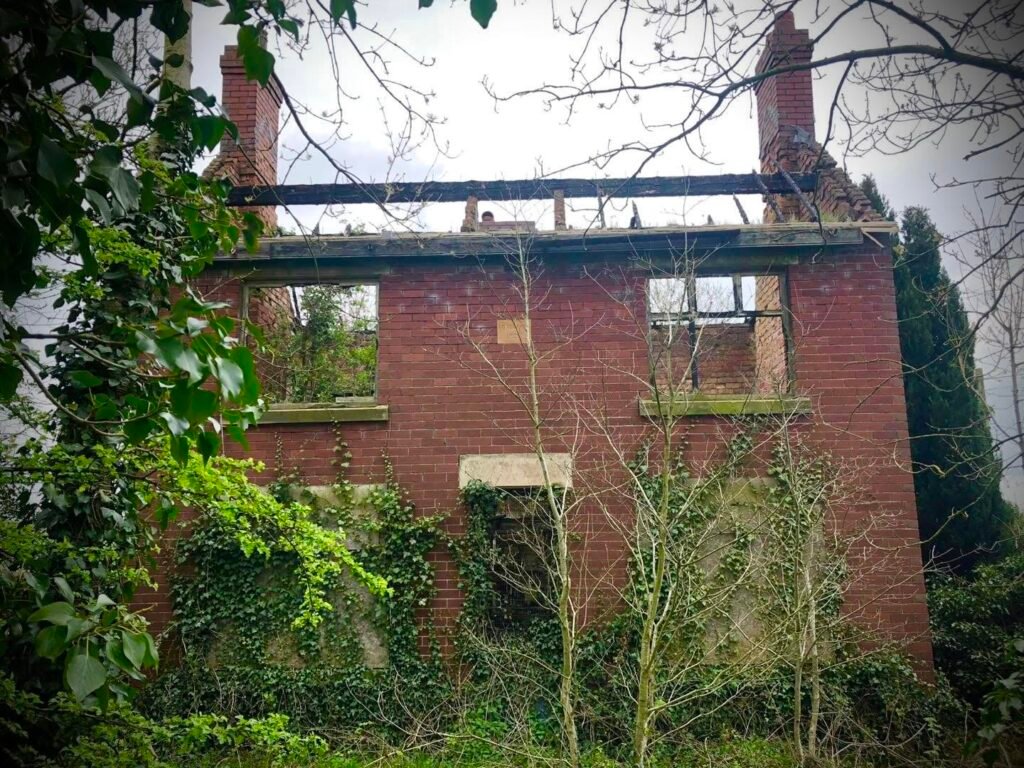
There is no roof. That is the first thing to understand about the Engineer’s House, and the photographs do not let you forget it. The house is a red-brick shell open to the sky, its two chimney stacks standing tall above walls that end in broken brickwork, its roof beams exposed like ribs. Ivy grows over the brickwork, bare branches cross the empty window openings, and the sky is visible from rooms that once had ceilings. It is less a house now than a ruin with a name.
The post that documents it says the house used to be lived in by a man who was an engineer. It says the house seems to have been burnt down — “seems” is the post’s own word, and it is kept here, because the post does not claim certainty. Walking through what remains, the explorer says, you can just about make out the old kitchen, the living room, and, looking up, what is left of the upstairs rooms, as well as the chimney still standing tall. There are loads of mechanic and engineering books lying around, he writes, as well as some tools and accessories. And Mother Nature, he adds, has started to reclaim the place and overtake it with overgrowth.
Everything in this article comes from that post and from the five photographs shown here. No address is given, no surname, and no date is given for the fire or for when the house was last lived in. The post itself is dated 7 May 2026.
What a burnt house leaves behind
Fire is the great eraser of abandoned houses. It takes the roof, the floors, the ceilings, the soft things — the curtains, the carpets, the clothes — and it leaves the hard things: brick, iron, tile, and whatever was too heavy or too wet to burn. The Engineer’s House shows that pattern clearly. The photographs are full of brick and iron and very little else.
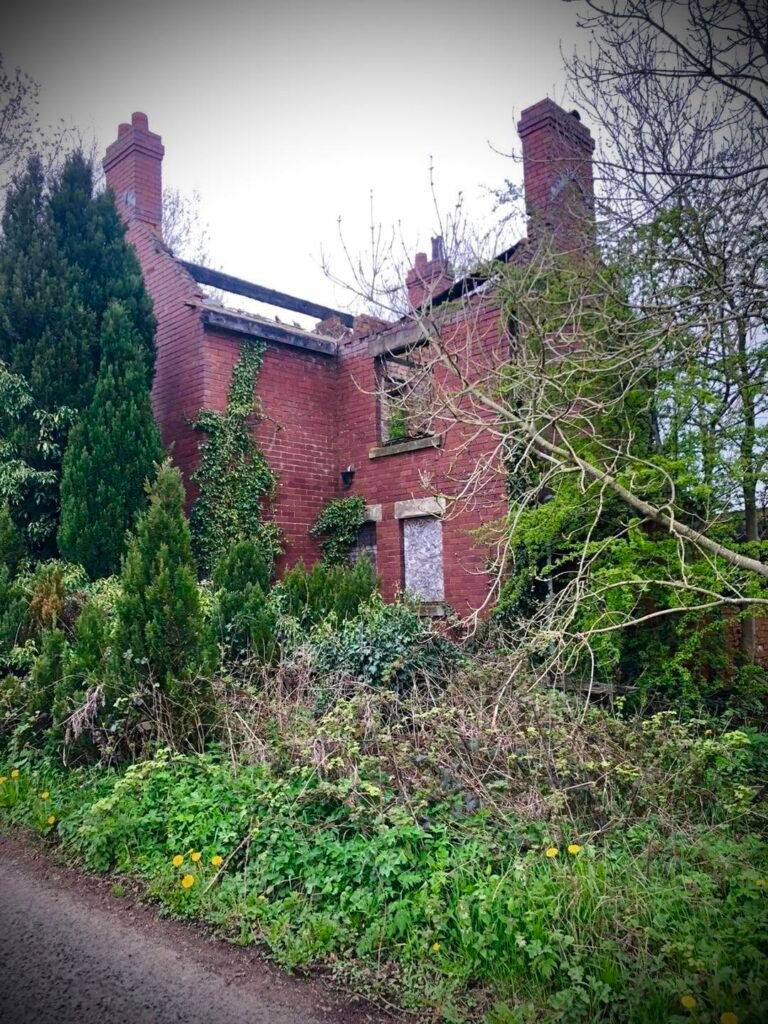
The second photograph, taken from the side, shows the scale of the loss. The house stands among trees, its red-brick walls covered in ivy, one window boarded up, the two chimneys rising above the broken wall tops. From this angle you can see that the roof is simply gone — not collapsed inward, not sagging, but gone, leaving the walls as a freestanding shell. A house without a roof is a house that is finished as a house. Everything after that is weather.
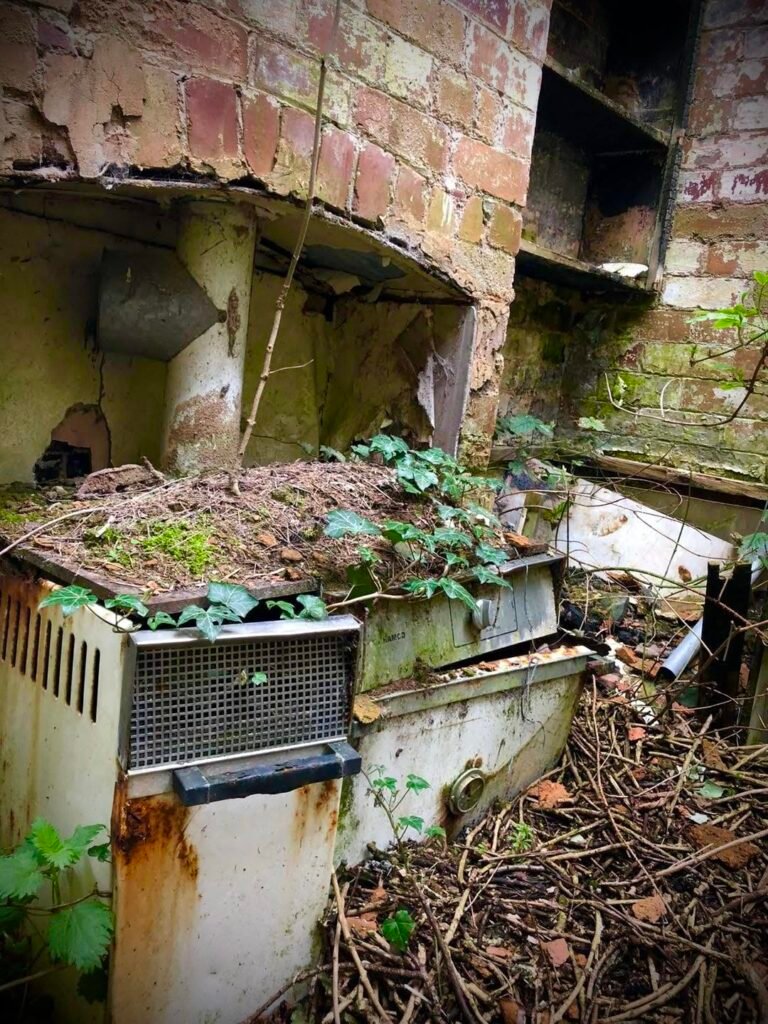
The third photograph is inside, in what the post identifies as the area of the old kitchen. A rusted old cooker stands in front of a crumbling brick fireplace alcove, its surface covered in ivy. A white pipe runs down the wall beside it. The floor is debris and plants growing through it. The cooker is the kind of object that tells you who lived here without a name being given: it is heavy, practical, built to last, and it outlasted the house around it. The ivy growing over it is doing what ivy does — finding the damp, finding the light, and taking over.
The books that survived the fire
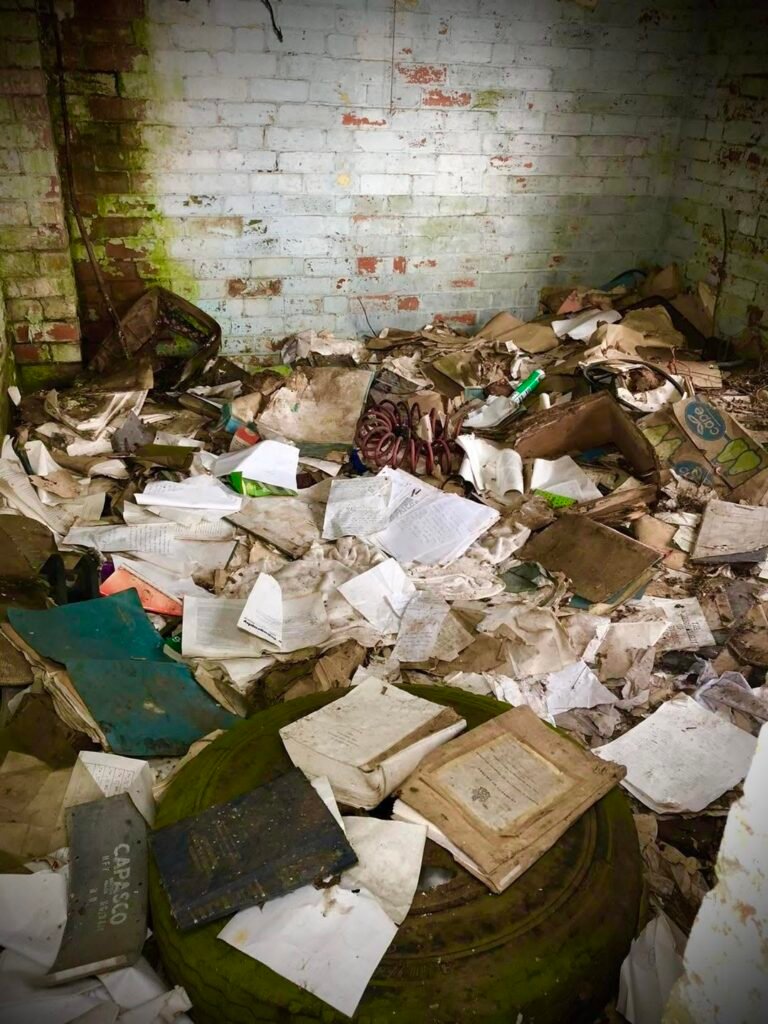
The fourth photograph is the most telling one in the set. Against a damp white-painted brick wall lies a heap of rotting books and papers, their pages swollen and stuck together, their covers peeling. Beside them are a rusted metal coil, a green bottle, and a wooden box. These are the mechanic and engineering books the post mentions — the books of a man who worked with machines. They did not burn. They rotted instead, slowly, in the damp, in a house with no roof.
There is something particular about books in a burnt house. In most abandoned houses, books survive as objects — annuals on a table, novels on a shelf — and they tell you what the people read. Here the books tell you what the man did. They are not decoration. They are the working library of an engineer, and they are rotting in a heap on a damp floor because there is no roof above them and no one to move them. The post does not name any of the books, and neither does this article. The heap is the fact. The titles are gone.
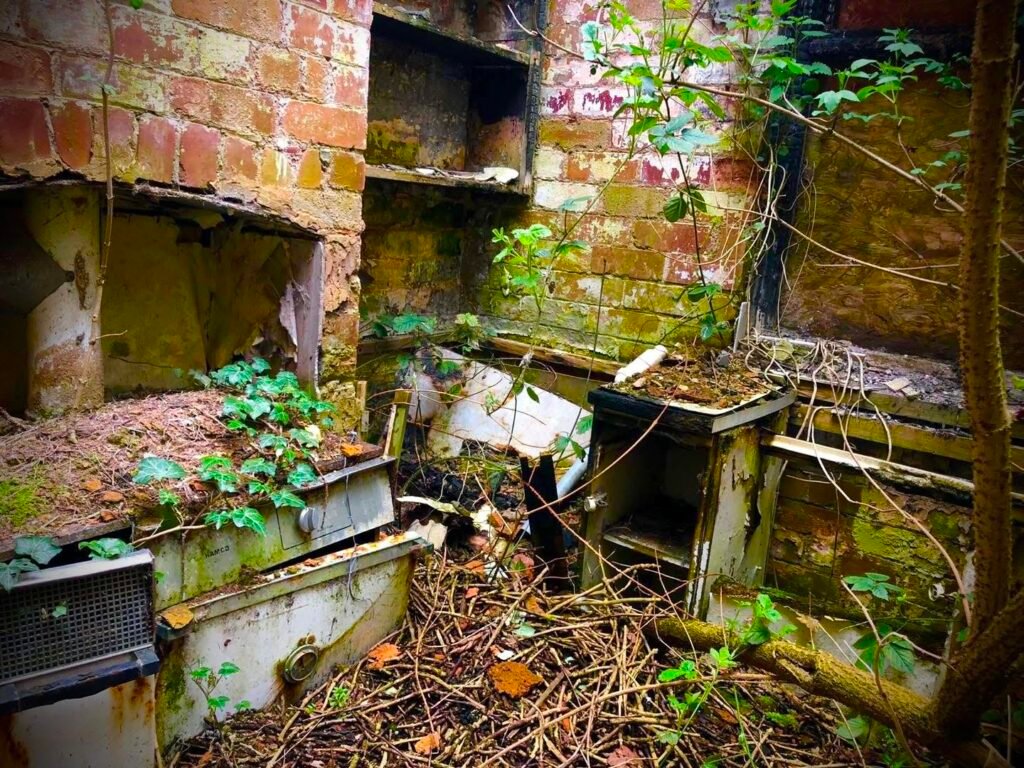
The fifth photograph shows the other end of the same room: a crumbling brick fireplace wall with an empty alcove, ivy and brambles growing through the rubble, a rusted metal cabinet, and a white appliance — the brand name HAMCO is visible on it — half-buried in debris. The fireplace is the skeleton of the house’s heating, and it is the only part of the room that still has its shape. Everything else is rubble, rust and growth.
A checklist for reading a ruin
A burnt, roofless house is harder to read than a furnished one, because most of the evidence is gone. But the photographs still give a reader something to work with. This is what can be said, and what cannot:
- The roof is gone and the walls stand as a shell — visible in the first two photographs.
- The chimneys still stand tall — the post says so, and the photographs confirm it.
- The kitchen area can still be made out, with a cooker and a fireplace alcove — the post says so, and the third photograph shows it.
- Engineering and mechanic books and tools were left behind — the post says so, and the fourth photograph shows the rotting heap.
- The fire is described as seeming to have happened, not proven — the post hedges, and this article keeps the hedge.
- No date is given for the fire, no name is given for the engineer, and no reason is given for why the house was never rebuilt.
That last point is the one that lingers. A house that burns down is usually either rebuilt or cleared away. This one was neither. It was left as a shell, and the shell was left to the weather, and the weather brought the ivy. The post calls it a shame to see the building looking so worn out and in disrepair. That is a mild way of putting it. The photographs are less mild: they show a house that has been open to the sky for long enough for trees to grow around it and plants to grow through its floors.
For a house that is lived in and on the market, see a lived-in 1902 home in Alexandria, Minnesota, where the questions are about upkeep and price rather than about a roof that no longer exists. More houses in this condition are gathered in abandoned houses and in abandoned mansions, and the site’s front page is abandoned.blog.
FAQ
Where is the Engineer’s House?
No location is given in the post, and none is given here.
Who lived there?
The post says the house used to be lived in by a man who was an engineer. No name is given.
Did the house burn down?
The post says the house seems to have been burnt down. That is the post’s wording, and the cause and date of any fire are not published.
What is still there?
According to the post and the photographs: the brick shell, two chimney stacks, a rusted cooker, a fireplace alcove, rotting engineering books, tools, a rusted cabinet and a white appliance, all among rubble and overgrowth.
When was the house explored?
The post itself is dated 7 May 2026. No separate explore date is given.
Will it be rebuilt?
The post does not say, and nothing is published about the house’s future.
Can I visit it?
No visiting information is given here, and entering private property without permission is not encouraged. A roofless, burnt structure is also dangerous.
Disclaimer
This article is general information only, not legal, tax, or financial advice. Rules on abandoned and private property differ by state and county; check county/local records and a local professional before acting. The account of the house, the fire and the engineer is as reported in the source post and has not been independently verified.
Photos
Photos by Luke2Explore, via the original Facebook post: https://www.facebook.com/Luke2Explore/posts/the-abandoned-engineers-housethis-old-former-home-that-is-now-a-crumbled-down-ho/1436220841876933/ — 5 of the 18 photos are shown here.