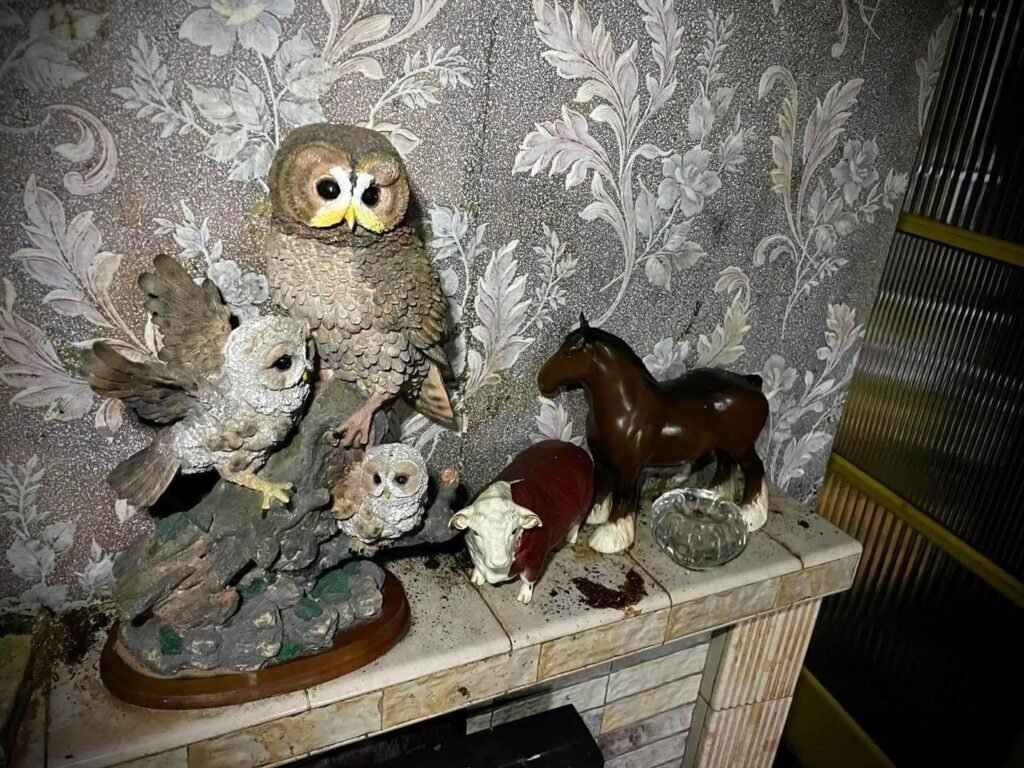
The owls gave the house its name. They are not real owls. They are figurines — three of them on a branch, a large tawny owl, a flying owl and an owlet — standing on a mantelpiece in a damp bungalow, with a model horse and a model cow for company. Somebody collected owls, and somebody arranged them carefully on the mantel, and then the house was left, and the owls stayed where they were put. The post that documents the house calls it the Owl House, and it says the little home now lies derelict, with a time capsule left inside as if time stood still.
The post says the house is believed to have belonged to a gentleman called Rob. “Believed” is the post’s own word, and it is kept here. No surname is given, no dates are given for Rob’s life, and no reason is given for why he left or what happened to him. Everything in this article comes from that post and from the five photographs shown here. The post itself is dated 28 October 2025.
A bungalow under an oak tree
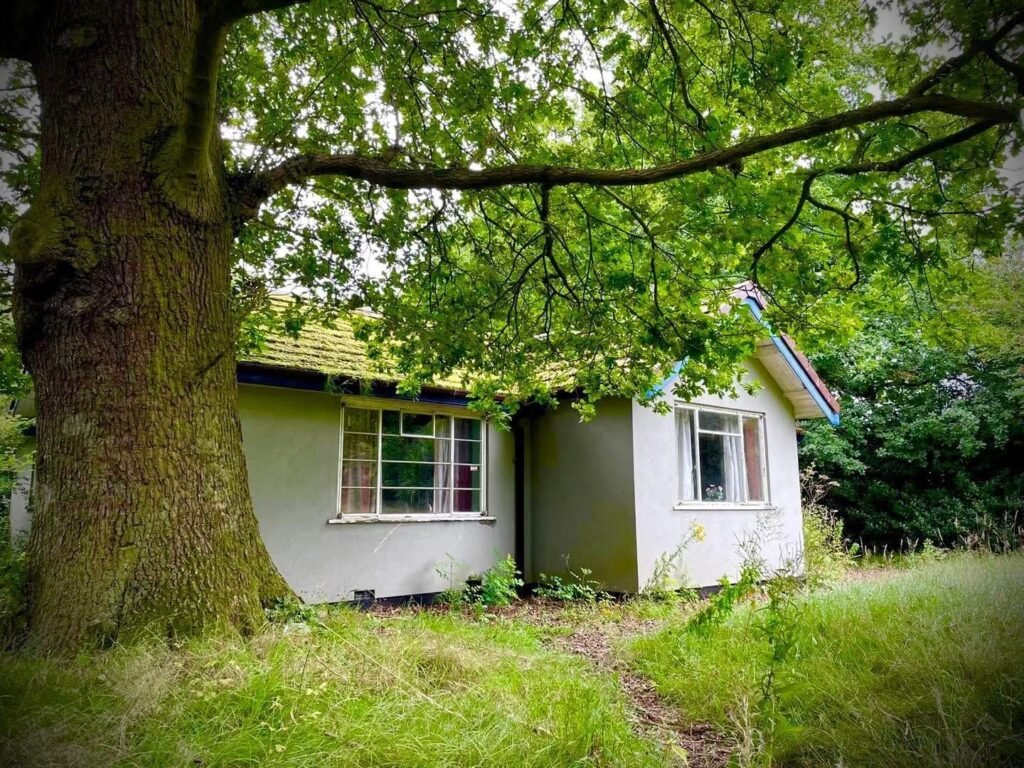
The featured photograph shows the house from the outside: a white single-storey bungalow with a mossy roof and big curtained windows, a huge oak tree at its left, and overgrown grass in front. It is a small house, and it looks like thousands of other small houses — except that the grass has not been cut, the roof has gone green with moss, and the curtains have not been drawn in a long time. The oak tree is the largest thing in the photograph, and it has been there far longer than the bungalow.
The post describes what the photographs confirm: the house was very mouldy inside, the floors were wet, very damp and decayed. That is the first thing a reader needs to know about the Owl House, because damp is the force that is destroying it. A bungalow with a sound roof can stand empty for years and stay mostly intact. A bungalow that lets water in rots from the inside, and the photographs show a house well into that process.
The living room, still furnished
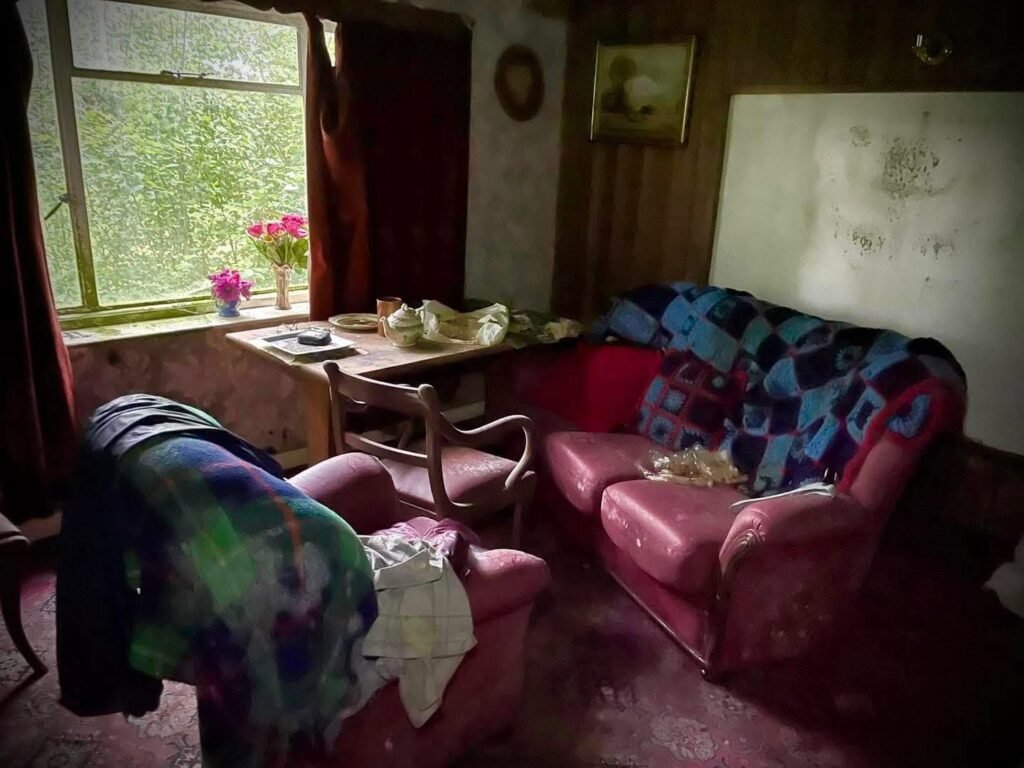
The second photograph is the living room, and it is the most lived-in-looking room in the set. A pink leather two-seater sofa sits under a blue-and-red patchwork blanket, with a pink armchair beside it, a tartan blanket folded over its arm. A wooden table holds a teapot and plates. On the windowsill are vases with pink flowers, and through the window you can see green trees. The room is damp — the post says so, and the photographs show the dull, wet look of a room that has not been heated or aired — but it is still furnished, still arranged, still recognisably a room where someone sat and ate and drank tea.
There is a small detail in this photograph that is easy to miss and hard to forget: the flowers in the vases on the windowsill are still there. They are not fresh. They are the remains of flowers, in vases, on a sill, in a house where nobody lives. Somebody put them there, and nobody took them away.
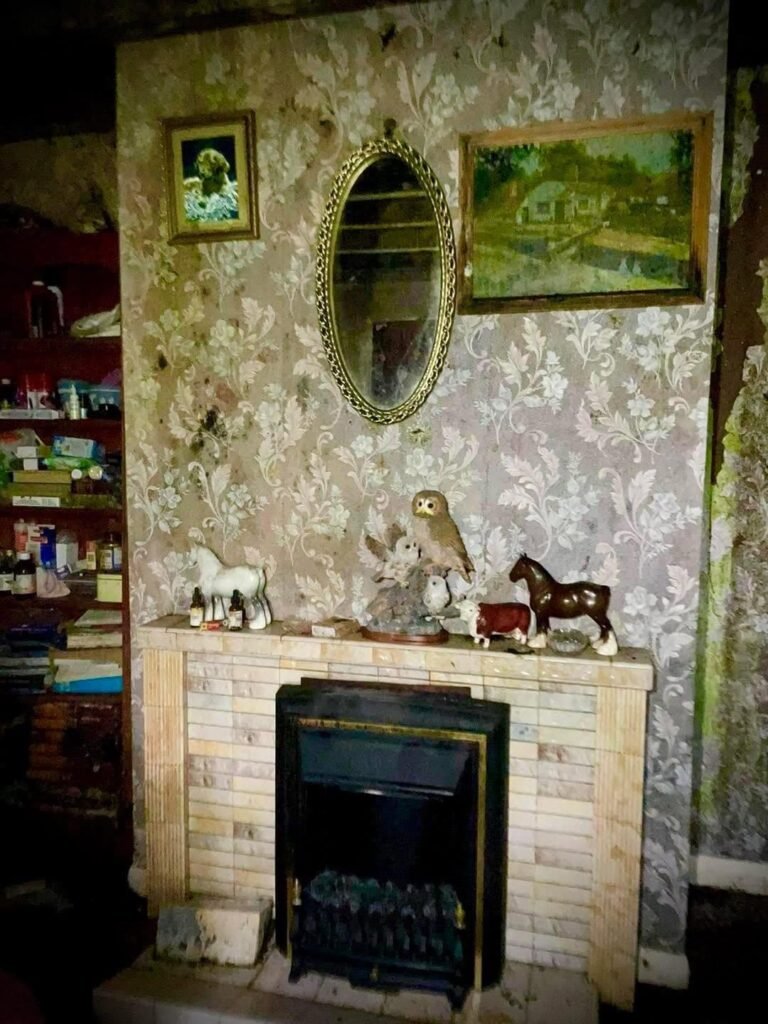
The fourth photograph — the fireplace in the same room — shows why the house got its name. The fireplace has a tiled surround, and on its mantel stand the owl figurines again, along with a white horse, a brown horse and a cow. Above the mantel hangs an oval gilt mirror, and beside it framed pictures, one of them a photograph of a dog. The wallpaper is floral, grey and faded. This is a mantelpiece that was arranged, not dumped: the animals are in a row, the mirror is centred, the pictures are hung. It is the most deliberate composition in the house, and it is also the most personal. Whoever lived here liked animals — owls, horses, a cow, a dog — and kept models of them where he could see them.
The green range and the cans from 2021
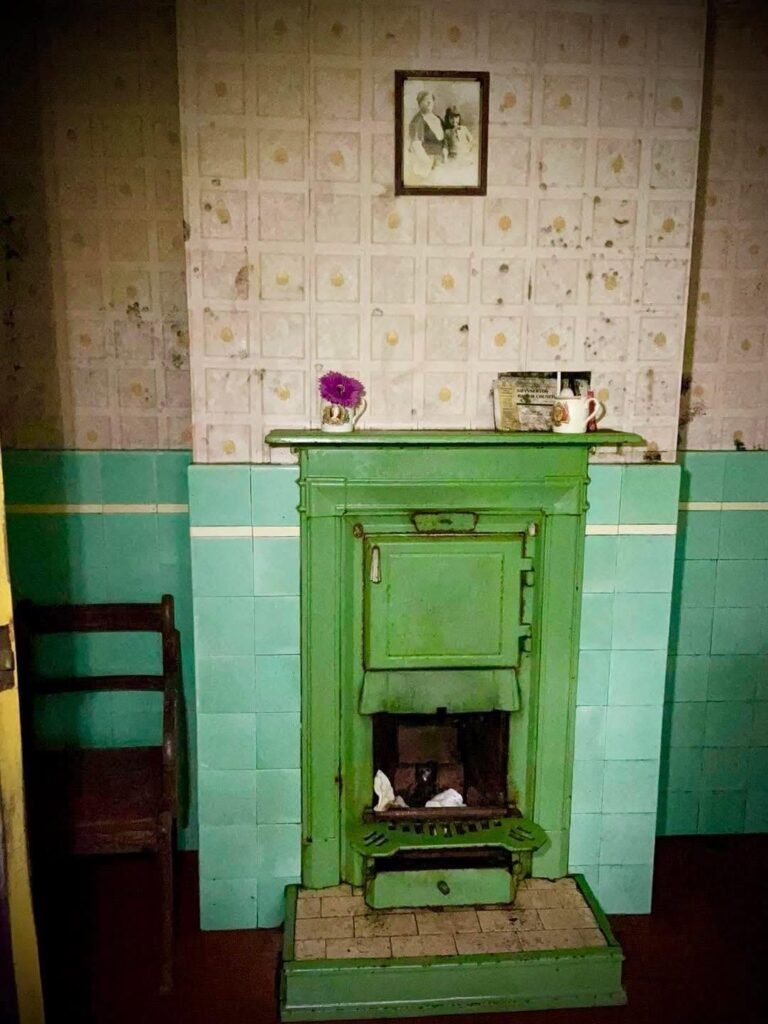
The fifth photograph shows the second fireplace, or rather the range: a green cast-iron fireplace with an oven door above the firebox, set into mint-green tiles. Above it, on patterned wallpaper, hangs a framed old photograph. On the mantel sit a vase with a purple flower and a mug. A wooden chair stands at the left. It is a small, old-fashioned kitchen range, the kind that heated a room and cooked the food, and it is still there, in its tiles, in a house that is rotting around it.
The post gives one more piece of evidence, and it is the only date in the whole story. The explorer and his party found food cans in the house that dated back to 2021 and 2022. That does not prove when the house was last lived in — a can with a 2021 date could have been bought earlier or later, and a house can hold old cans for years after its owner leaves. But it does give a rough floor to the timeline: somebody was buying food in cans in 2021 and 2022, and the cans were still in the house when it was explored. The post does not say what the cans contained, or where they were found, and neither does this article. The dates are the fact. Everything else about them is guesswork, and it is left as guesswork.
That is also why the post’s phrase “time capsule” fits this house better than most. A time capsule is usually something somebody seals on purpose. Here the seal is damp and mould and a door that was never opened again. The sofa is still under its blanket. The teapot is still on the table. The owls are still on the mantel. Nothing was packed away. Everything was simply left, and the house closed around it.
| What the post says | What the five photos show | What is not known |
|---|---|---|
| The house belonged to a gentleman called Rob | No people in any photograph; owl figurines, model animals, a dog photo | Rob’s surname, when he lived here, or what happened to him |
| The house was very mouldy, floors wet and decayed | Damp living room, dull wet surfaces, mossy roof | When the damp started, or how bad it is now |
| Food cans dated 2021 and 2022 were found | No cans visible in the five photographs | When the house was last lived in |
| A time capsule left as if time stood still | Furnished rooms, teapot, blankets, owls on the mantel | Whether anything has changed since October 2025 |
For a house that is lived in and on the market, see a lived-in 1902 home in Alexandria, Minnesota, where the questions are about upkeep and price rather than about a bungalow left to the damp. More houses in this condition are gathered in abandoned houses and in abandoned mansions, and the site’s front page is abandoned.blog.
FAQ
Where is the Owl House?
No location is given in the post, and none is given here.
Who was Rob?
The post says the house is believed to have belonged to a gentleman called Rob. No surname or further detail is given.
Why is it called the Owl House?
Because of the owl figurines on the mantelpiece, shown in the photographs.
How long has it been empty?
The post does not say. Food cans dated 2021 and 2022 were found inside, but that does not by itself prove when the house was last lived in.
What is still inside?
According to the photographs: a pink leather sofa and armchair, a table with a teapot, owl figurines and model animals on the mantels, a green cast-iron range, and a framed old photograph.
Is the house in bad condition?
The post says it was very mouldy, with wet, damp and decayed floors. The photographs show a damp interior and a mossy roof.
Can I visit it?
No visiting information is given here, and entering private property without permission is not encouraged.
Disclaimer
This article is general information only, not legal, tax, or financial advice. Rules on abandoned and private property differ by state and county; check county/local records and a local professional before acting. The account of the house and of Rob is as reported in the source post and has not been independently verified.
Photos
Photos by Luke2Explore, via the original Facebook post: https://www.facebook.com/Luke2Explore/posts/abandoned-owl-housethis-little-home-now-lays-derelict-with-a-time-capsule-left-s/1275411957957823/ — 5 of the 28 photos are shown here.