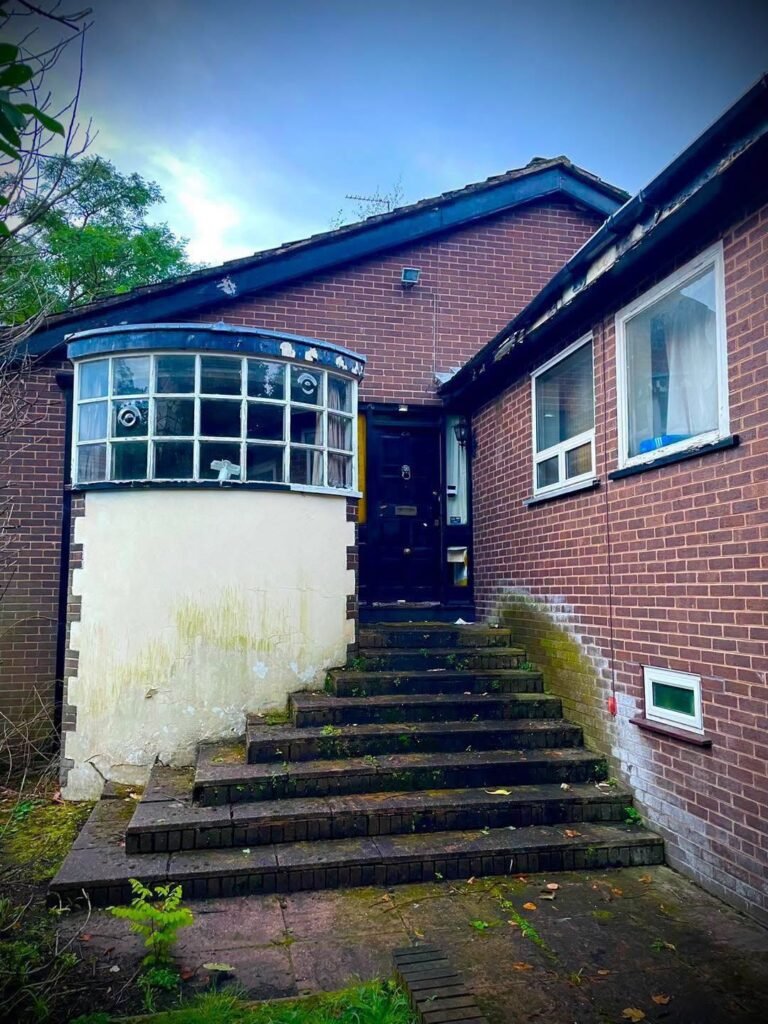
The house looks ordinary from the outside. A red-brick bungalow, a curved bay window, a black front door at the top of mossy steps. Nothing about it says what the explorer who photographed it says happened inside. He calls it the Fake Drugs House, and the name comes from the story the post tells: the woman who lived here, a carer, was arrested for making and selling fake medication from her home.
Everything in this article comes from that post and from the five photographs shown here. The post gives no name for the woman, no address, and no location beyond the house itself. The court details below are the post’s account of what happened, not independently verified facts.
What the post says happened
The post says the home is believed to have been abandoned for nearly seven years. It says the owner, a woman who worked as a carer, lost her job and began making fake medication at home, selling it to people suffering from ill health. She was caught, the post says, when her daughter’s boyfriend walked in on her making the fake medication one day at the house.
Police then searched the home and found £21,000 worth of fake drugs in her bedroom. When they found the pills, the post says, she told them she was only trying to earn extra money because she had lost her job and was struggling to pay her bills. She pleaded guilty to 12 counts of selling fake medication, and her partner was warned that he would also receive a prison sentence for his part.
The judge, as the post reports it, told her that her actions had seriously put innocent people at risk, because the fake pills were so dangerous they could have caused serious harm. She tried to tell the judge she had never given any of the fake medication to anyone, but the judge said she had been making it for over a year and had sold it to people suffering from ill health. The post says the medication had actually been given to 20 people in total.
In the end, according to the post, she was given a 16-month prison sentence, suspended for two years, and ordered to pay £21,000 in compensation to the people who had been given the fake medication. She was also given a two-year community order and ordered to carry out 200 hours of unpaid work.
| Step in the post’s account | What the post says |
|---|---|
| Losing the job | The owner, a carer, lost her job and struggled to pay her bills |
| Making the pills | She made fake medication at home for over a year |
| Being caught | Her daughter’s boyfriend walked in on her making it |
| The search | Police found £21,000 of fake drugs in her bedroom |
| The plea | She pleaded guilty to 12 counts of selling fake medication |
| The sentence | 16 months, suspended for two years, plus £21,000 compensation, a two-year community order and 200 hours of unpaid work |
None of this is verified against court records here. The post is the only source, and the article repeats it as the post’s account. No name is given in the post, and none is given here.
The robot in the window
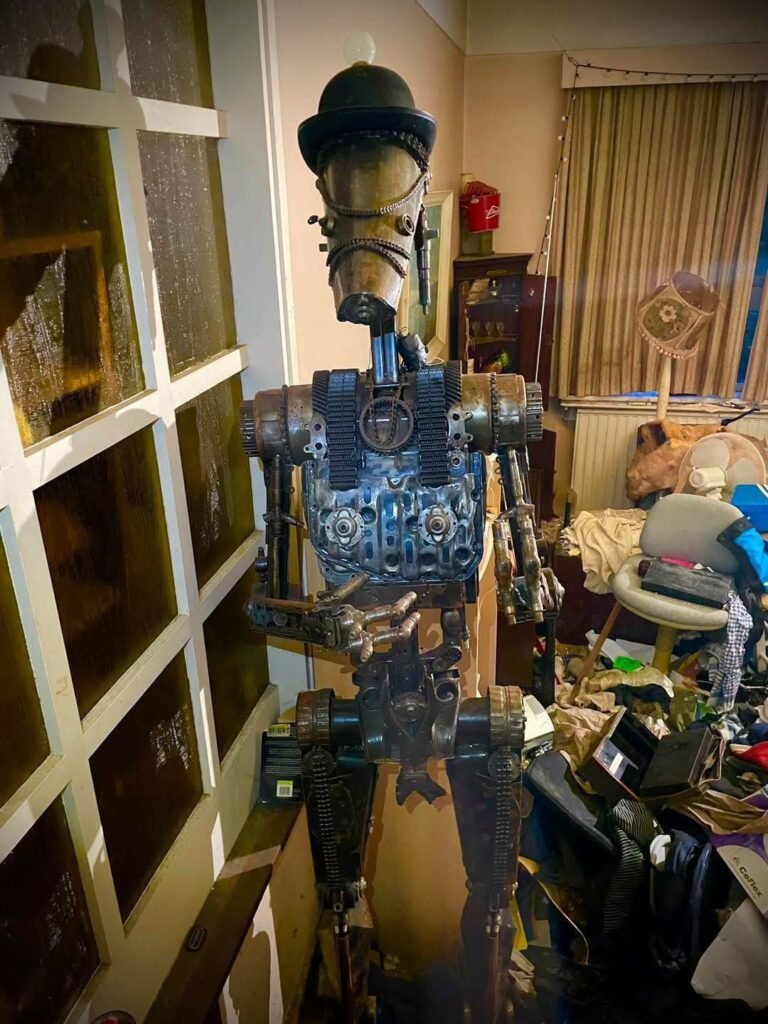
The strangest of the five photographs is the second one. Standing by a window with lace curtains is a tall homemade metal robot, built from scrap — gears, chains, engine parts — wearing a bowler hat, with a light bulb on top. It looks part Dalek, part garden ornament, and it is the last thing you would expect to find in a house with this story.
The room around it is cluttered: a chair piled with clothes, a fan, a lamp with a floral shade, boxes and bags on the floor. The robot is the one thing in the room that looks deliberately made, not left. Somebody built it, or had it built, and put it where the light from the window would fall on it.
It is a reminder that the house was a home before it was a story. Whatever happened here, someone lived in these rooms, chose these objects, and kept a metal figure with a bowler hat by the window.
Cats, toys and a galaxy far away
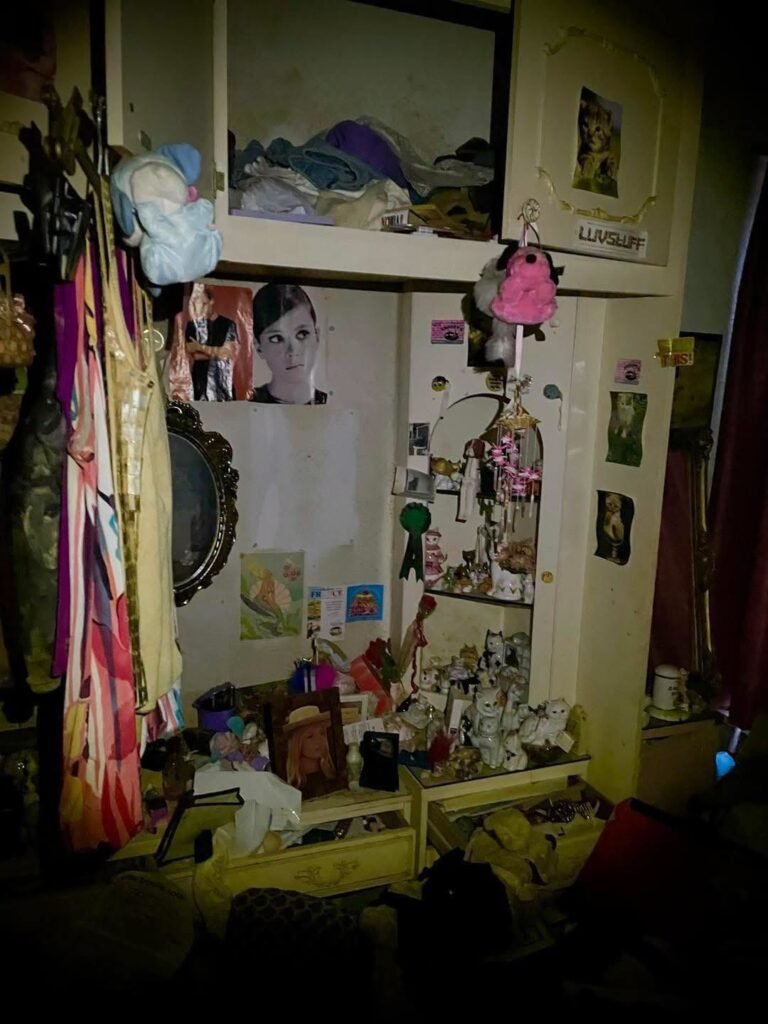
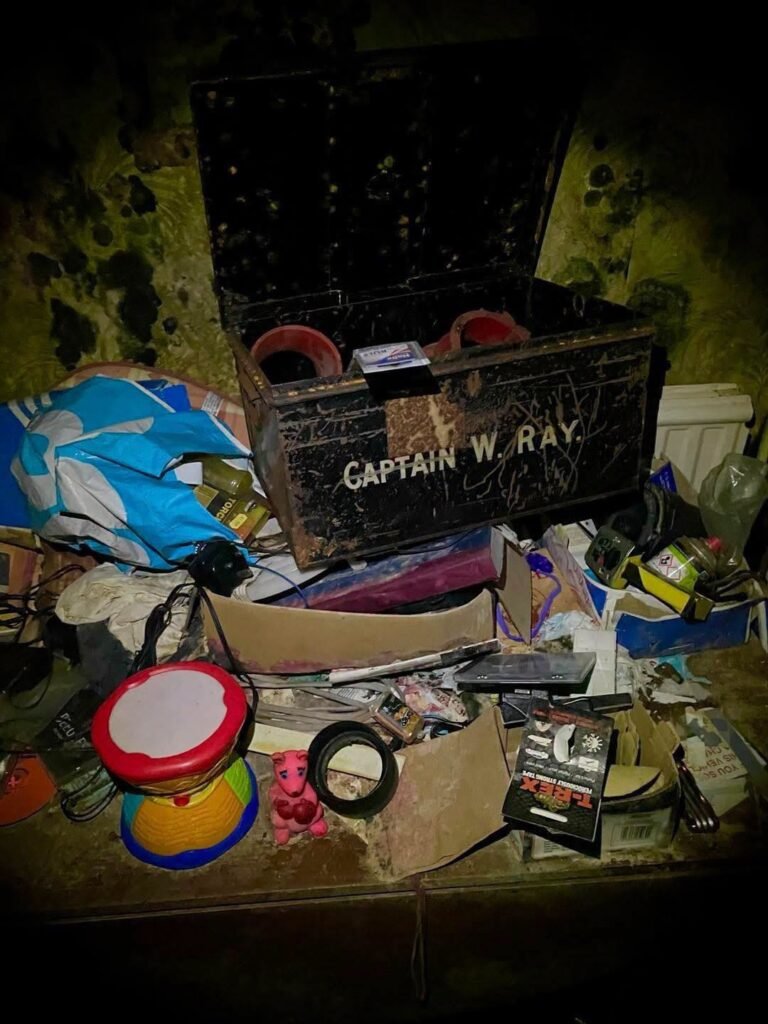
The other photographs fill in that home. One shows a bedroom or dressing area with an open wardrobe, cat pictures and posters on the wall, cat ornaments lined up on a dressing table, and a pink plush toy. Another shows a dark, cluttered corner with an open black metal trunk stencilled “CAPTAIN W. RAY.”, surrounded by toys — a colourful toy drum, a pink toy, T-REX packaging, a blue bag — against mouldy green wallpaper.
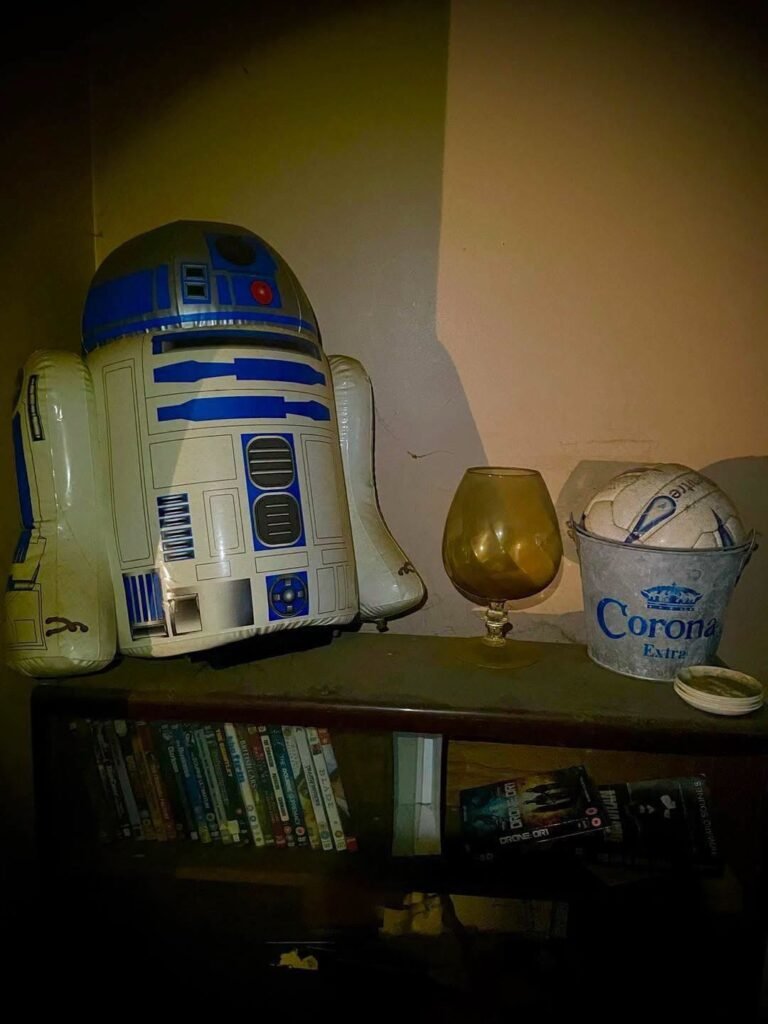
The fifth photograph has a large inflatable R2-D2 from Star Wars sitting on a wooden shelf, next to a large amber brandy glass and a Corona Extra ice bucket with a football, with DVDs and books below. It is an odd shelf, and it is also an ordinary one: the kind of shelf that collects the things a household actually likes.
None of the five photographs shows the pills, the police search, or anything to do with the medication. What they show is the house as it was left — cats on the walls, toys in a corner, a robot by the window, a film character on a shelf. The post says the home has been abandoned for nearly seven years, and the photographs look the part: damp, mould, clutter that has not moved in a long time.
What we do not know
The post does not say where the house is, when exactly the arrest happened, or what has happened to the house since. It does not say whether the woman or her partner ever returned, or whether the house has been sold, boarded up, or simply left. The photographs show a house that is decaying but still full of things, and that is all the evidence there is.
For a contrast with a house that is lived in and on the market, see a lived-in 1902 home in Alexandria, Minnesota, where the questions are about upkeep and price rather than about what a closed house leaves behind. More houses in this condition are gathered in abandoned houses and in abandoned mansions, and the site’s front page is abandoned.blog.
FAQ
Where is the Fake Drugs House?
No location is given in the post, and none is given here.
Who lived there?
The post says the owner was a woman who worked as a carer. No name is given in the post, and none is given here.
What was she accused of?
According to the post, making and selling fake medication from her home, and pleading guilty to 12 counts of selling fake medication.
How much fake medication was found?
The post says police found £21,000 worth of fake drugs in her bedroom.
What sentence did she receive?
According to the post, a 16-month prison sentence suspended for two years, £21,000 in compensation, a two-year community order and 200 hours of unpaid work.
How long has the house been empty?
The post says it is believed to have been abandoned for nearly seven years. That is the post’s estimate, not a verified date.
Can I visit it?
No visiting information is given here, and entering private property without permission is not encouraged.
Disclaimer
This article is general information only, not legal, tax, or financial advice. Rules on abandoned and private property differ by state and county; check county/local records and a local professional before acting. The account of the arrest and sentence is as reported in the source post and has not been independently verified.
Photos
Photos by Luke2Explore, via the original Facebook post: https://www.facebook.com/Luke2Explore/posts/abandoned-fake-drugs-housethis-abandoned-home-is-known-as-the-fake-drug-house-th/1499473848884965/ — 5 of the 27 photos are shown here.