An Old Abandoned Home: The Couple’s House, Mould and All
The post is short, and it does not try to be more than it is. “Another abandoned place from the weekend,” the explorer writes. “An old abandoned home, with its different but strange design of how the home was built. A time capsule left behind with so many things left behind. This house has a story to tell, with a elderly couple who once lived here. Shame to see the house trashed and taken over by mould, damp and Mother Nature taking over.”
That is the whole of the story as published on 25 January 2022. No names. No place. No dates for when the couple lived there or when they left. Just a house, a strange design, a time capsule, and the mould. Everything in this article comes from that post and from the five photographs shown here.
A house built differently
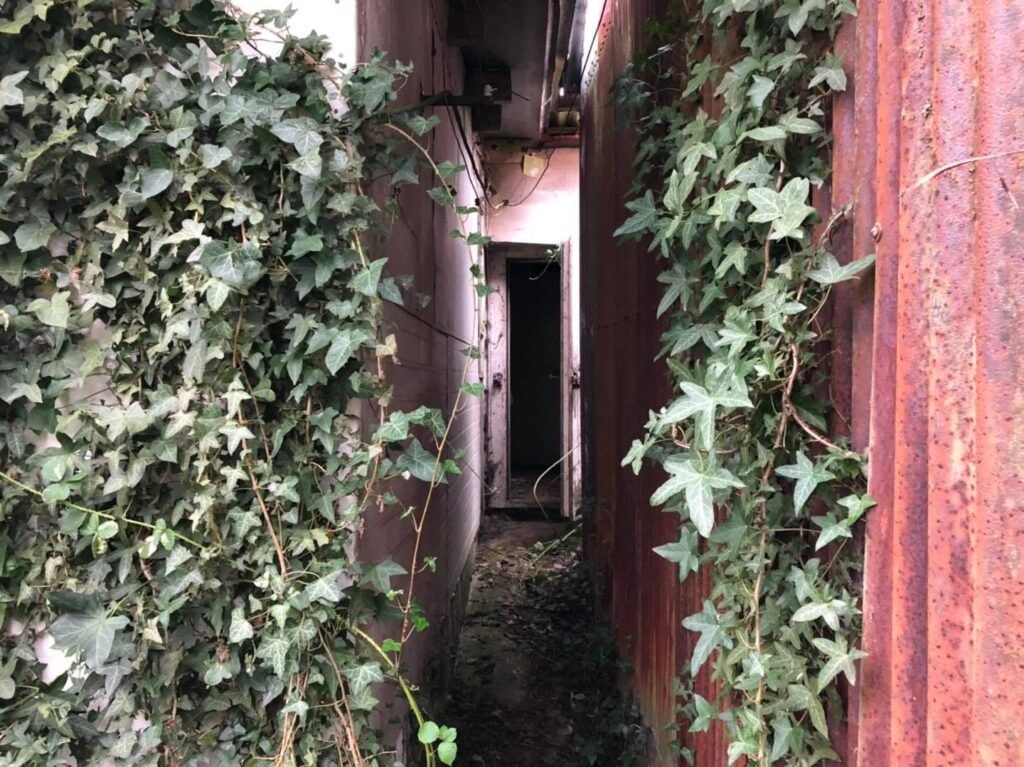
The first thing the post tells you is that the house is strange — not haunted, not grand, just built differently. The first photograph shows what that might mean. It is a narrow side passage, choked with ivy, between the house’s red wooden wall on one side and a rusty corrugated fence on the other, leading to a dark doorway at the far end. It is the only exterior shot among the five photographs, and it is not a picture of a house so much as a picture of a gap — a tight, green, dripping corridor that you would have to squeeze through to get inside.
Houses like this were often added to over decades: a room here, a lean-to there, a passage that was never meant to be a passage. The post does not explain the design, and the photographs cannot explain it either. What they show is a building that grew in pieces, and then was left to the ivy.
The ivy is doing what ivy does. It covers the wall, it covers the fence, it reaches for the doorway. The post says Mother Nature is taking over, and the first photograph is the proof: the house is still there, but the green is winning.
The bedroom the mannequins kept
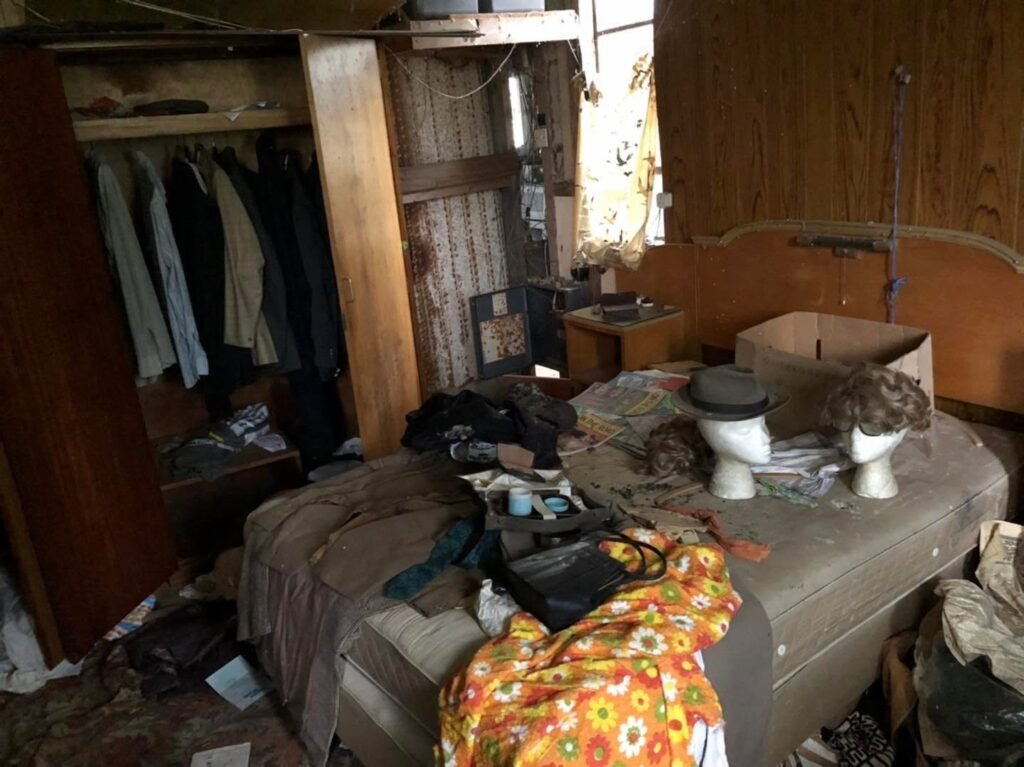
The second photograph is the strangest of the five. A trashed bedroom, a filthy bed, an open wardrobe with clothes still hanging in it — and on the bed, two mannequin heads. One wears a hat. The other wears a curly wig and glasses. A floral blanket is thrown across the mattress, and a handbag sits beside it.
Mannequin heads in a bedroom are the kind of detail that invites a story, and it is important not to invent one. The post does not say why they were there. They could have belonged to a wig shop, a hairdresser, a seamstress, or simply to someone who collected odd things. The wardrobe is full of ordinary clothes — shirts, jackets, everyday wear — which suggests an ordinary couple, not a shop. But that is an inference, and it is labelled as one: the post says an elderly couple lived here, and the clothes and the bedroom fit that. The mannequin heads do not fit anything, and they are left unexplained, as they were found.
What the photograph does prove is the trashing. The bed is filthy, papers and clothes are scattered, and the room has the damp, stale look of a place that has been open to the weather and to visitors who did not live there.
Green armchairs and a stack of dead screens
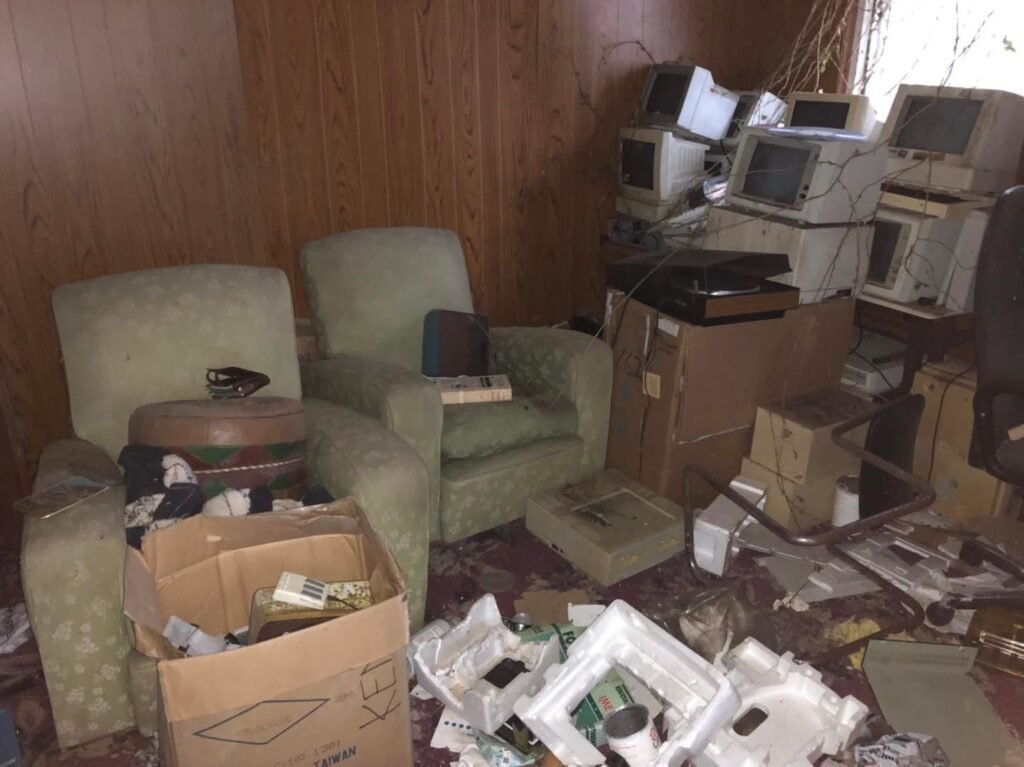
The third photograph shows another trashed room: two green armchairs, and beside them a stack of old CRT monitors. The monitors are the kind that sat on desks in the 1990s and early 2000s — heavy, deep, grey-beige boxes, now useless. There are several of them, stacked like bricks.
A stack of dead monitors is a small mystery of its own. One monitor is a household object. Several, stacked in a living room, suggest somebody who kept old electronics, or who repaired them, or who simply never threw anything away. The post does not say, and the photographs do not say. They say only that the couple’s house held more than a couple’s ordinary things — it held accumulations, the way old houses do when nobody clears them out for years.
The green armchairs are the counterweight to the monitors. They are domestic, comfortable-looking even under the dust, the kind of chairs an elderly couple would sit in of an evening. The room is trashed, but it was once a sitting room, and the chairs still sit where chairs belong.
The smallest things last longest
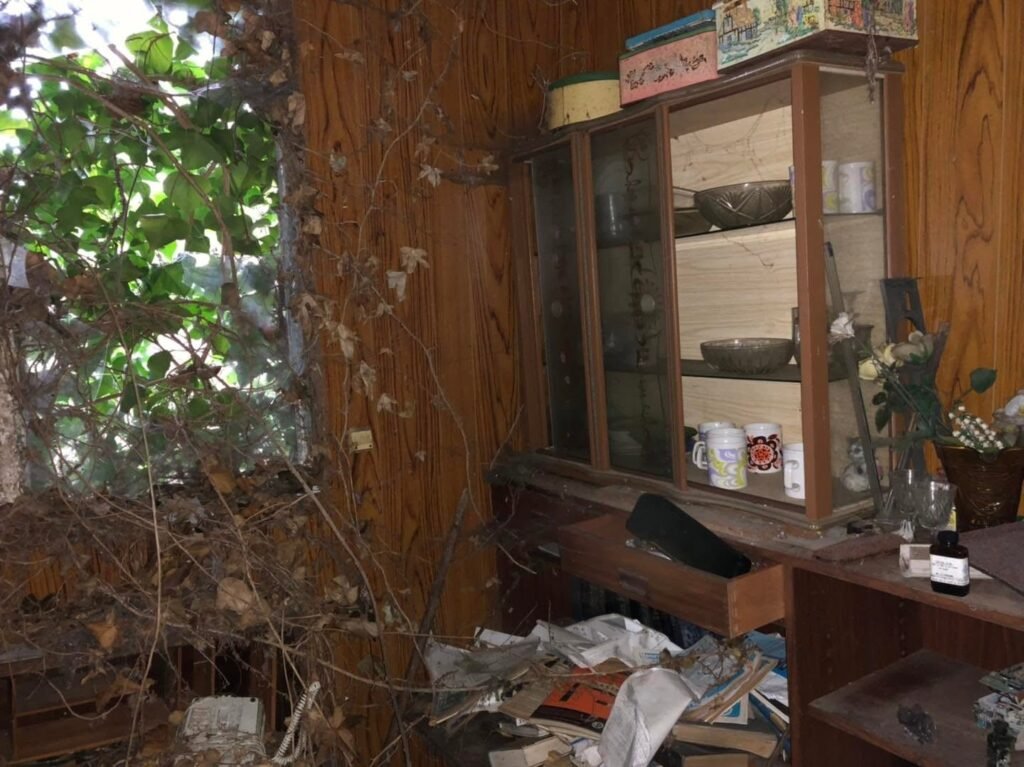
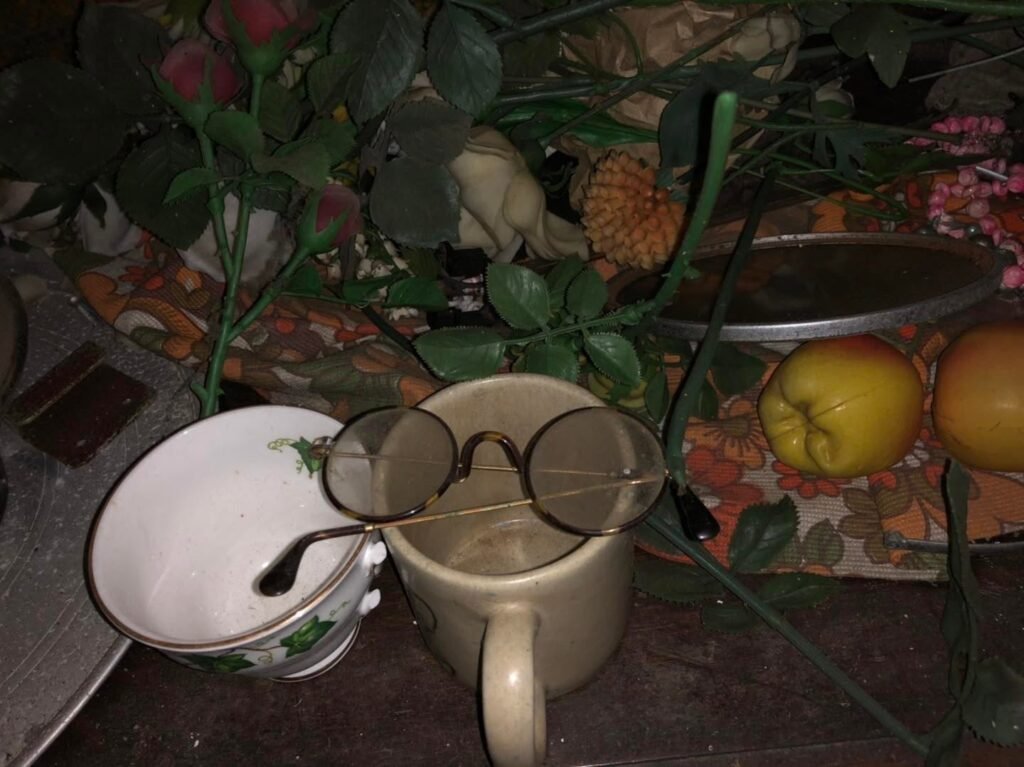
The last two photographs are the quietest, and in some ways the most telling. The fourth shows a wood-panelled room with ivy coming through a broken window, and a glass cabinet full of bowls and mugs — everyday crockery, kept behind glass, now dusty and forgotten. The fifth is a close-up still life: a pair of round spectacles resting on a mug, a floral teacup, artificial roses, a pinecone, and wax apples arranged together.
The spectacles are the detail that stops you. Glasses are personal in a way that furniture is not. They were made for one person’s eyes. Somebody wore them every day, put them down on a mug one evening, and never picked them up again. The post does not say whose they were — the husband’s, the wife’s, nobody knows — but they are the most human object in the five photographs, precisely because they are so small and so ordinary.
| Photo | What it shows | What it does not prove |
|---|---|---|
| The ivy passage | A strange, narrow side approach to a dark doorway | Why the house was built this way |
| The bedroom | Two mannequin heads on a filthy bed, clothes in the wardrobe | Why the mannequin heads were there |
| The armchairs | Two green armchairs and a stack of CRT monitors | Whose monitors they were, or why there were so many |
| The cabinet | Bowls and mugs behind glass, ivy through the window | When the window broke |
| The still life | Spectacles on a mug, a teacup, roses, a pinecone, wax apples | Whose spectacles they were |
What we do not know
The post does not name the couple, give the house’s location, or say when they lived there or when they left. It does not say how the house came to be trashed, or whether it has been cleared or demolished since January 2022. The mannequin heads, the monitors, and the spectacles are all unexplained, and they stay unexplained here.
For a contrast with a house that is lived in and on the market, see a lived-in 1902 home in Alexandria, Minnesota, where the questions are about upkeep and price rather than about what a closed house leaves behind. More houses in this condition are gathered in abandoned houses and in abandoned mansions, and the site’s front page is abandoned.blog.
FAQ
Where is this old abandoned home?
No location is given in the post, and none is given here.
Who lived there?
The post says an elderly couple once lived in the house. No names are given.
When was it explored?
The post is dated 25 January 2022, and describes the visit as “from the weekend”.
Why is it called a time capsule?
Because so many of the couple’s things were left behind in place — clothes, crockery, furniture, spectacles — as the post describes it.
What are the mannequin heads?
The post does not say. They were found on the bed in the trashed bedroom, and no explanation is given.
How long has the house been empty?
The post does not say. That is not published.
Can I visit it?
No visiting information is given here, and entering private property without permission is not encouraged.
Disclaimer
This article is general information only, not legal, tax, or financial advice. Rules on abandoned and private property differ by state and county; check county/local records and a local professional before acting. The account of the house and the couple is as reported in the source post and has not been independently verified.
Photos
Photos by Luke2Explore, via the original Facebook post: https://www.facebook.com/Luke2Explore/posts/another-abandoned-place-from-the-weekendan-old-abandoned-homewith-its-different-/301998805295431/ — 5 of the 20 photos are shown here.