The mould is the first thing the post warns you about. “Old farmhouse that’s sat empty for a good few years the mould setting in upstairs was not good,” Urbex Lost & Found wrote on 22 November 2026, and the photographs that follow make the warning plain. This is not a house that was emptied in a hurry and left clean. It is a house that has been sitting, season after season, while damp worked its way through the upstairs rooms and the garden grew up around the walls.
That is almost everything the post says. There is no name for the house, no location, no date for when it was last lived in, and no owner. The caption is short and the photographs do most of the talking. Five of the post’s 45 photographs are shown here, and this article stays inside what they actually show.
A Brick Farmhouse After Dark
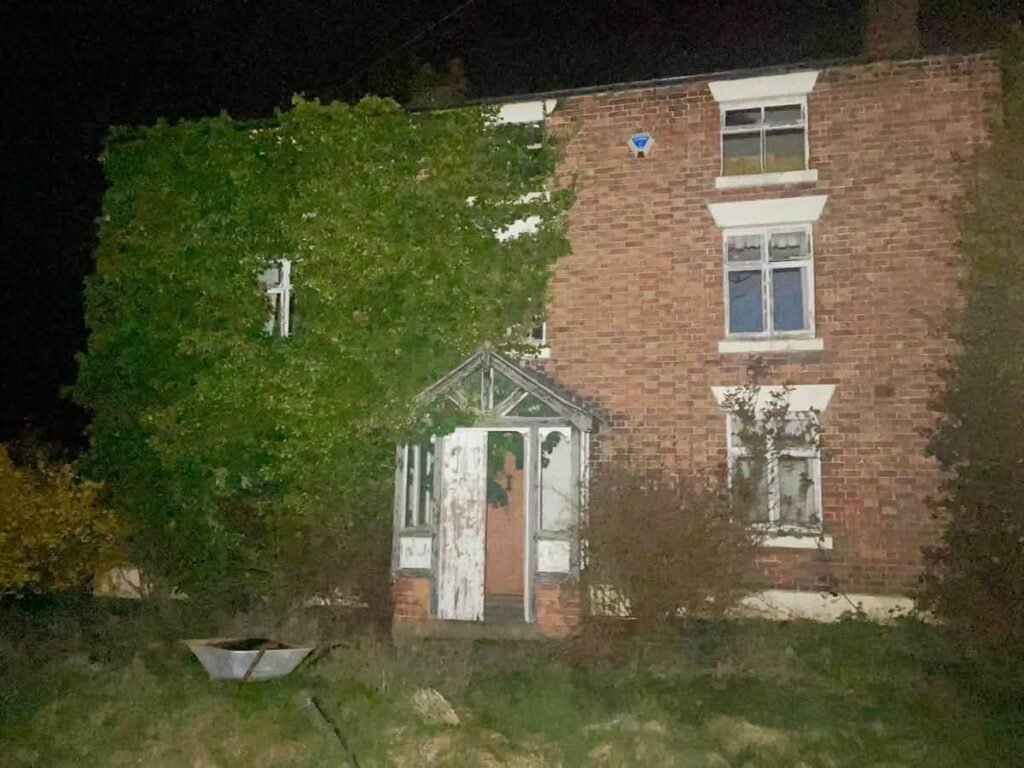
The only exterior photograph was taken at night, lit by a camera flash, and it sets the tone for the rest. The house is a two-storey red-brick farmhouse, its left-hand side and part of its upper floor swallowed by ivy so thick that only a sliver of a window shows through it. Three white-framed sash windows run down the right-hand side, their glass dark, the lowest one half-hidden by a bare shrub. A small alarm box sits on the brickwork between the top and middle windows — a reminder that someone, at some point, tried to protect this place.
The porch is the saddest part of the frame. Its white paint is peeling away in long strips, the glass panels are grimy, and the door behind it stands partly open to darkness. The grass in front has grown long and rough, and a metal wheelbarrow sits abandoned on it, its barrow tipped and empty. Nothing in the photograph suggests a recent visit. The house looks as though it has been left to the ivy and the dark for a long time.
The post does not say where the house stands, and this article will not try to place it. That matters, because the interesting question the photographs raise — how long “a good few years” really is — has no answer in the post. The house is presented as it was found, not as a listing, and there is no agent, no asking price, and no address to check against any record.
Two Fireplaces, Two Eras
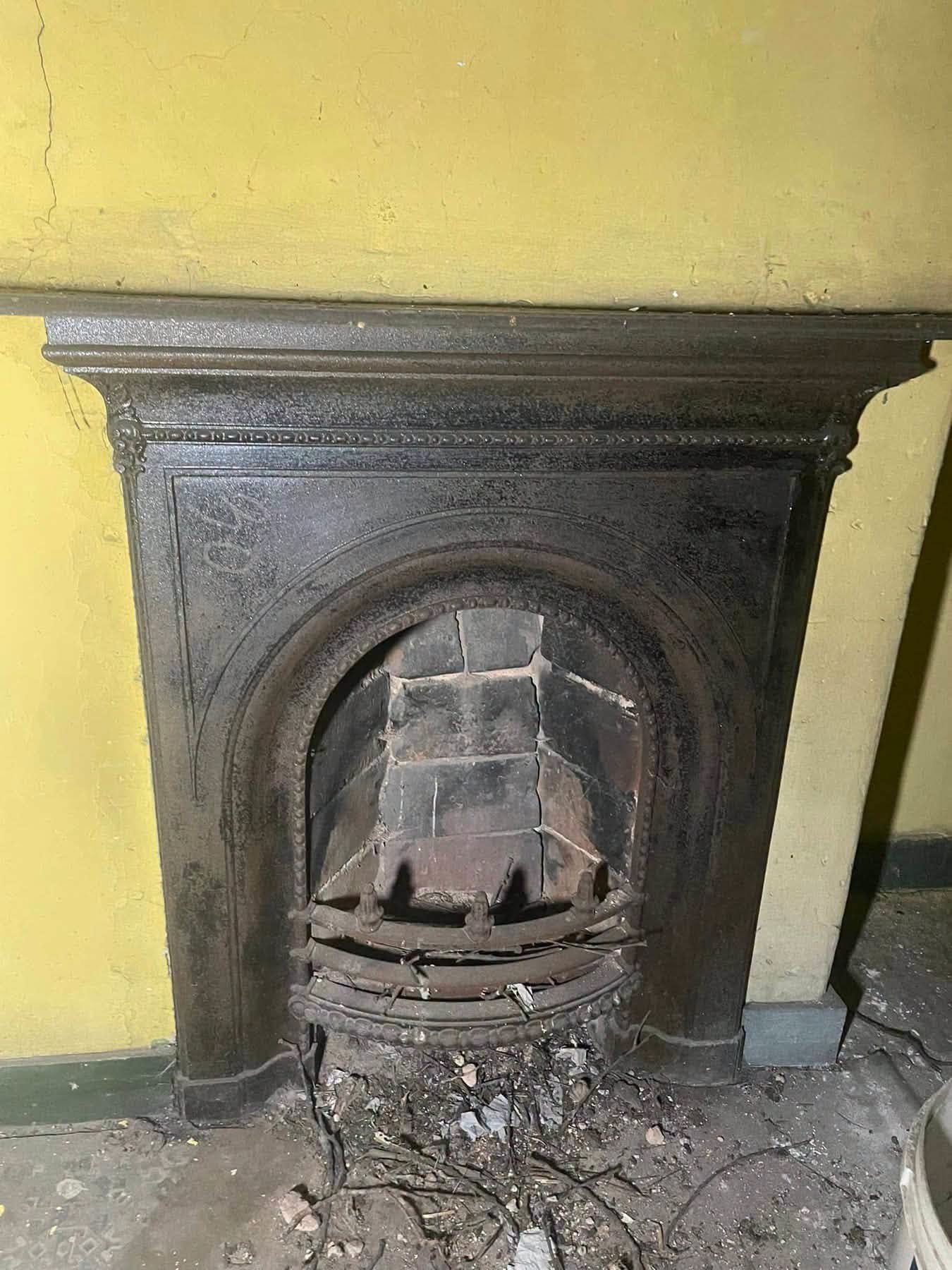
Inside, the house keeps two very different fireplaces, and the contrast between them says more about the people who lived here than anything else in the post. The first is an ornate cast-iron fireplace, arched and heavy, set into a yellow-painted wall. Its firebrick back is cracked clean through, the iron grate is rusted and bent, and the floor in front of it is scattered with twigs, dust and fallen debris. It is the kind of fireplace that was the pride of a Victorian or Edwardian living room, and it now sits cold behind a carpet that has not been swept in years.
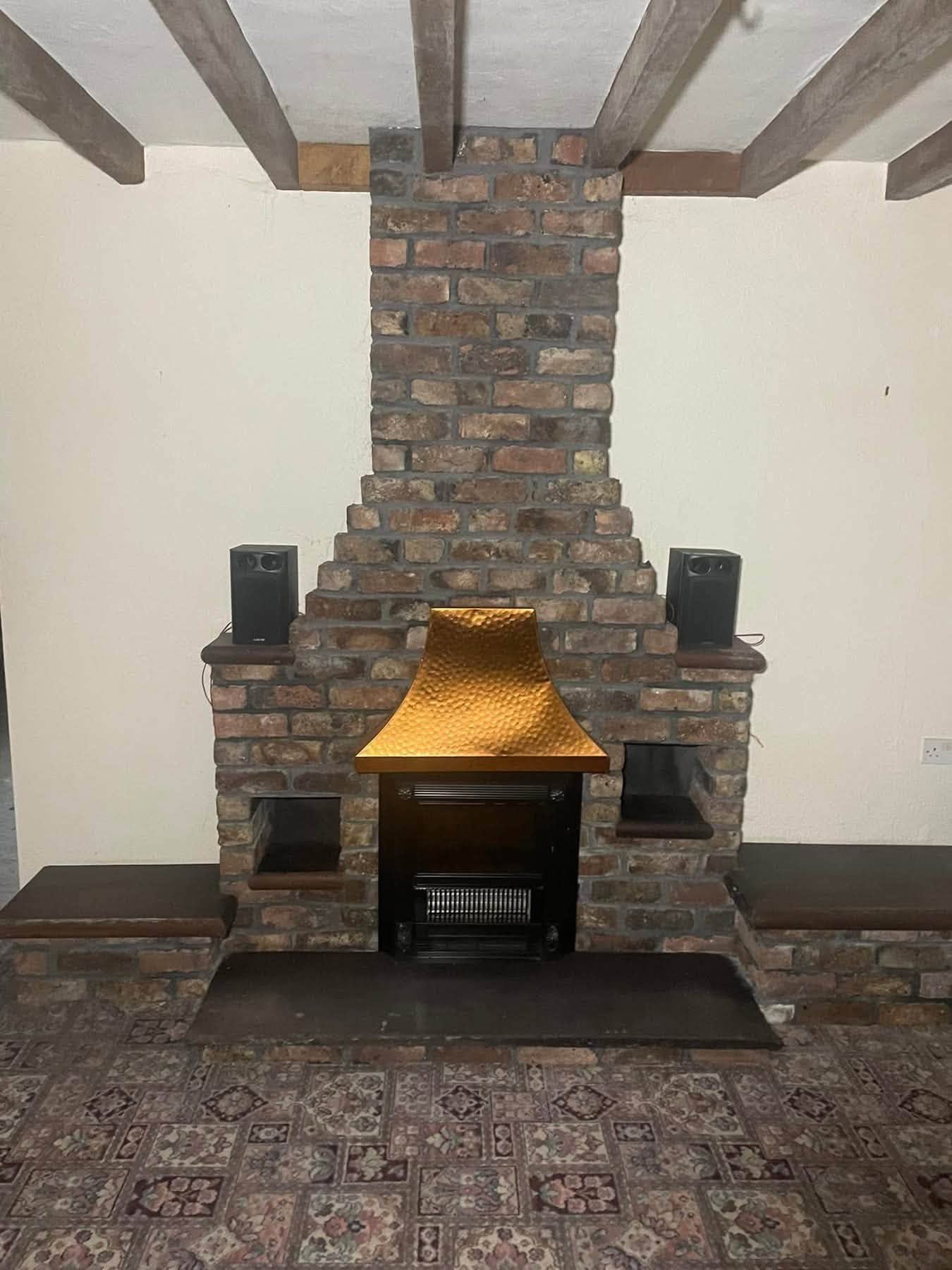
The second fireplace could hardly be more different. It is a broad brick chimney breast rising to exposed ceiling beams, with a hammered-copper hood over a black electric fire. Two speakers sit on the ledge on either side of the chimney, and the patterned carpet in front of it is still laid flat and whole. This is a later addition, a room updated for a different kind of living — music, television, an electric fire instead of coal. The beams above it are bare wood, the walls plain white, and the whole room looks tidier and more recent than the room with the cast-iron grate.
Put together, the two fireplaces tell a small, honest story. The house was lived in across more than one generation, updated at least once, and then left. Neither fireplace gives a date for when the last person moved out. The post gives none either, and this article will not invent one.
The Bureau and the Flowers
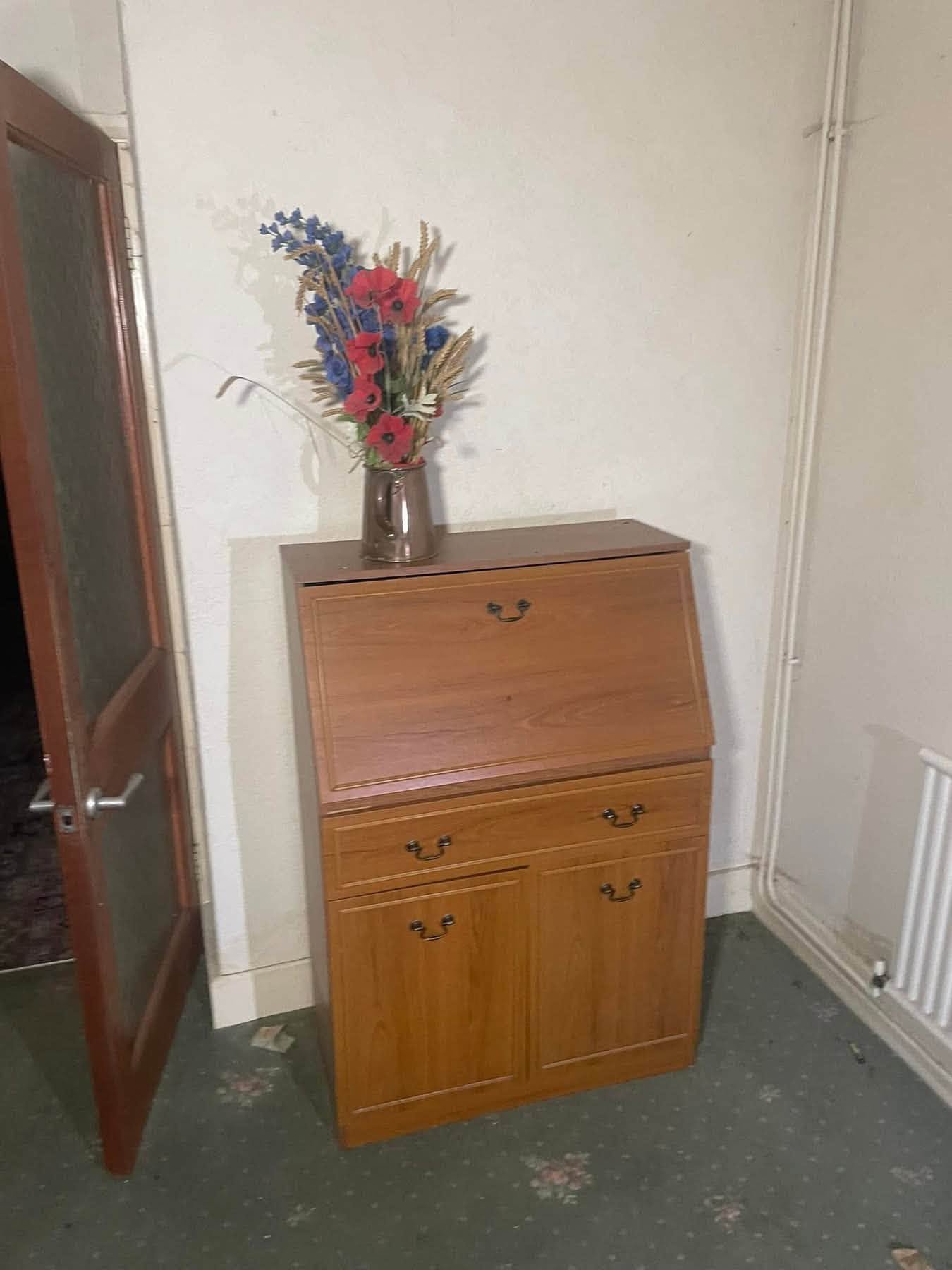
The most quietly affecting photograph is not a fireplace or a mouldy wall. It is a wooden bureau cabinet standing in a corner, its drop front closed, its drawers and cupboard doors shut. On top of it sits a metal jug holding a bunch of flowers — red poppies, blue cornflowers, and ears of wheat. The flowers are artificial, or dried; they have kept their colour long after real flowers would have faded. A door stands open beside the cabinet, a radiator runs along the wall, and the green patterned carpet underfoot is worn but intact.
It is the kind of object that stops you, because it looks deliberate. Someone put those flowers there. They were not left by accident, and they were not part of the house’s structure. They were a choice, a small attempt to make a corner of the house look cared for. That they are still standing, upright and bright, in a house where the upstairs is rotting with mould is the contrast the whole post turns on. The house was a home, and then it stopped being one, and the things that were meant to make it pleasant simply stayed where they were put.
Upstairs, Where the Mould Is
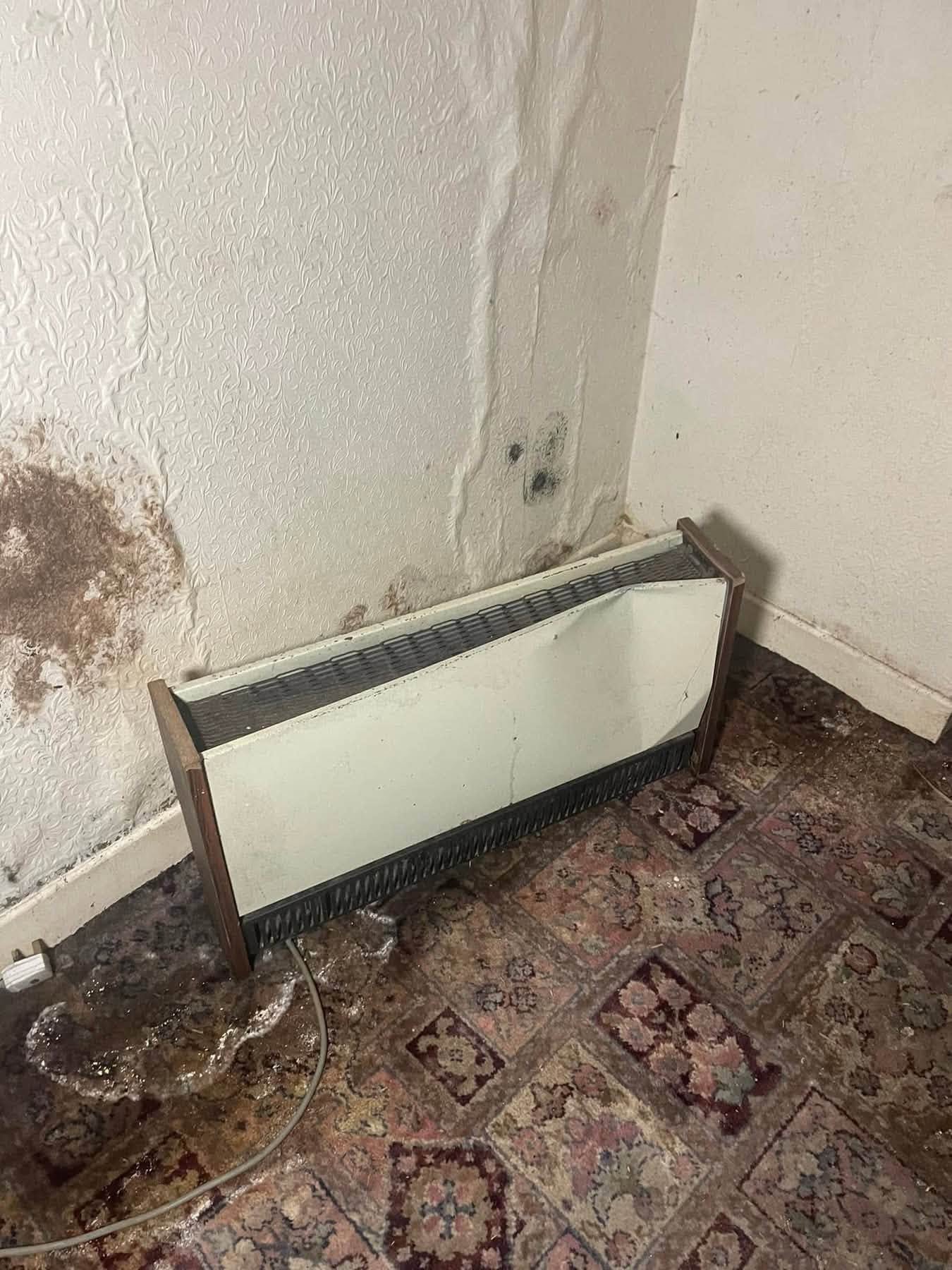
The last photograph is the one the caption warned about. A room with peeling, patterned wallpaper, the paper lifting away from the wall in long, damp curls. Black spots of mould bloom across the plaster, and a brown damp stain spreads from the skirting board upward. A pale storage heater leans against the wall at an angle, its front panel dented, its cable trailing across a carpet that is stained dark in patches. The floor covering is the same patterned carpet seen downstairs, but here it is discoloured and wet-looking near the wall.
The post says the mould upstairs “was not good”, and the photograph backs that up without exaggeration. This is damp that has had years to work, not a single leak. The wallpaper has given up holding to the wall, and the mould has spread across the plaster in a way that suggests the room has been cold and wet for a long time. It is the clearest evidence in the post of how long the house has stood empty — long enough for the building itself to start breaking down from the inside.
There is a practical point here, and it is worth stating plainly. A house in this condition is not a project to wander into. Damp and mould like this can make the air unsafe, floors and ceilings may be weakened, and the building is private property. Do not attempt to find or enter it.
What We Know, and What We Don’t
Here is the full list of what the post actually establishes. An old farmhouse has sat empty for a good few years. Its upstairs rooms have bad mould. The house is a two-storey red-brick building, partly covered in ivy, photographed at night. Inside, it has an ornate cast-iron fireplace, a brick chimney breast with a copper hood and an electric fire, a bureau cabinet with a jug of artificial flowers, and at least one upstairs room with severe damp and mould. The post was published by Urbex Lost & Found on 22 November 2026 and contains 45 photographs. That is all.
Everything else is [TO VERIFY]: the location, the age of the house, when it was last occupied, who lived there, who owns it now, whether it has been sold or is for sale, and what has happened to the house since the photographs were taken. The post gives no agent, no price, and no owner name, so none of those appear here.
More houses left in this state are gathered in abandoned houses, and grander empty homes in abandoned mansions. For the opposite end of the scale — a house that is lived in and on the market — see a 1902 home in Alexandria, Minnesota, and the front page of the site is abandoned.blog.
Frequently Asked Questions
Where is this old farmhouse?
The post does not give a location — no county, town, or road. The exact address is not public, and this article does not publish one.
How long has the farmhouse been empty?
The post says only that it has “sat empty for a good few years”. No exact number of years is given, and the date it was last occupied is [TO VERIFY].
How bad is the mould upstairs?
The post describes it as “not good”, and the photograph of the upstairs room shows peeling wallpaper, black mould spots across the plaster, and a damp-stained carpet. The full extent is not shown in these five photographs.
What is inside the farmhouse?
An ornate cast-iron fireplace, a brick chimney breast with a hammered-copper hood and electric fire, two speakers, a bureau cabinet with a jug of flowers, and at least one upstairs room with severe damp and mould. The five photographs here are 5 of the 45 in the original post.
How old is the house?
The post does not say. The cast-iron fireplace and the brickwork suggest an older house, but no build date is given, so the age is [TO VERIFY].
Can I visit the farmhouse?
No. The location is not public, the house is private property, and entering an abandoned building is trespassing and can be dangerous. This article is not a guide to finding or entering it.
Why was the house left empty?
The post does not say. No owner, no sale, and no reason for the house being left are given. Any reason would be guesswork.
Disclaimer
This article is based only on the Urbex Lost & Found Facebook post of 22 November 2026 and the five photographs in that post shown here. The caption is quoted as published. Location, age, ownership, and sale details are not stated in the source and are marked [TO VERIFY]. Do not attempt to find or enter this property. Abandoned buildings are private property, may be structurally unsafe, and entering them is trespassing.
Photos
Photos by Urbex Lost & Found, via the original Facebook post: https://www.facebook.com/UrbexLostNFound/posts/pfbid037Y1yeyAwJzEVc632BApb2cooGHhVFg9MmZ7UQ3AhBWYuB1H2SZSSXdZvSBVvdDQl — 5 of the 45 photos are shown here.