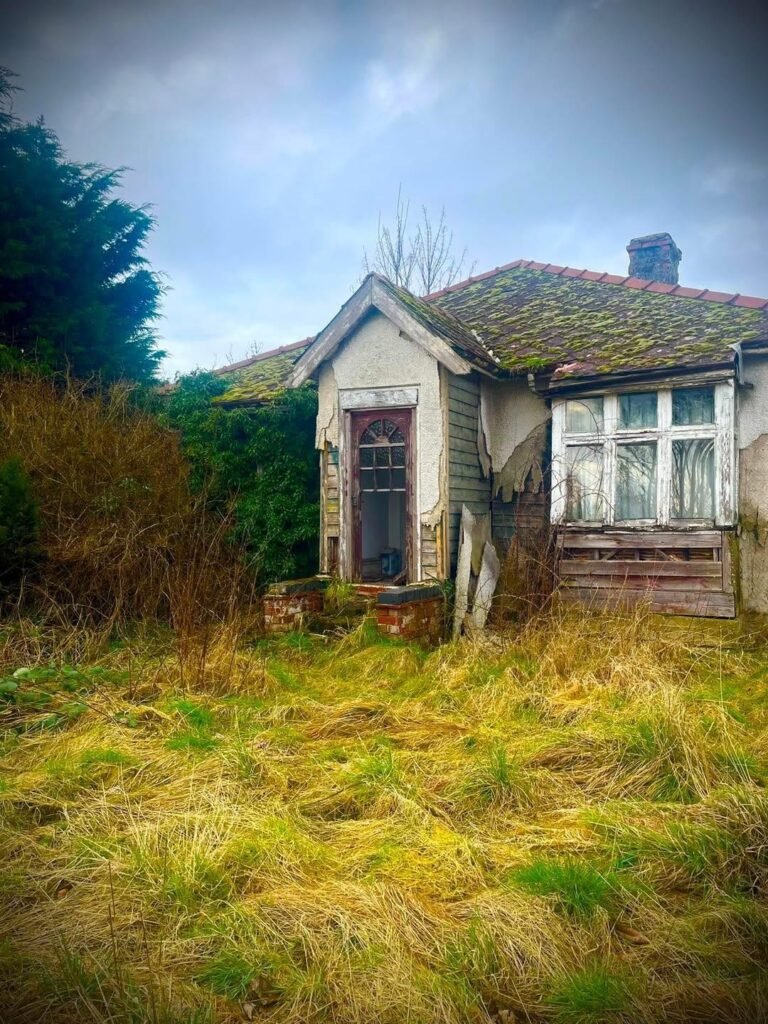
The bungalow is named for what was found on its floor: letters, written by hand, in wartime. They are the reason the place has a name at all, because almost nothing else about it is known. The post that documents it, dated 16 November 2025, says plainly that the explorer does not have too much information on this one. What he has is a derelict bungalow, an elderly couple who once lived there, a set of old letters, and a belief — his own — that the home has been demolished since he explored it in 2024.
Everything in this article comes from that post and from the five photographs shown here. No location is given, no surname, and no date is given for when the couple lived there or when the house was built.
The letters
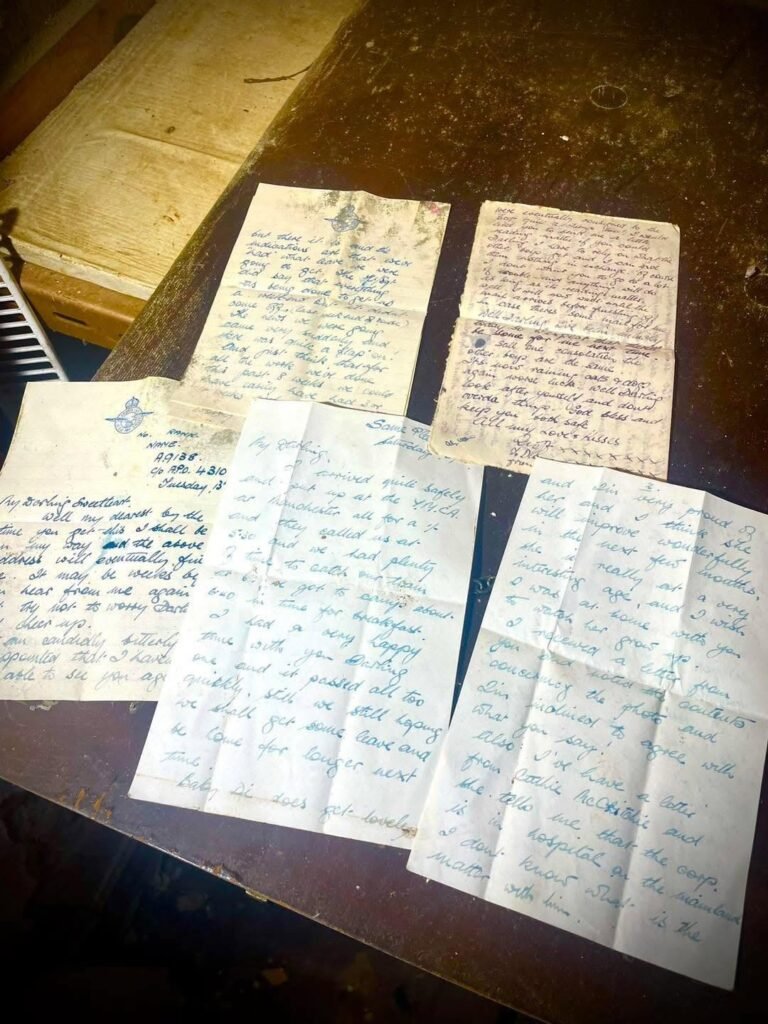
The second photograph is the heart of the article. Five handwritten letters lie spread on a dark table, their blue ink faded but still legible in places. One envelope carries a blue RAF crest. The writing is in a careful hand, the paper is thin and yellowed, and one letter begins “My Darling Sweetheart” — the kind of opening that belongs to a particular time, and to a particular kind of absence.
The post says the bungalow is known as the war time letters bungalow because it has old letters from the person who maybe had time in the RAF, who once lived there. That “maybe” is important, and it is kept here. The crest on the envelope and the wartime dates are consistent with RAF service, and the post’s own wording treats the connection as a possibility, not a certainty. Nothing in the photographs proves the letter-writer served in the RAF, and nothing here claims it. What the photographs prove is that somebody in this house kept wartime letters — kept them for decades, through a whole life, until the house itself was left behind.
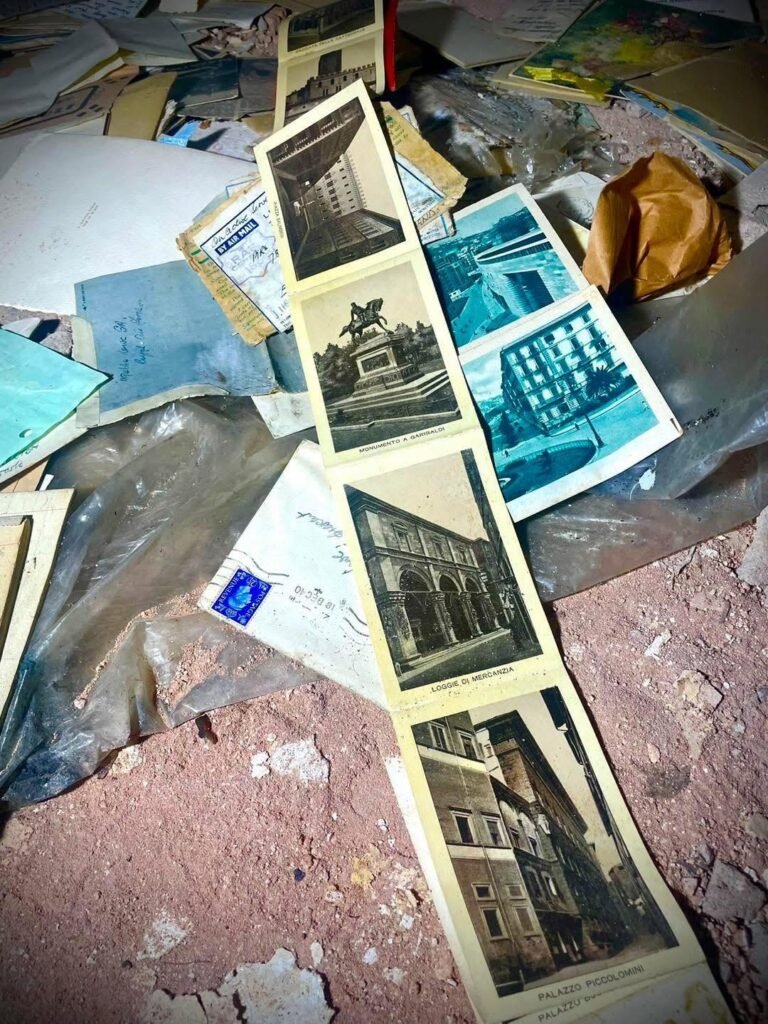
The letters are not the only paper in the house. The third photograph shows a strip of old photographic negatives and postcards laid out on a dusty floor: a monument on horseback, captioned “Monumento a Garibaldi”; a palace with arched loggias, captioned “Loggia di Mercanzia”; a street scene captioned “Palazzo Piccolomini”; and blue-tinted city views beside them. An envelope with a blue stamp lies nearby. These are travel photographs, or souvenirs of a journey — somebody in this house had been to Italy, or knew somebody who had, and kept the pictures.
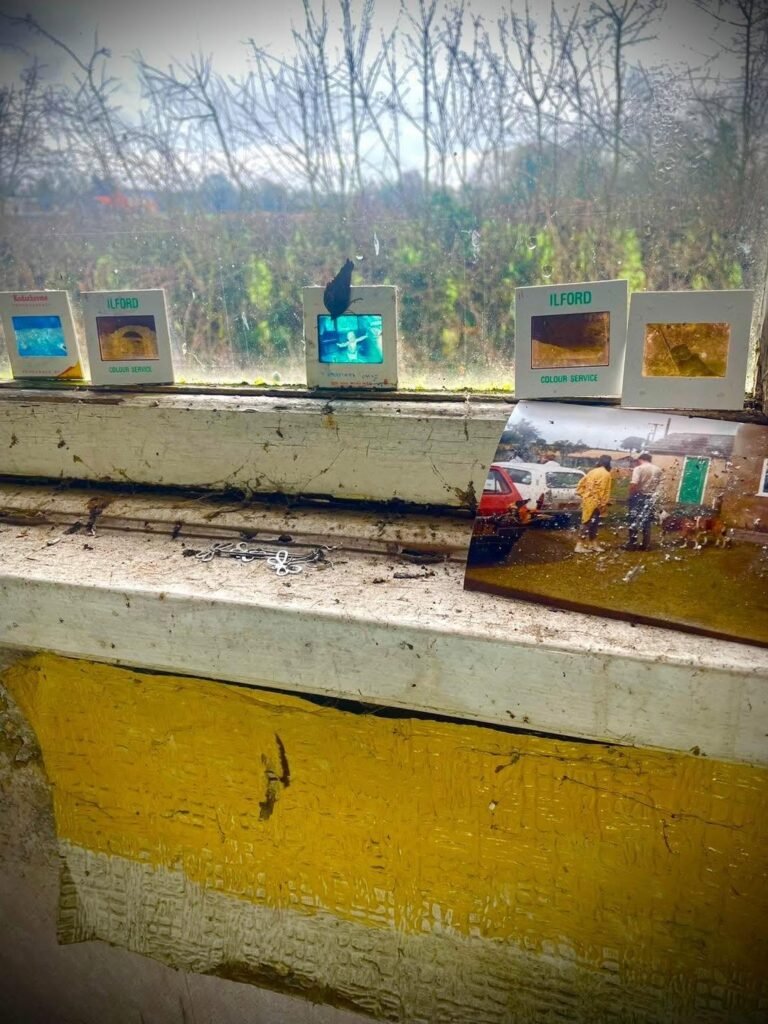
And the fifth photograph shows the same habit in miniature: Ilford slide frames and a Kodachrome slide lined up on a dirty window sill, their images held up to the light from outside, with a family photograph leaning against the sill below them — a colour print of people standing by a red car outside a house with a green door. The post says the negatives were left scattered on the floor and on windows, to show up from the light outside and show what was on them. That is exactly what the photograph shows: somebody’s slides, propped in a window so the light could pass through them, in a house where the light was the only projector left.
A house that was already going
The first photograph shows the bungalow from the front, and it is a long way gone. The roof is thick with moss, the render is peeling off the walls in sheets, the red glazed front door stands ajar on a dark interior, and the bay window is boarded below its panes. Yellow grass, flattened and overgrown, covers the ground in front. The chimney is still standing. The trees behind the house are bare.
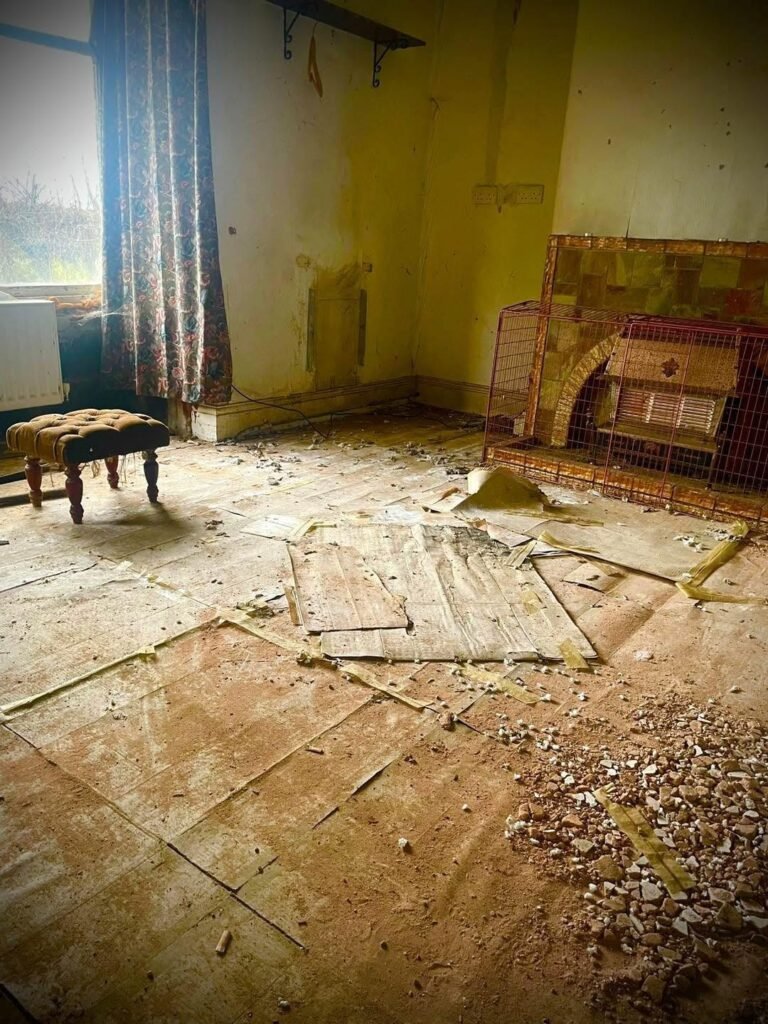
The fourth photograph shows the inside, and it is worse. A yellow room with peeling floorboards, its floor covered in debris and broken plaster, a small tufted footstool standing alone by the window, floral curtains hanging beside it, and a red fireguard in front of a tiled fireplace. The wall above the fireplace is stained yellow, and a shelf bracket hangs empty. The post says the bungalow is mostly trashed, but still has some of the old belongings and memories dotted about. The photographs agree: the rooms are wrecked, and the things that matter — the letters, the photographs, the slides — are still there, on the floor and on the sills, because nobody came to take them.
The post adds two details that the five photographs do not show. There is, it says, an old farm barn at the back with two cars still left behind, and there is even a swimming pool still there, taken over by Mother Nature. Neither is pictured here, and neither is described further. They are reported as the post reports them.
Explored in 2024, believed gone since
The post says the explorer visited in 2024, and that he believes the home has been demolished since then. That belief is his, and it is presented here as his belief, not as a verified fact. No demolition date is given, no record is quoted, and none is claimed here. If the belief is right, then these five photographs are among the last records of the house — a house that was already mostly trashed when it was photographed, and that may no longer stand at all.
That is a common pattern in this series, and it is worth stating plainly each time it happens. The photographs are not a visit to a place that is waiting to be explored. They are a record of a place at one moment, and the moment has passed. The letters, the negatives, and the slides may still exist somewhere, or they may have gone with the house. The post does not say, and this article does not guess.
- The exterior: moss-covered roof, peeling render, red glazed door ajar, boarded bay window, overgrown yellow grass.
- The letters: five handwritten wartime letters on a dark table, one envelope with a blue RAF crest.
- The negatives: a strip of old postcards and negatives on a dusty floor — a monument, a palace, blue-tinted city views — and an envelope with a blue stamp.
- The yellow room: peeling floorboards, debris, a footstool, floral curtains, a red fireguard before a tiled fireplace.
- The window sill: Ilford slide frames held to the light, and a family photograph leaning against the sill, yellow paint below.
A house that is lived in and for sale is a different kind of place from this one, and the difference is worth seeing side by side: a lived-in 1902 home in Alexandria, Minnesota shows what upkeep and a price look like, where this bungalow shows what happens when upkeep stops and nobody comes back. More houses in this condition are gathered in abandoned houses and in abandoned mansions, and the site’s front page is abandoned.blog.
FAQ
Where is the War Time Letters Bungalow?
No location is given in the post, and none is given here.
Why is it called the War Time Letters Bungalow?
Because old wartime letters were found in the house, according to the post. The photographs show five handwritten letters, one with a blue RAF crest.
Did the person who lived there serve in the RAF?
The post says the letters are from a person who maybe had time in the RAF. That is a possibility the post raises, not a verified fact.
Who lived there?
According to the post, an elderly couple. No further personal details are given here.
What else was left in the house?
According to the post and the photographs: photographic negatives and postcards, Ilford slide frames, a family photograph, furniture, and debris. The post also mentions a farm barn with two cars and a swimming pool, neither shown in the five photographs here.
When was it explored?
The post says the explorer visited in 2024. The post itself is dated 16 November 2025.
Is the house still there?
The explorer believes the home has been demolished since his visit. That is his belief, not a verified fact, and no demolition date is published.
Can I visit it?
No visiting information is given here, and entering private property without permission is not encouraged.
Disclaimer
This article is general information only, not legal, tax, or financial advice. Rules on abandoned and private property differ by state and county; check county/local records and a local professional before acting. The account of the bungalow, the letters and the RAF connection is as reported in the source post and has not been independently verified.
Photos
Photos by Luke2Explore, via the original Facebook post: https://www.facebook.com/Luke2Explore/posts/the-abandoned-war-time-letters-bungalowthe-abandoned-wartime-letter-bungalow-is-/1292253056273713/ — 5 of the 30 photos are shown here.