There is something deeply unsettling about walking into an abandoned car factory and finding the production line exactly where it stopped.
Not cleared out. Not stripped bare. Just… frozen.
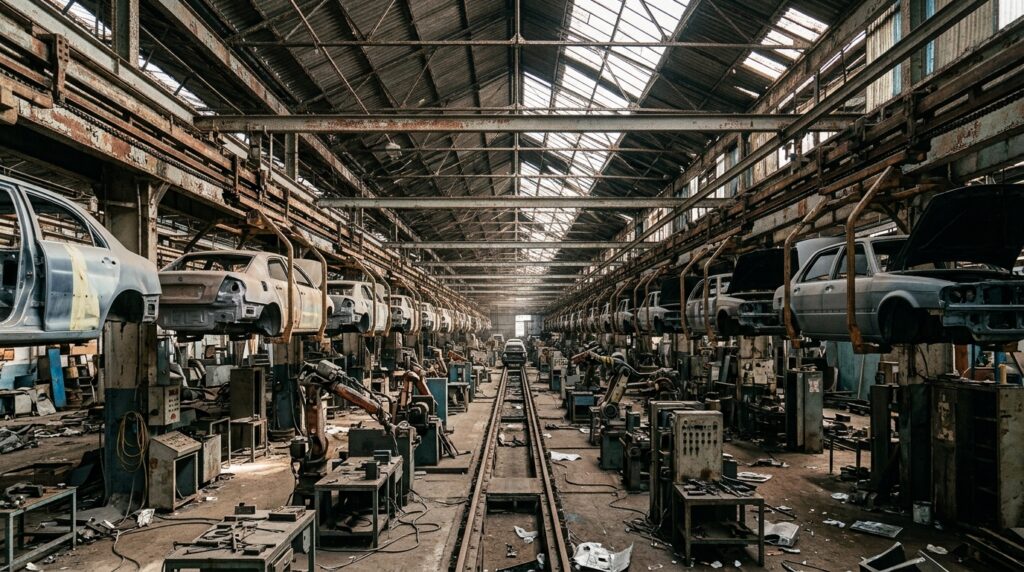
Hundreds of car shells — doors missing, hoods hanging open, windshields never fitted — stretch down an assembly line that hasn’t moved in decades. Rust creeps across steel frames the way ivy takes over an old wall. Dust lies so thick on the floor that every footstep leaves a clean impression, like snow.
This isn’t a movie set. It’s real. And it’s one of the most haunting places you’ll ever read about.
What Happens When a Car Factory Dies?
Most people assume that when a factory closes, everything gets sold off, scrapped, or repurposed. The machines get auctioned. The raw materials get removed. The building gets demolished or converted.
But that’s not always how it goes.
Sometimes a factory closes so fast — due to bankruptcy, sudden legal trouble, or economic collapse — that no one has time to clean up. Workers walk out one Friday afternoon and simply never come back. The lights go off. The gates lock. And everything inside stays exactly as it was.
That’s precisely what happened here.
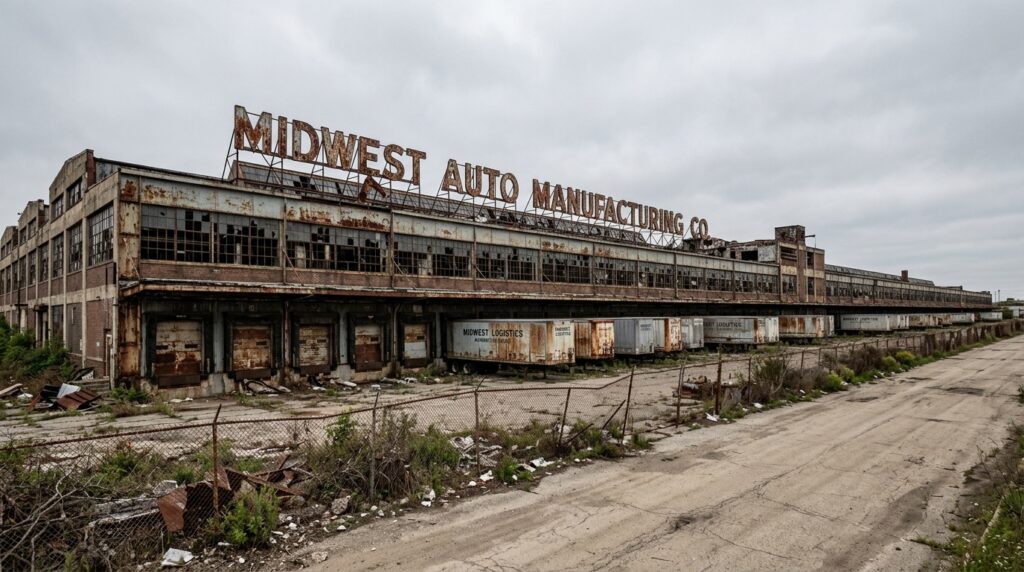
The facility in question was a mid-century automobile plant that once hummed with the noise of pneumatic drills, conveyor belts, and thousands of workers on rotating shifts. At its peak, it produced hundreds of vehicles a week. Entire communities depended on it.
Then the orders dried up. The contracts fell through. And one day, the company folded almost overnight.
What they left behind is extraordinary.
A Walk Through the Factory Floor
The First Thing You Notice Is the Silence
Industrial spaces aren’t quiet by nature. They’re built for noise — machines, voices, the constant rumble of production. So when that noise is gone, the silence feels physical. It presses against your ears.
Step through the main entrance and the scale of the place hits you immediately. The factory floor stretches the length of several football fields. Steel support columns disappear upward into a ceiling so high it catches its own weather — condensation drips from the girders on cold mornings like slow, reluctant rain.
The natural light filters through rows of grimy skylights above, casting long, pale rectangles across the floor. It gives the whole space a strange, cathedral-like quality. Solemn. Still. Almost reverent.
The Cars Themselves Tell the Story
And then you see them.
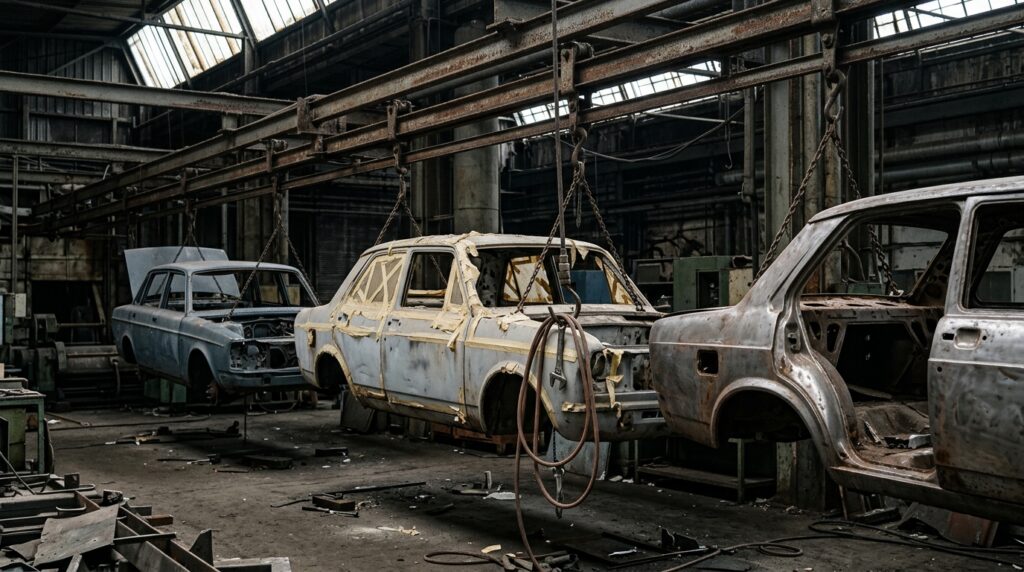
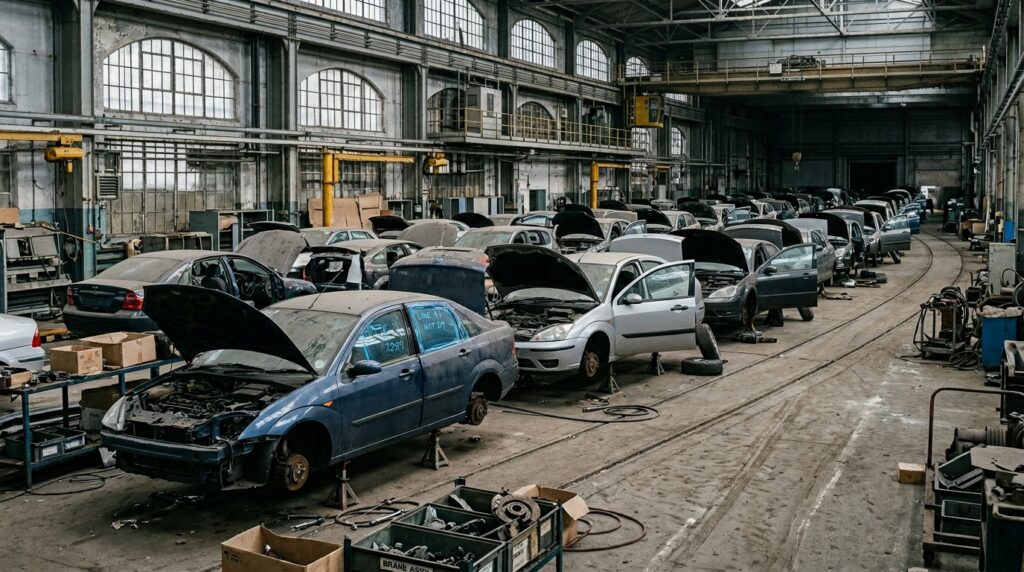
Row after row of car bodies, sitting on rusted assembly cradles, exactly where they were left. Some are little more than bare metal shells — just a chassis, a frame, four wheel arches with nothing inside. Others are further along the line, with dashboards partially installed, steering columns in place, even some upholstery fitted to the seats.
A few have their hoods open, exposing engine bays that were never filled. Wiring harnesses dangle from exposed cavities like loose nerves. Paint — once glossy, now matte with age — has bubbled and flaked in long strips, revealing the grey primer beneath.
The colours are mostly muted now: faded greens, chalky whites, an occasional flash of what was once bright red. They’re the colours of a different era. A different country, almost.
What makes it so affecting is the sense of interrupted purpose. These cars were almost finished. They were almost driven off a lot somewhere, almost owned by someone. They never got that chance.
The Machinery Left Behind
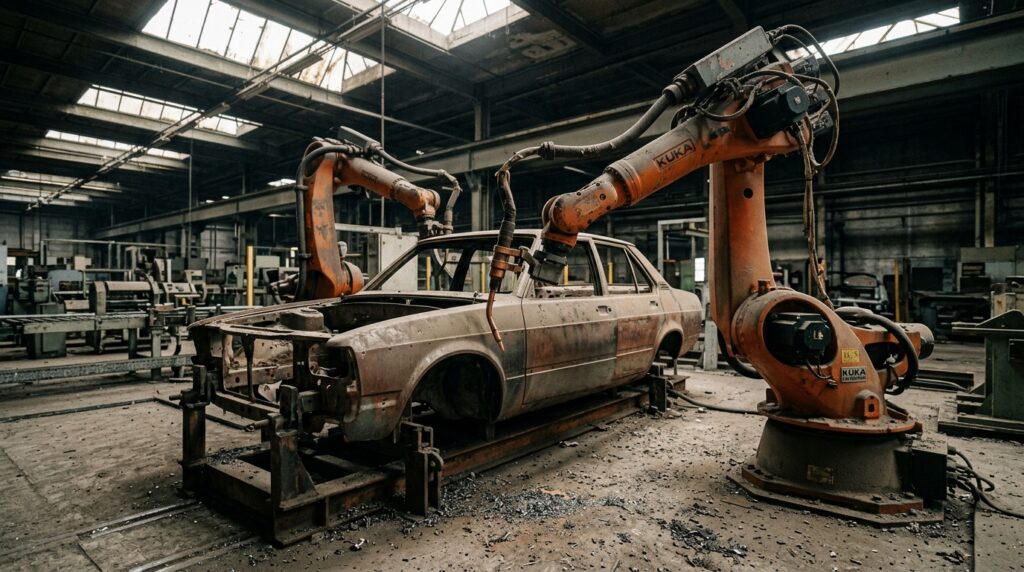
Beyond the cars themselves, the machinery is equally remarkable.
Overhead cranes still hang from their tracks, arms extended mid-reach, as if frozen in the act of lifting. Hydraulic lifts sit in their lowered positions, waiting for a vehicle that won’t come. Tool stations still hold wrenches and impact drivers in their holders, coated in a thick film of greasy dust.
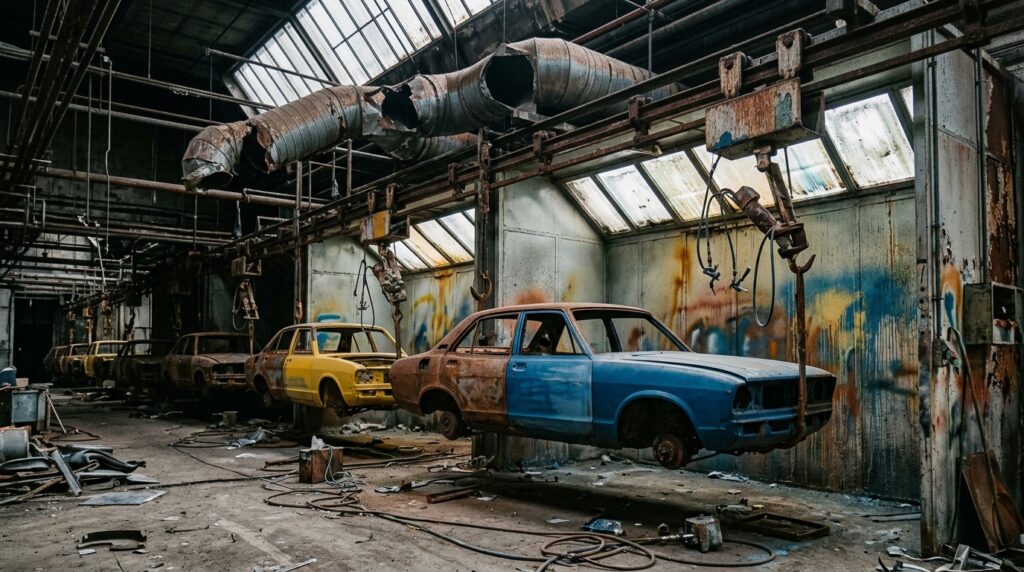
One corner of the floor contains what appears to be a paint booth — a sealed chamber used for spraying bodywork. The walls inside are striped with decades of overspray in a dozen different colours, a geological record of every car that passed through. Blues over reds over yellows over greens. It’s accidentally beautiful.
You can learn more about how automotive assembly lines evolved over the 20th century — the history behind these machines makes the abandonment feel even more significant.
The History Behind the Factory
Built in an Era of Optimism
The factory was constructed in the postwar boom period, when automobile manufacturing was one of the most powerful industries in the world. Governments actively encouraged factory construction. Land was cheap. Labour was available. Consumer demand was exploding.
The plant was designed using the modular industrial architecture typical of the era — long, low buildings with sawtooth rooflines designed to maximise natural light on the floor below. This style of factory design, developed in the early 20th century, was considered both practical and progressive. Many similar buildings have since been recognised for theirindustrial heritage significance.
At its height, the facility employed thousands of people across three shifts. It ran twenty-four hours a day, six days a week. The surrounding town built its identity around the plant. Shops, pubs, housing estates — everything orbited the factory like planets around a sun.
The Decline
The trouble started gradually, as it often does.
New competition from overseas manufacturers began to undercut prices. The company struggled to modernise its production methods. A series of labour disputes through the 1970s and 1980s slowed output and damaged investor confidence. Management changed hands twice. Investment dried up.
By the early 1990s, the order books were almost empty. The workforce had shrunk dramatically. There were rumours of closure for years before it actually happened — the kind of drawn-out uncertainty that hollows out a community long before the gates finally shut.
When the end came, it came quickly. A financial restructuring failed. Creditors moved in. The factory closed with very little notice, leaving partially finished vehicles on the line and unpaid workers who had no idea it would be their last shift.
The site passed through several hands over the following years. Plans were drawn up, then abandoned. A brief attempt at reopening under a different brand failed within months. Eventually, the site was simply locked and left — too expensive to demolish, too complicated to redevelop, too forgotten to matter.
Why Places Like This Survive
The Economics of Abandonment
It seems counterintuitive that a building this large — on land this valuable — could simply be left to rot. But the economics of industrial abandonment are stranger than they appear.
Demolition is expensive. Remediation of contaminated land (oil, chemical solvents, heavy metals) can cost millions. Legal disputes over ownership, liability, and planning permissions can tie a site up in court for decades. Sometimes it’s genuinely cheaper to do nothing.
There’s also the question of memory. Local communities often resist demolition of major employers, even long after they’ve closed. The factory represents jobs, identity, history. Tearing it down feels like erasing something. So it lingers.
Meanwhile, the building slowly eats itself. Roof panels fail. Water gets in. Mould spreads. Metal corrodes. Glass breaks. What was once a functioning facility becomes, over time, a ruin.
What Urban Explorers Find Here
The urban exploration community — often called urbex — has documented dozens of sites like this one. And while our archives at abandoned.blog cover many forgotten factories, this one stands out for a simple reason: the sheer quantity of half-finished cars.
Most abandoned factories have been stripped. Scrappers get in early, removing anything with monetary value — copper wire, steel, aluminium. What’s left is usually just the shell of a building.
Here, the cars remained. Whether because of ongoing legal disputes over ownership, or because they were considered too deteriorated to be worth moving, or simply because no one ever got around to it — the vehicles stayed. And that makes this place extraordinary.
What the Cars Look Like Now
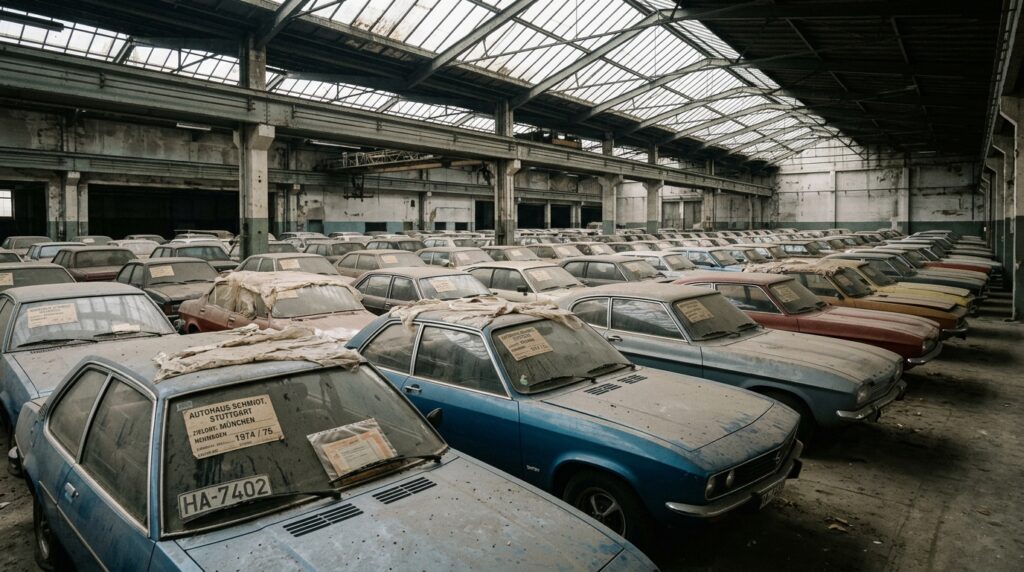
Time is not gentle with steel.
The cars closest to the external walls — where moisture and temperature fluctuations are most severe — have deteriorated the most dramatically. Body panels have rusted through entirely in places, leaving lace-like patterns of oxidation where solid metal once was. Tyres (those that were ever fitted) have cracked and crumbled. Seats that were upholstered in fabric have become homes for birds and small animals, the stuffing pulled out and repurposed for nests.
Further inside, where conditions are more stable, some cars are in surprisingly better condition. The paint is still intact on a few. One vehicle, near what appears to have been the end of the line, looks almost ready to drive — except that it has no engine, no glass, and a floor eaten through by rust.
There’s something poetic about that. Almost, but not quite.
If you’re interested in other places where time stopped mid-motion,our feature on abandoned industrial sites captures that same quality — the feeling that people simply walked away and never looked back.
The Atmosphere: What It Actually Feels Like
Words can only go so far, but let’s try.
The smell hits you first. It’s a specific combination: engine oil, old rubber, damp concrete, and something metallic and faintly sweet that you can’t quite identify. It’s not unpleasant, exactly. It’s just old. Dense with time.
The light is always moving. As clouds pass over the skylights, the quality of the light shifts — from grey and flat to warm and golden and back again. The cars cast long shadows in the afternoon. In certain conditions, the whole floor looks like a painting.
Sound travels strangely in large industrial spaces. A pigeon landing on a girder three hundred metres away sounds close. Your own breathing sounds too loud. The building occasionally pops and groans as temperature changes stress the metal frame.
And then there are the details you notice as your eyes adjust. A worker’s glove on a tool bench, stiff as cardboard. A faded safety poster on the wall, still legible: THINK SAFETY EVERY DAY. A clipboard with a paper checklist attached, the handwriting still visible despite the years. Someone’s name, in neat block letters, at the top.
These small human traces are what elevate a place like this from interesting to haunting.
Exploring Safely and Responsibly
It’s worth being clear: urban exploration of abandoned sites can be dangerous and, in many cases, illegal without landowner permission.
Structures like this one carry real hazards — unstable floors, asbestos-containing materials common in industrial buildings of this era, poor air quality, and structural collapse risks. Professional photographers and documentarians who visit sites like this do so with proper safety equipment, research, and often explicit permission.
The right way to experience places like this is through the work of those who document them properly. Our urban exploration guides at abandoned.blog explain how responsible documentation works and what to look for when researching a site’s history safely.
Conclusion: A Factory Frozen in Time
The abandoned car factory is many things at once.
It’s an economic story — of an industry that rose, dominated, and collapsed. It’s an architectural story — of a building type that defined an era and was then discarded. It’s a human story — of thousands of workers whose livelihoods ended without warning.
But most of all, it’s a time story.
Walking through an abandoned car factory where hundreds of half-built vehicles still wait on the line is like stepping into a paused moment. The assembly line stopped mid-sentence, and no one ever came back to finish the thought.
That’s what makes these places so powerful. They don’t just show you the past. They make you feel it.
Frequently Asked Questions
Q: Where is this abandoned car factory located?
Most documented facilities of this type are located in the former industrial heartlands of Europe and North America. Specific locations are often kept private by explorers to protect the sites from vandalism.
Q: Are the cars still there today?
Conditions at abandoned sites change over time. Scrappers, developers, and natural deterioration all affect what remains. Documentation from explorers captures a moment in time that may no longer exist.
Q: Is it legal to visit abandoned factories?
Generally, no — without explicit landowner permission, entering an abandoned property constitutes trespassing. Always research local laws and seek proper authorisation before visiting any site.
Q: Why weren’t the cars removed when the factory closed?
Legal disputes, remediation costs, and ownership complications frequently prevent asset removal from closed industrial sites. Vehicles in various states of completion also have limited salvage value once deteriorated.
Q: How do urban explorers document these places safely?
Experienced documentarians use proper protective equipment, conduct advance structural research, work in teams, and increasingly seek formal permission from landowners or heritage organisations before entering.
All content on this site is intended for historical and educational purposes. We do not encourage trespassing or illegal entry to any property.