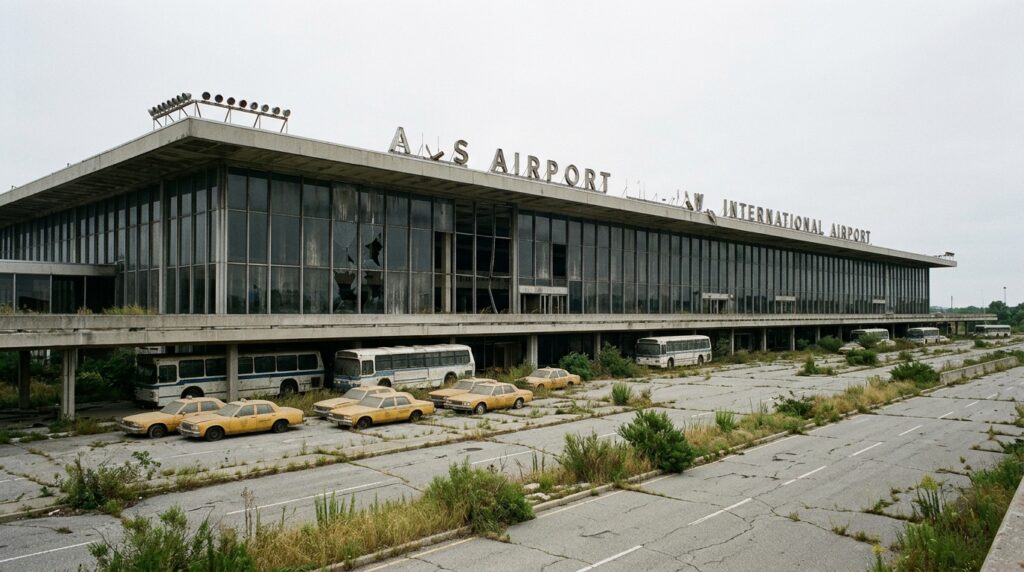
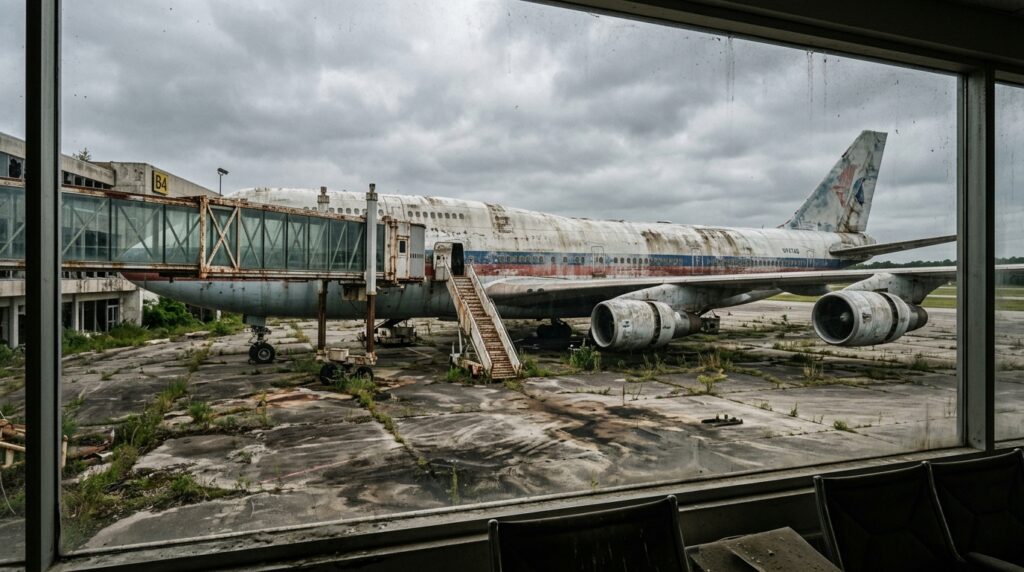
There is something deeply unsettling about an abandoned airport.
Not because it is dark or dangerous. But because airports are supposed to be the loudest, busiest places on earth. They are built on noise — jet engines, rolling luggage, gate announcements, crying children. Remove all of that, and what is left feels like a wound.
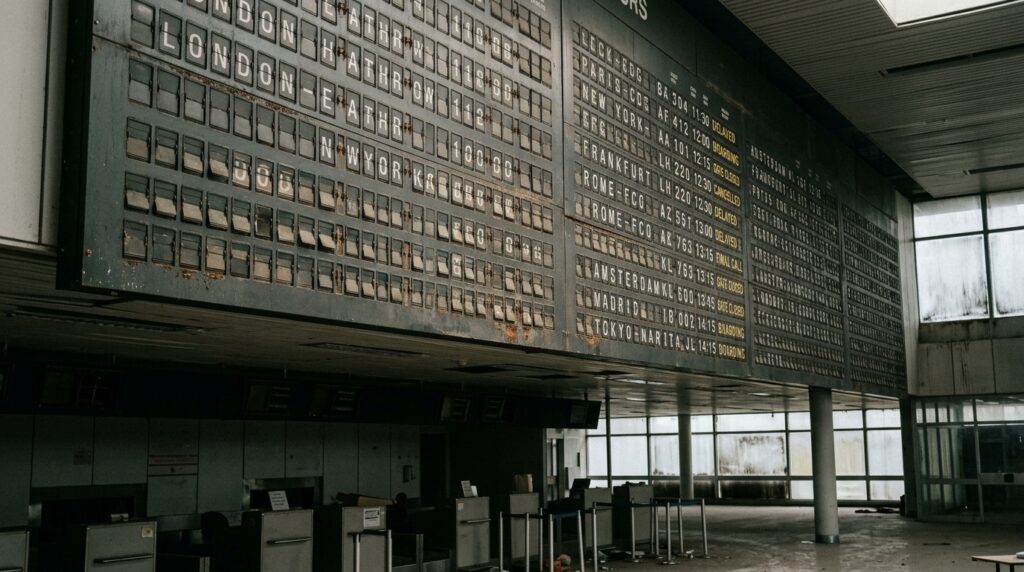
This one still has its departure board up.
The letters. The destinations. The times. All of it frozen mid-scroll, like the world hit pause and simply never pressed play again. Somewhere between Gate 4 and the duty-free shop, time stopped. And no one came back to turn the lights off.
Welcome to one of the most haunting places you will ever read about.
What Makes an Abandoned Airport Different From Other Ruins?
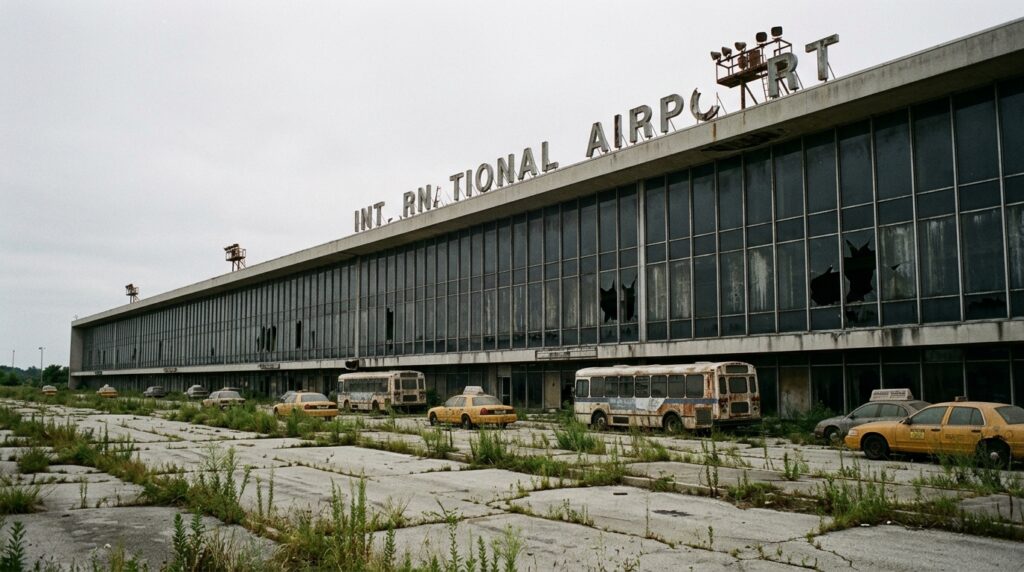
Most abandoned places feel forgotten. Old factories, crumbling mansions, empty churches — they decay quietly, slowly absorbed back into the earth.
An abandoned airport does not feel forgotten. It feels interrupted.
The infrastructure was built to move tens of thousands of people every single day. The halls were designed for crowds. The seating was bolted down in rows because personal space was always a luxury here. Every surface was engineered to handle the chaos of modern travel.
Now there is just dust and silence.
And somehow, that contrast — the scale of what was expected versus the emptiness of what remains — is what makes these places so emotionally powerful. If you have ever explored forgotten places or read about the world’s most hauntingly beautiful abandoned locations, you already understand this feeling.
The Architecture of Expectation
Airports are not built to be beautiful. They are built to process.
Long corridors push passengers forward. Low ceilings keep energy moving. Glass walls face the runways because even non-aviation people want to watch the planes. Every design choice was once a calculated decision to move human beings efficiently from one point to another.
Walk through it empty and those same design choices become something else entirely.
The long corridor is no longer purposeful — it is oppressive. The rows of plastic seating look like a stage set with no actors. The baggage carousel sits perfectly still, a metal loop going nowhere.
The History Behind the Frozen Departure Board
Every abandoned airport has a story. None of them end well.
Some were victims of economic collapse. Regional airlines folded. Passenger numbers dropped below the break-even point and the runway lights went dark one final evening. Others were casualties of political decisions — a new terminal built forty kilometres away, leaving the old one to gather dust while its replacement gleamed in the distance.
A few were closed by disaster. Floods, earthquakes, volcanic ash.
The departure board in this particular terminal tells its own story. The destinations listed — mostly short-haul routes, a few international connections — paint a picture of what this airport once was. Not a major hub. Something smaller, more regional. A place where families said goodbye and reunions happened with tears under fluorescent lights.
According to aviation heritage records on Wikipedia, dozens of commercial airports across Europe and North America have been decommissioned since the 1980s. Most were absorbed into other land uses. A small number were simply left standing.
This is one of the ones that was left.
The Last Flight Out
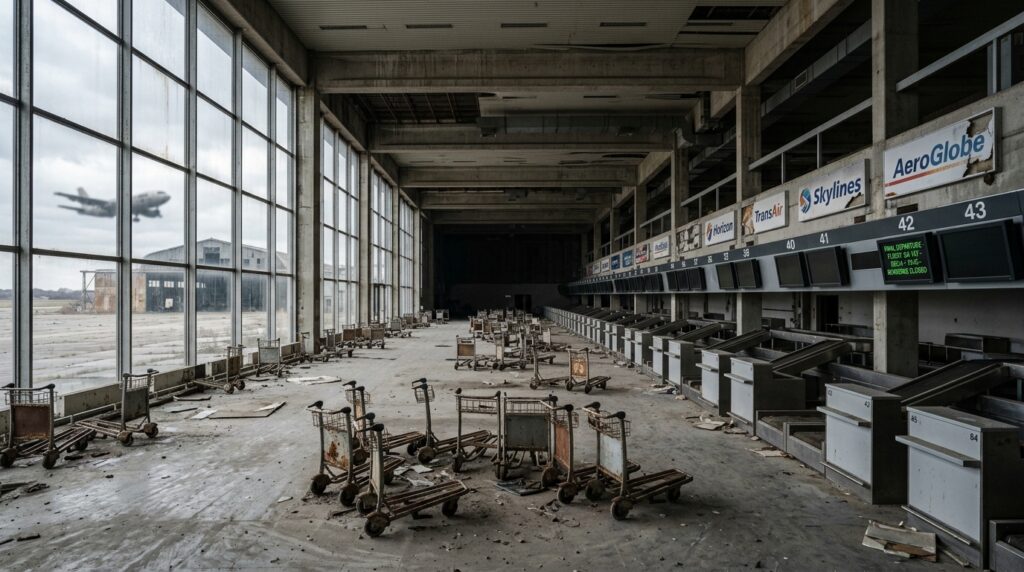
Records suggest the final commercial flight departed on an unremarkable Tuesday morning.
There was no ceremony. No last announcement. The ground crew completed their checks, the passengers boarded, and the plane taxied to the runway for what nobody realised would be the final time. Within months, the terminal was locked and the airline had redirected its routes elsewhere.
The departure board, however, was never reset.
Whether this was oversight or sentiment, no one can say for certain. What is certain is that it still stands today, its mechanical flip-tiles locked in their last position, showing a set of flights that have now been delayed by decades.
Exploring the Terminal: What You Would Find Today
Walking through the terminal — hypothetically, and only with proper authorisation — would be an exercise in sensory contradiction.
The Smell
It hits first. Stale air, heavy with the particular mustiness of a sealed building. Not rot exactly. More like stillness made physical. Old plastic, aged rubber flooring, the ghost of ten thousand spilled coffees.
The Sound
Or rather, the absence of it.
Airports are acoustically lively spaces. All that hard surface — concrete floors, glass walls, steel ceilings — bounces sound endlessly. In an active terminal, the result is a constant low roar of overlapping noise.
Empty, those same hard surfaces amplify every tiny sound you make. A footstep becomes an event. A dropped phone sounds like a gunshot. You become painfully, almost embarrassingly aware of your own breathing.
The Light
Where the roof panels have cracked or shifted, thin columns of dusty light fall to the floor. On the right morning, the effect is almost cathedral-like. Particles of dust drift through those beams in absolute silence.
The fluorescent tube lighting gave up long ago, of course. Most of the fixtures hang dark. A few flicker occasionally — a phenomenon caused by moisture in old wiring rather than anything more dramatic, though the effect is no less unsettling.
The Details That Stop You Cold
- A departures board still showing flight numbers and gate assignments
- Plastic chairs bolted in rows, some still holding old magazines
- A currency exchange booth with rate cards still displayed in the window
- Rubber stamps left beside an immigration desk
- A single child’s toy left near a gate, small and faded
It is always the small things. Not the grand scale of the decay, but the personal objects left behind by the last people who passed through.
Why Airports Are Abandoned — The Real Reasons
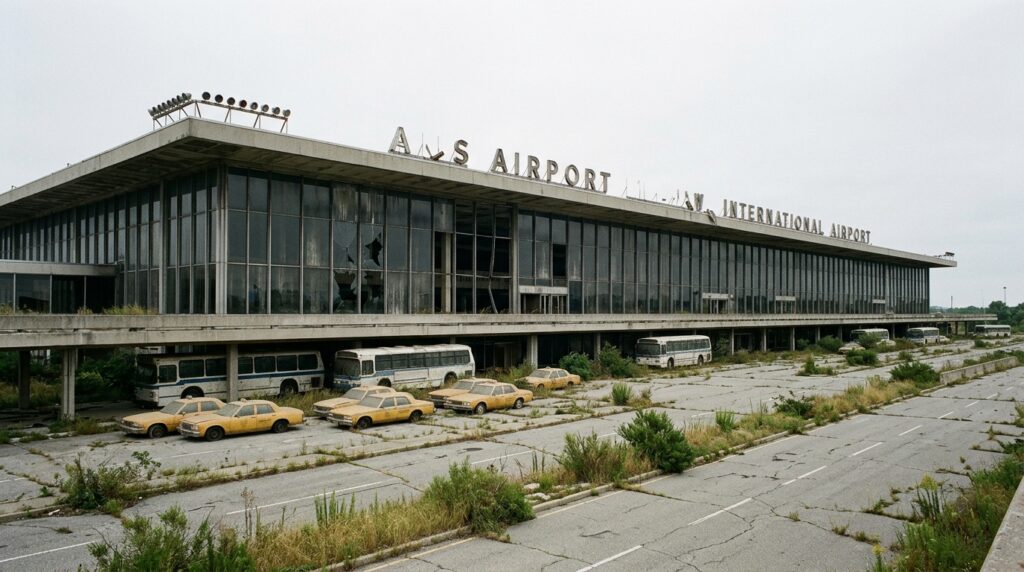
Understanding why an airport closes helps make sense of what you are looking at.
1. Economic Unviability
Regional airports are expensive to maintain. They require constant staffing, active runways, navigation equipment, and emergency services on standby. When passenger numbers drop below a certain threshold, the operating costs simply cannot be justified.
Many smaller airports in the post-deregulation era of commercial aviation found themselves unable to compete. Budget airlines bypassed them entirely in favour of larger hubs with more routes and better connections.
2. Political and Infrastructure Decisions
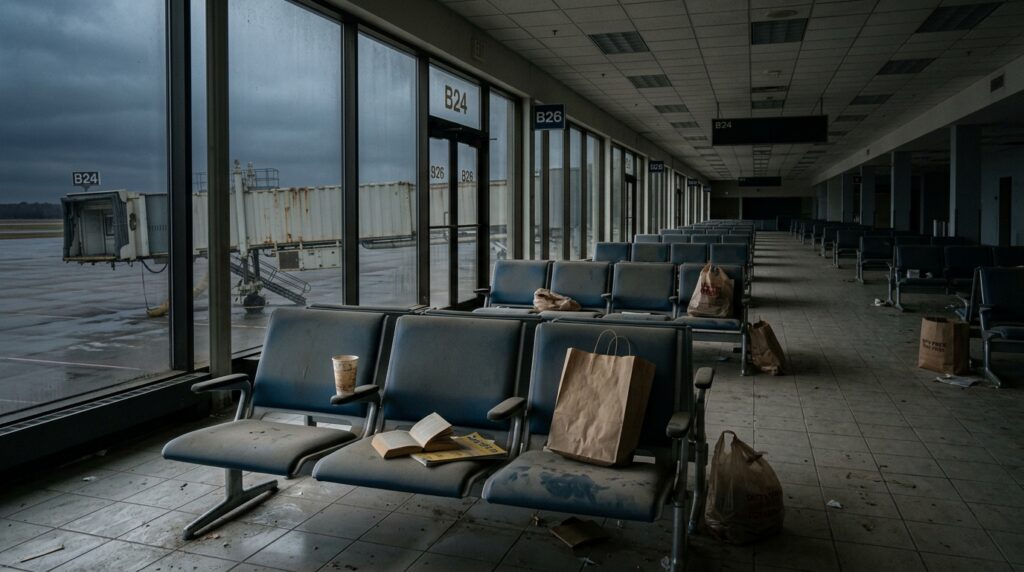
Sometimes a new airport is built nearby. Sometimes a government redirects investment toward a larger regional hub. The old facility becomes redundant almost overnight.
This is not unique to aviation — it mirrors what happened to many train stations and ferry terminals across the 20th century.
3. Environmental and Planning Constraints
Airports take up significant land. As urban areas expanded, some airports found themselves surrounded by residential development. Noise complaints, planning restrictions, and land values all conspired to make continued operation untenable.
Closure became the path of least resistance.
4. Disaster and Force Majeure
A small number of airports were closed by events outside human control. The most famous modern example is the airport near the Soufrière Hills volcano on Montserrat — buried under ash and rendered permanently inoperable. For more about aviation’s abandoned and forgotten corners, the abandoned places archive on this site explores several such stories in depth.
The Cultural Resonance of Abandoned Transit Spaces
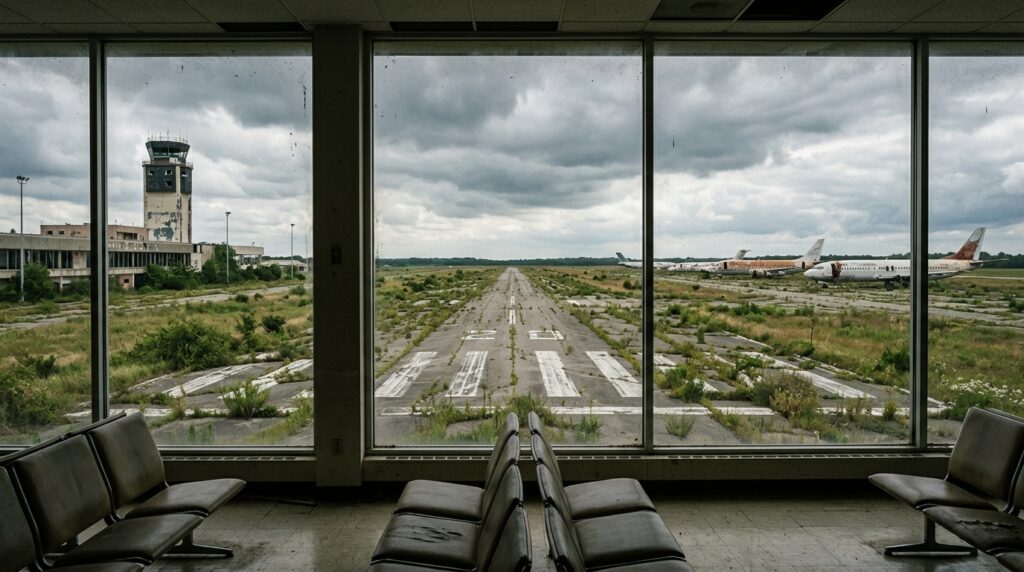
There is a specific genre of emotional response to abandoned transit infrastructure.
Philosophers and cultural theorists sometimes call these spaces non-places — locations defined by movement and transition rather than identity or belonging. Train stations, motorway service areas, airport terminals. Places you pass through, never places you actually are.
When a non-place is abandoned, it becomes something stranger. It retains all its structural grammar — the queues, the gates, the check-in desks — but the function has vanished. What you are left with is pure architecture, stripped of purpose.
It is, in its way, a deeply philosophical experience.
You stand in a space designed entirely around human movement and there is absolutely no movement at all. The building asks a question with its every corridor and doorway — where are you going? — and the only honest answer is nowhere.
The Departure Board: A Symbol Frozen in Time
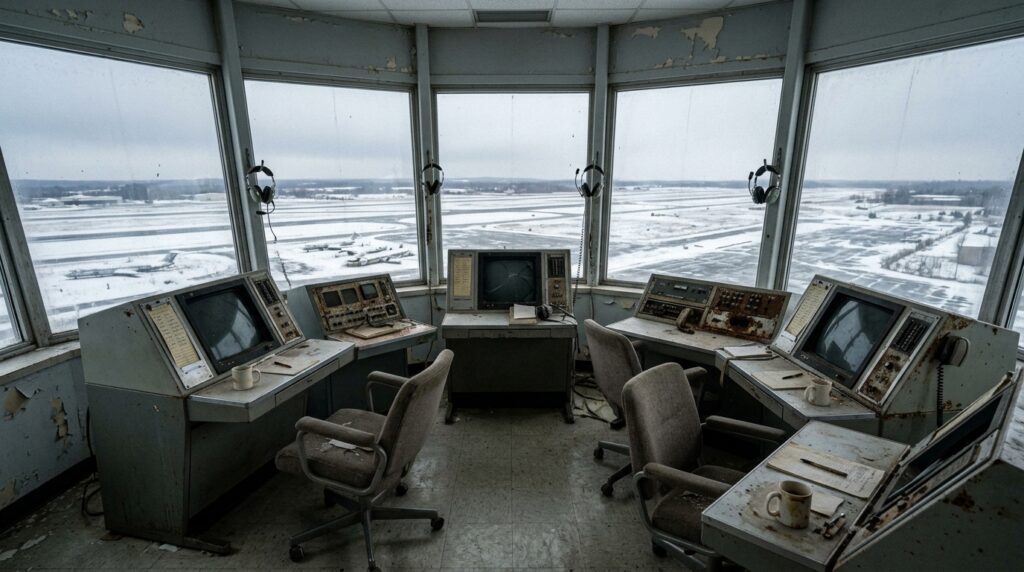
Let us return to that board for a moment.
Mechanical split-flap displays — the kind that make that iconic rattling cascade of sound when they update — were the standard departure board technology from roughly the 1960s through the 1990s. Most major airports replaced them with LED and LCD screens in the late 1990s and 2000s. A working split-flap display is now a rarity.
A stopped split-flap display in an abandoned terminal is something else entirely.
Each tile is a small mechanical component, held in place by the last electrical impulse it ever received. The destinations it shows were real. The flight times were published in actual schedules. Somewhere, there may be a person alive today who was booked on one of those flights — who remembers checking that board and finding their gate.
That board has not moved since.
Of all the abandoned places catalogued on abandoned.blog, few carry the symbolic weight of a frozen departure board. It is, in its way, the most honest monument to abandonment that a building can offer.
Is It Legal to Visit Abandoned Airports?
This question comes up every time someone writes about urban exploration.
The short answer: usually no, without explicit permission from the property owner or relevant authority.
Most abandoned airports are privately owned, under the custody of a government body, or protected under heritage legislation. Entering without permission is trespassing, regardless of how photogenic the interior may be.
The responsible approach — and the one this site always advocates — is to seek legitimate access. Some abandoned sites are open for guided tours. Others can be visited through heritage organisations or photography groups that hold proper authorisation.
If you are passionate about documenting forgotten places, pursue it legally. The photographs will be just as striking, and you will not be contributing to the vandalism and damage that has destroyed so many remarkable sites.
What Happens to Abandoned Airports?
Most do not stay abandoned indefinitely.
The land is simply too valuable, and the infrastructure — however dated — is still substantial. Common outcomes include:
- Conversion to film and television sets — several famous abandoned airports have enjoyed second lives as movie locations
- Redevelopment as logistics hubs — the hangars and runways repurposed for cargo operations
- Heritage preservation — a small number are protected as architectural or historical landmarks
- Complete demolition — the majority are eventually cleared for housing or commercial development
- Partial reuse — terminal buildings converted to museums, event spaces, or offices while the runways are decommissioned
The airport in this story falls into an uncertain category. Its future has not been formally decided. For now, it stands exactly as the last passengers left it — departure board and all.
Conclusion: An Abandoned Airport Where Time Still Waits
Every abandoned airport tells a story about the particular moment when the world moved on without it.
The departure board frozen mid-update. The gate numbers still visible on their signs. The empty baggage hall echoing with nothing. These are not just aesthetic details — they are a record of an ending that happened too quickly for anyone to properly mark.
There is no ceremony in an airport closure. No last ceremony, no final photograph, no community gathering. One day the flights stop. The lights go out. The building waits.
And sometimes, it keeps waiting.
If this kind of exploration resonates with you — the history, the silence, the stories left behind in abandoned spaces — there is a whole world of forgotten places worth understanding. None of them will disappoint.
Frequently Asked Questions
Q: Are abandoned airports safe to explore? Structurally, abandoned airports can be dangerous. Roofs deteriorate, flooring weakens, and asbestos was commonly used in buildings from the mid-20th century. Never enter an abandoned structure without proper authorisation and safety awareness.
Q: Why do some airports get abandoned instead of demolished? Demolition is expensive and time-consuming. Many property owners or government bodies defer the decision for years — sometimes decades — while ownership disputes, planning applications, or funding questions remain unresolved.
Q: What is a split-flap departure board? A split-flap display uses rows of mechanical tiles, each printed with letters and numbers, that flip to create changing text. They produce a distinctive rattling sound when updating and were the dominant airport display technology from the 1960s to the 1990s.
Q: Where can I find more information about abandoned places? Heritage organisations and urban exploration communities document many such sites. Always prioritise legal access and responsible documentation.
Q: Are there many abandoned airports in the world? Yes — according to aviation historians, hundreds of commercial and military airports have been decommissioned globally since the post-war era. Many have been redeveloped. A notable number remain standing in various states of decay.
This article is for informational and historical purposes only. The author does not encourage trespassing or illegal entry of any kind. Always respect private property and local laws.