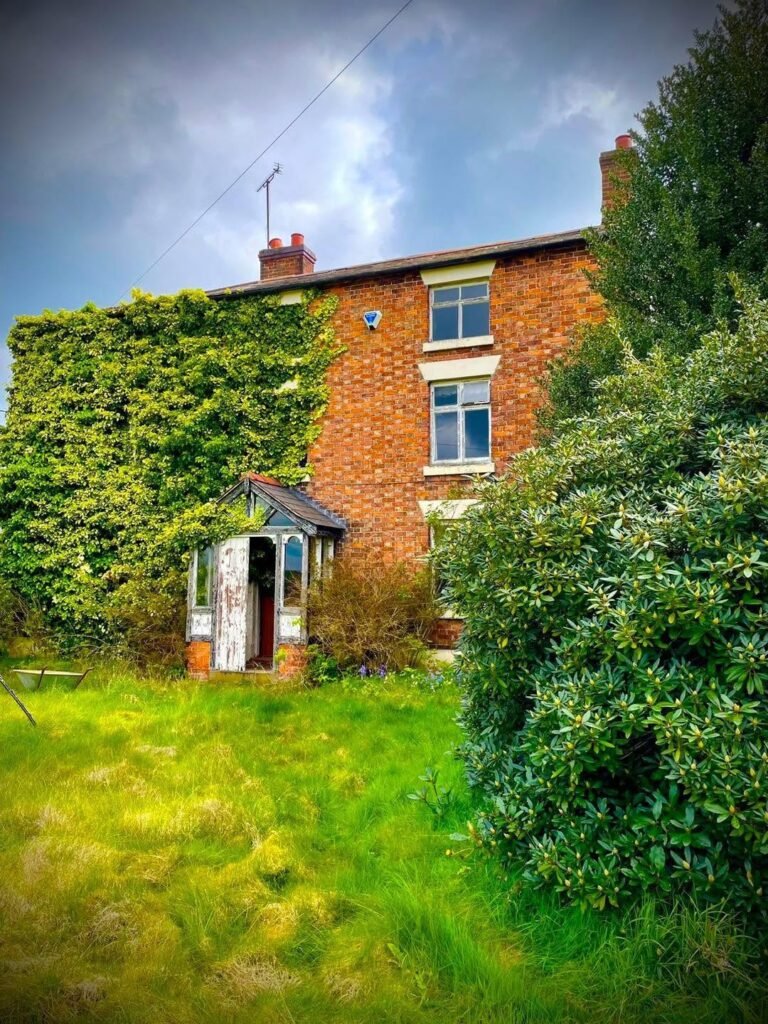
The ivy got there first. It covers the whole left half of the house, a thick green wall climbing past the upstairs windows and over the roofline, and it has started on the porch too. The rest of the building is still visible — red brick, white-framed windows, two chimneys — but the plant is winning the argument about who owns the place now. This is the house Luke2Explore calls the Abandoned Ivy Manor, posted on 25 January 2026, and the post is unusually honest about how little it knows.
That honesty is worth keeping. The post says there is not much history or information on this one. What it can say is that the house was once lived in by farmers, that it sits derelict, and that it has been abandoned for quite some time. No village, no county, no date of abandonment is given, and none is given here either. Everything in this article comes from that post and from the five photographs shown here.
A bigger house than it looks from the road
From the front, the manor reads as an ordinary two-storey farmhouse. Inside, the post says, it is massive: more than five rooms upstairs, a huge living room, a kitchen, and three to four rooms downstairs. That is at least ten rooms in a building that looks, from the lawn, like a family home of modest size.
The size matters because it changes what the emptiness means. A cottage left empty is one family’s story. A house of ten or more rooms, once lived in by farmers, left with almost nothing inside, is a working household that came apart — or moved on — and left the building to the damp. The post does not say which, and guessing would be inventing a history the source does not have.
| Floor | What the post says is there |
|---|---|
| Upstairs | More than 5 rooms |
| Downstairs | Huge living room, kitchen, 3–4 rooms |
| Left behind | Not much |
The table is short because the facts are short. That is the whole of what the post records about the layout, and the photographs fill in the rest only in fragments: two bedrooms, one fireplace wall, one small detail of a phone and a mirror.
What the rooms still hold
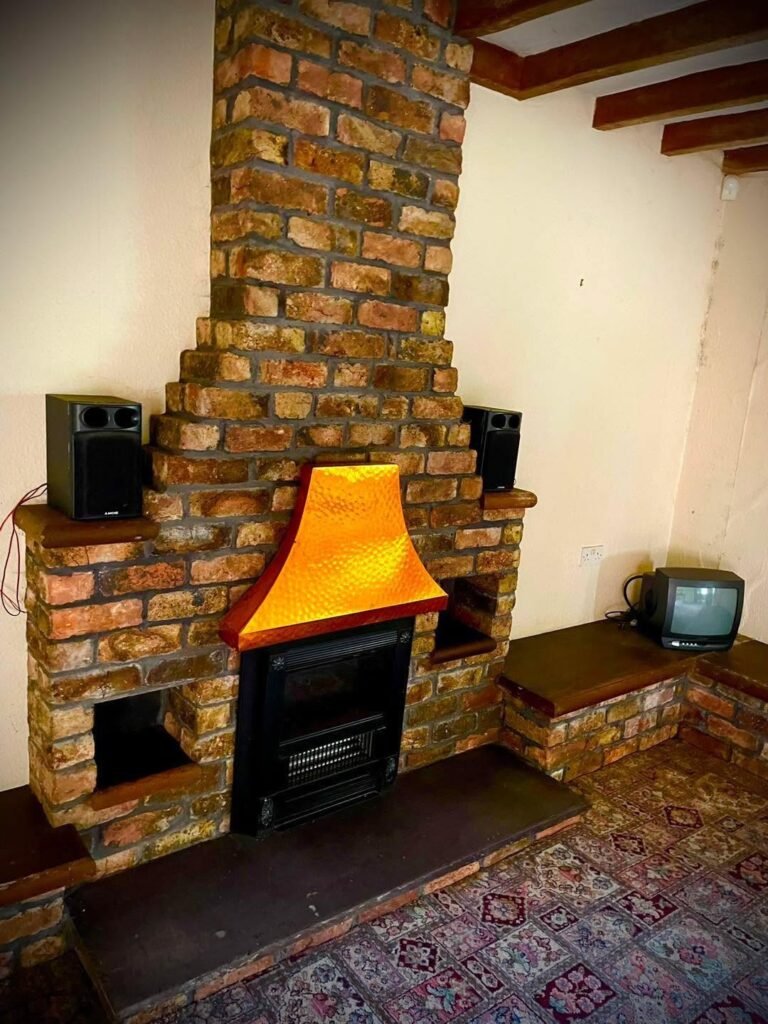
The first interior photograph is the fireplace wall: a brick fireplace with a bright orange or copper hood, black speakers sitting on the mantel ledges, and a small CRT television on a brick bench below. It is the kind of arrangement that dates itself — the television, the speakers, the patterned carpet — without needing a year attached to it.
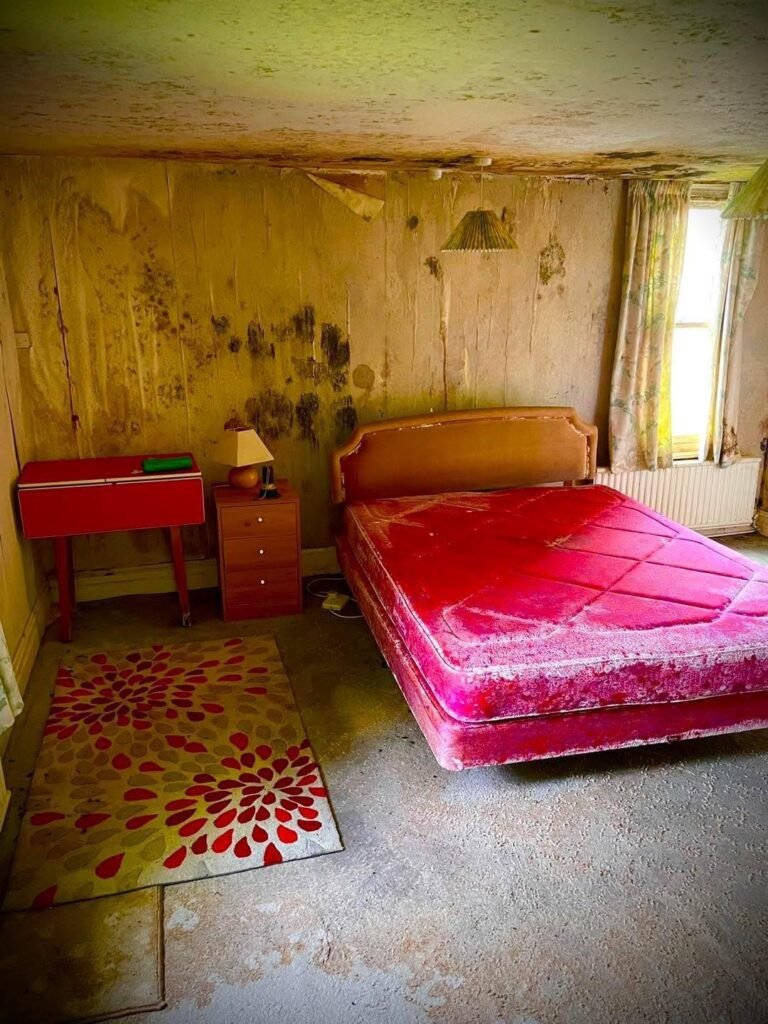
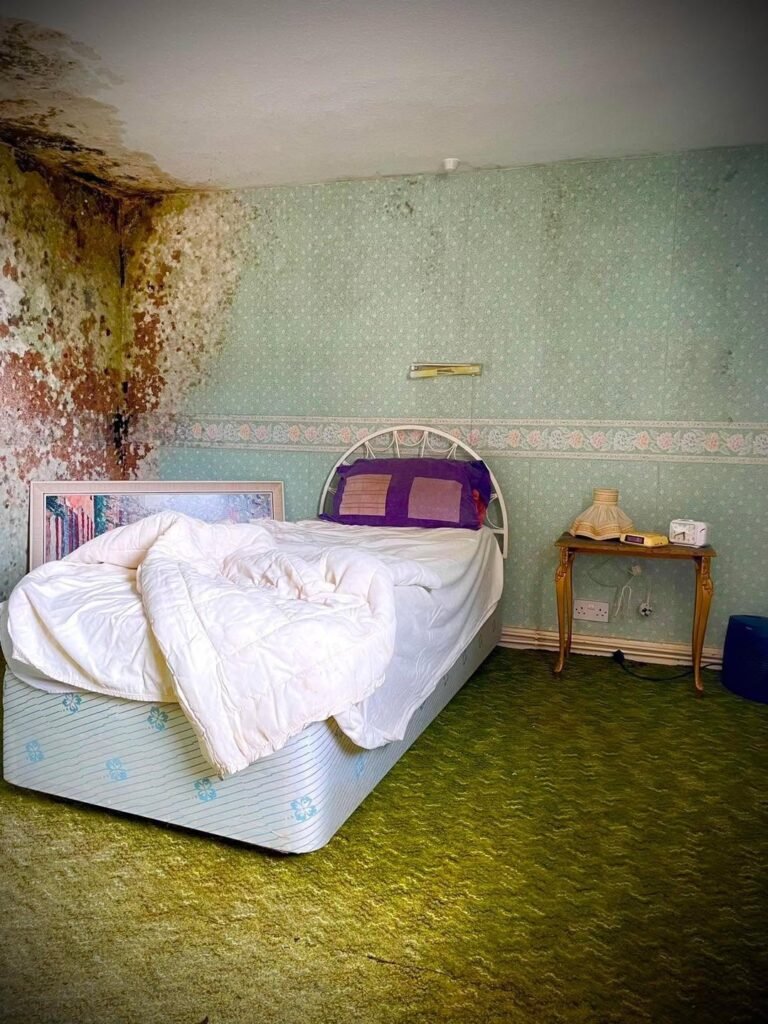
The two bedrooms tell the same story in a sadder register. One has a bare red and pink quilted mattress on a brown headboard bed, a bright red side table, and a small wooden bedside drawer with a lamp, all of it under yellow wallpaper stained with mould. The other has a single bed with white bedding and a purple pillow against a white metal headboard, a wooden bedside table with a woven lamp and a radio, and green carpet under pale-green floral wallpaper, with heavy damp staining running across the wall and into the ceiling corner.
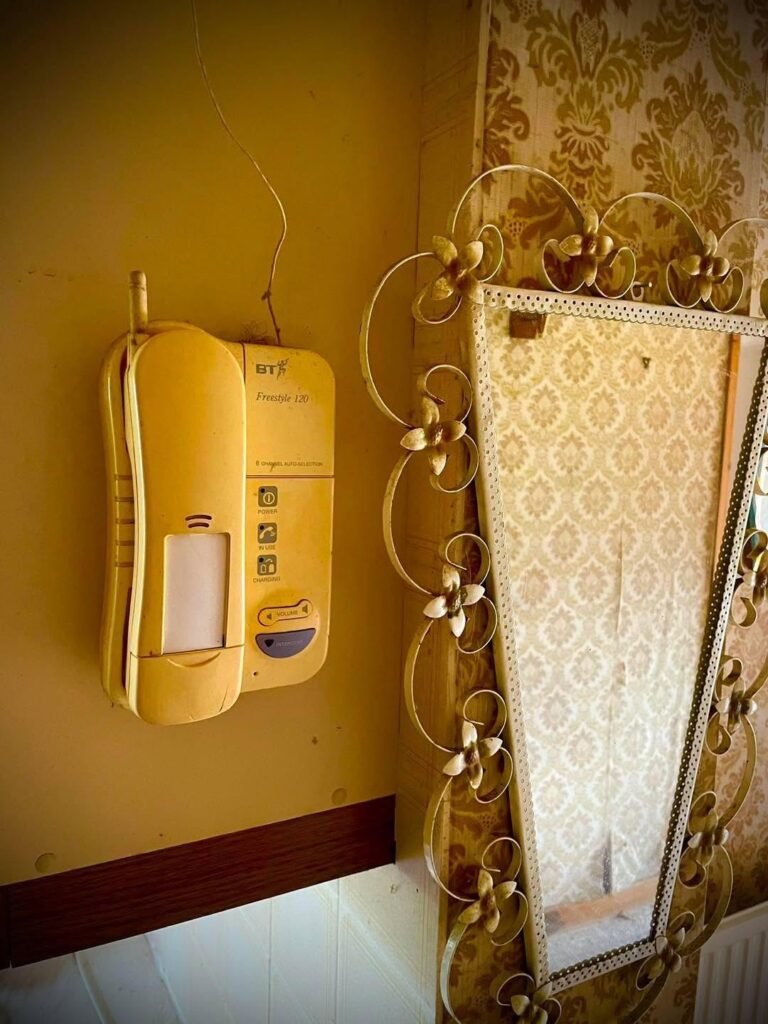
The last photograph is the smallest and the most telling. A yellowed BT “Freestyle 120” cordless phone hangs on a yellow wall beside an ornate gold-framed mirror with floral scrollwork, against faded floral wallpaper. The phone is a household object from a specific era, and it is still on its hook. Nobody came back for it.
None of these rooms looks cleared out in a hurry. They look picked over slowly, or simply left, with the damp doing the rest. The ceilings are stained, the wallpaper is peeling, and the carpets are the colour of rooms that have not been heated in years.
Why the ivy matters
It would be easy to treat the ivy as decoration, but it is also the most honest clock in the photographs. Ivy that thick does not grow in a season. It takes years of no pruning, no clearing, no one cutting it back from the windows. The overgrown lawn and the large bush crowding the front say the same thing: nobody has stood in that garden with a pair of shears for a long time.
That is the real subject of this post. Not a mystery, not a tragedy with a known ending, but a farmhouse that was once full — more than five rooms upstairs, a huge living room, a kitchen — and is now a building being slowly reclaimed by the plants around it. The post ends by hoping the reader enjoys the pictures and has a good week ahead. There is nothing more to add to that, because there is nothing more the source knows.
For a contrast with a house that is lived in and on the market, see a lived-in 1902 home in Alexandria, Minnesota, where the questions are about upkeep and price rather than about what years of damp and ivy do to a farmhouse. More houses in this condition are gathered in abandoned houses, and the site’s front page is abandoned.blog.
FAQ
Where is Ivy Manor?
The post does not give a location beyond calling it a farmhouse once lived in by farmers. No exact address is given here.
Who lived there?
According to the post, farmers lived in the house. No names are given.
How big is the house?
The post says it has more than five rooms upstairs, a huge living room, a kitchen, and three to four rooms downstairs.
How long has it been abandoned?
The post says it has been abandoned for quite some time. No date is given.
What is left inside?
According to the post, not much is left behind. The photographs show a fireplace with a CRT television, two bedrooms with beds and small furniture, and a cordless phone still on the wall.
Can I visit it?
No visiting information is given here, and entering private property without permission is not encouraged.
Disclaimer
This article is general information only, not legal, tax, or financial advice. Rules on abandoned and private property differ by state and county; check county/local records and a local professional before acting. The account of the house and its former occupants is as reported in the source post and has not been independently verified.
Photos
Photos by Luke2Explore, via the original Facebook post: https://www.facebook.com/Luke2Explore/posts/abandoned-ivy-manorthe-derelict-ivy-manor-not-much-history-information-on-this-o/1347610644071287/ — 5 of the 25 photos are shown here.