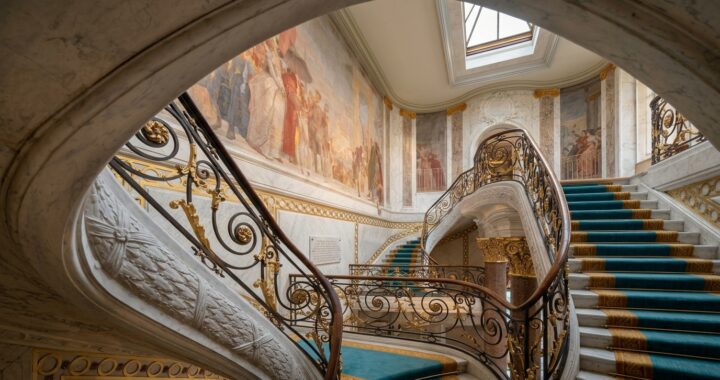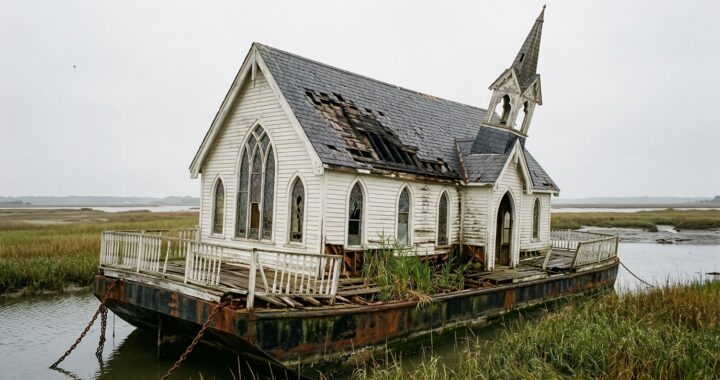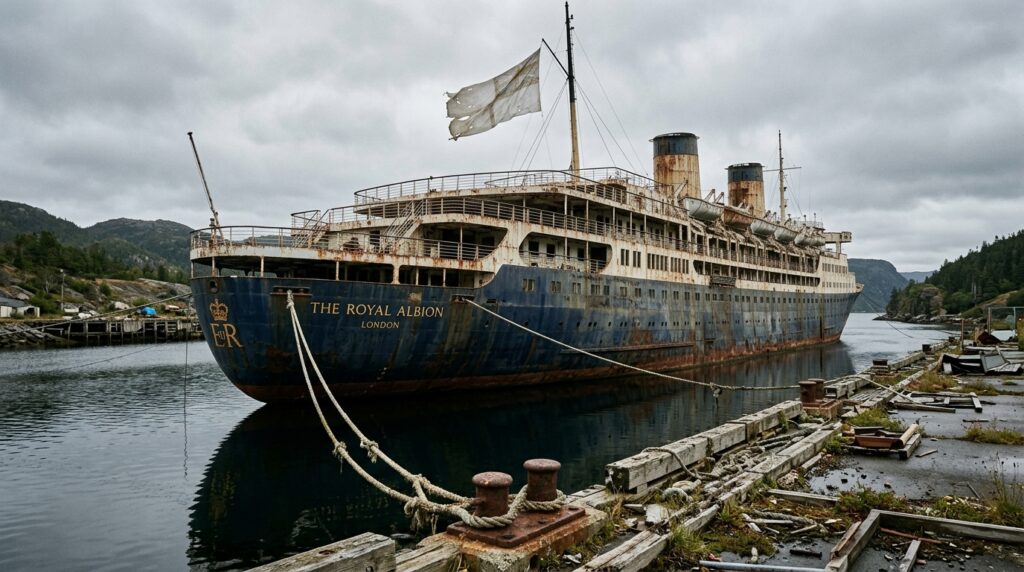
There’s something deeply unsettling about a ship that no longer moves. The ocean didn’t swallow it. No storm dragged it under. It simply… stopped. And everything inside — the chandeliers, the carpets, the gilded staircases — just stayed.
Introduction: A Ghost on the Water
The first thing you notice is the silence.
Not the comfortable kind, either. This is the silence of something that used to roar — with engines, with laughter, with the clink of crystal glasses in a first-class dining room. Now it just sits. Rusting. Forgetting.
The abandoned royal cruise ship I’m about to walk you through is one of the most surreal places I’ve ever set foot inside. Grand staircases still sweep upward to empty decks. The grand hall’s ceiling plasterwork — cracked but holding — catches the thin light filtering through salt-fogged portholes. Somewhere deeper in the hull, water drips in a steady, hollow rhythm.
This isn’t a horror story. It’s a history lesson wearing a ghost costume.
The Golden Age of Ocean Liners: A World That No Longer Exists
To understand what makes an abandoned cruise ship so haunting, you first have to understand what these vessels meant.
From roughly the 1880s through the 1960s, ocean liners were the undisputed kings of long-distance travel. They weren’t just transport. They were floating cities — complete with ballrooms, libraries, smoking lounges, swimming pools, and restaurants that would put most landlocked establishments to shame.
The grandest ships were deliberately designed to feel like palaces. Architects drew inspiration from Versailles, from the great hotels of London and Paris, from the ornate theatres of Vienna. Walls were panelled in mahogany and teak. Floors were laid in Italian marble. Ceilings soared.
First-class passengers expected — and received — a level of luxury that bordered on absurd. Seven-course dinners. Live orchestras. Private promenades. Staterooms furnished with real antiques.
For a few decades, these ships weren’t just popular. They were aspirational. Crossing the Atlantic or the Pacific on a great liner was something you dressed up for. Something you wrote home about.
Then the jet age arrived. And almost overnight, it ended.
According to Wikipedia’s history of ocean liners, transatlantic passenger numbers by sea dropped dramatically through the 1960s as commercial aviation expanded — a shift that left dozens of grand ships economically unviable within a single decade.
The ships that had cost millions to build suddenly couldn’t fill their berths. Companies merged, folded, or pivoted to cruising. And some vessels — the proudest, grandest ones — simply ran out of road.
Finding the Ship: What Urban Explorers Don’t Tell You
Most urbex content skips the part that matters most: the research.
Finding a genuinely untouched abandoned ship isn’t like finding a derelict house. Ships are expensive to maintain, expensive to scrap, and endlessly argued over by port authorities, heritage groups, environmental agencies, and insurance companies. Which means they often sit in legal limbo for years — sometimes decades.
The ship I’m describing here fits that exact pattern. It changed owners twice. It was promised to a museum that never materialised. A private buyer made a deposit, then walked away. And through all of it, the ship just sat at its berth, slowly rusting, with no one quite willing to deal with it.
I found out about it through a combination of old maritime registry records, port authority notices, and a brief but telling local newspaper article from years prior. For serious explorers, that kind of documentary archaeology is half the work.
A note on safety and legality: I want to be absolutely clear — I’m not encouraging anyone to trespass on private or restricted property. Abandoned ships carry genuine physical dangers: rotting decks, unstable bulkheads, toxic materials including asbestos and heavy metals, and unpredictable flooding in lower compartments. Any visit to a site like this should be conducted legally, with appropriate permissions, and with proper safety equipment.
For more examples of historically significant abandoned places explored responsibly, browse the archive at Abandoned Blog — a resource I return to regularly for context and community.
Step Inside: The Grand Hall
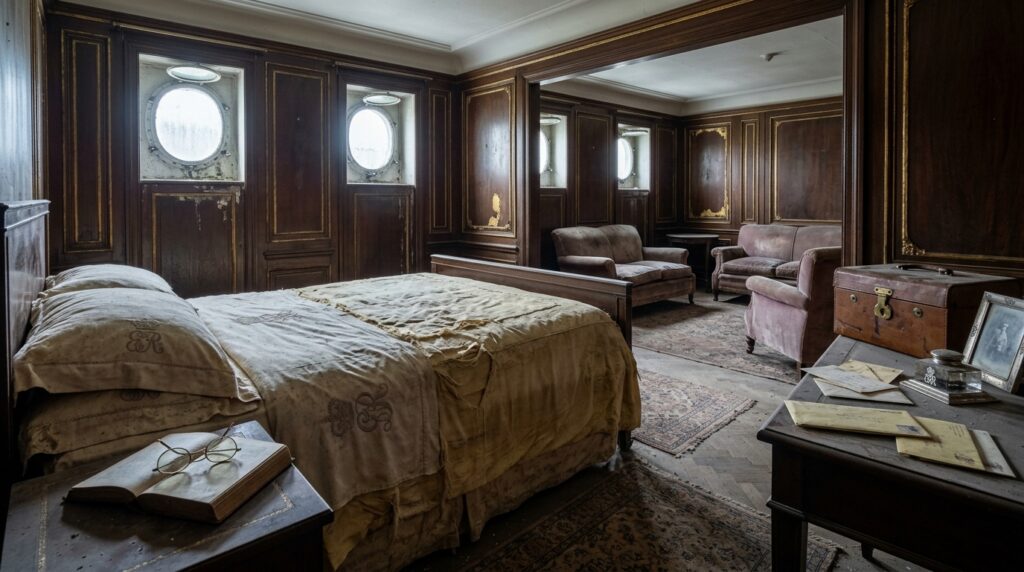
This is the part I know you’re here for.
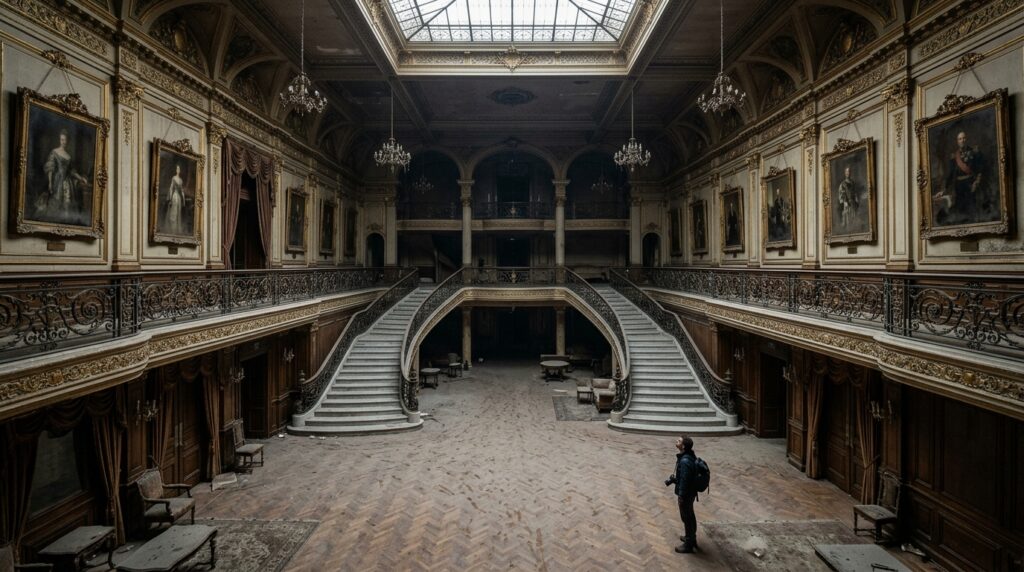
The grand hall sits at the centre of the ship’s upper passenger decks — a deliberate architectural choice, positioning it as the social heart of the vessel. Two decks high. Wrapped in a curving balcony supported by slender iron columns, each one painted cream and gold. Or what was cream and gold. Now it’s the colour of old teeth.
The floor is still there. Inlaid parquet wood, geometric patterns radiating outward from the centre — a sunburst design that was probably breathtaking when it was polished weekly. Today it’s warped and buckled in places, the gaps between boards wide enough to lose your footing. But the pattern survives. You can still see exactly what it was meant to be.
The chandelier is the detail that stops everyone.
It hangs from the ceiling on a chain so heavily oxidised that it looks almost organic, like something grown rather than forged. The crystal drops — hundreds of them — are filmed with a decade of dust and salt, but they’re still there. They still catch the light. On a clear afternoon, when sun angles in from the porthole on the port side, the whole hall fills with tiny scattered prisms.
It shouldn’t be beautiful. But it is.
Deck by Deck: What Survives
The First-Class Dining Room
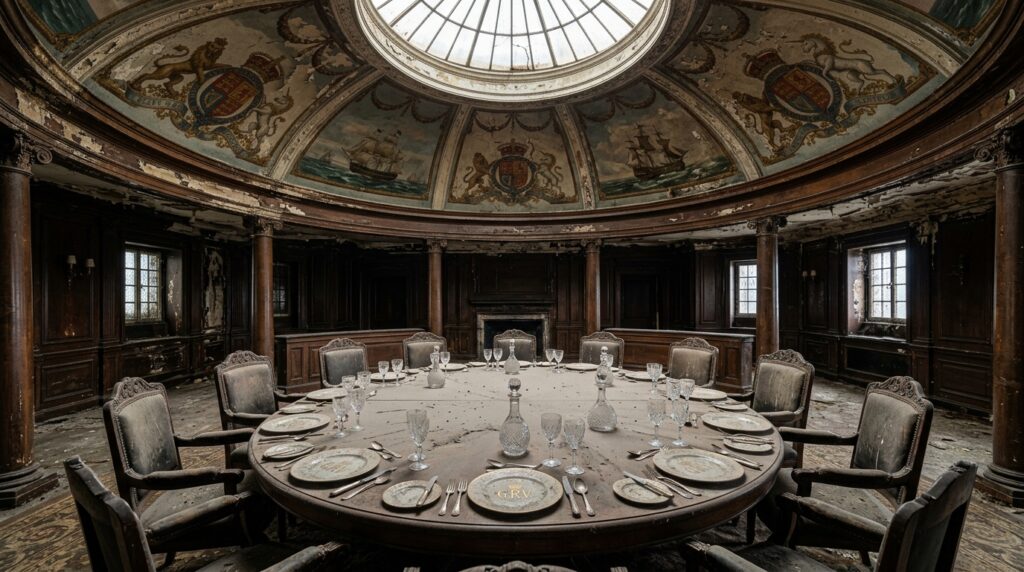
Move aft from the grand hall and you find the dining room. Long tables — solid mahogany, from the weight of them — still occupy the floor space. Some still have chairs around them. White tablecloths, or what remains of them, have fused with the tabletops in the humidity. Place settings are long gone, looted in the early years.
But the wall panels survive. Dark wood, inlaid with lighter geometric marquetry in the Art Deco style. The ceiling medallions are intact. The service hatch to the galley still opens on its original hinges — with a groan like something in pain, but it opens.
The Captain’s Promenade
Up two decks and forward, the captain’s promenade wraps around the bridge superstructure. Out here, the sea air has done more damage. The teak decking is largely gone — rotted through, or stripped. But the brass fittings on the railings have weathered to a deep chocolate brown, and the view — over the foredeck, past the anchor chains, out to the waterline — still carries that sense of command that these spaces were designed to project.
The Ballroom
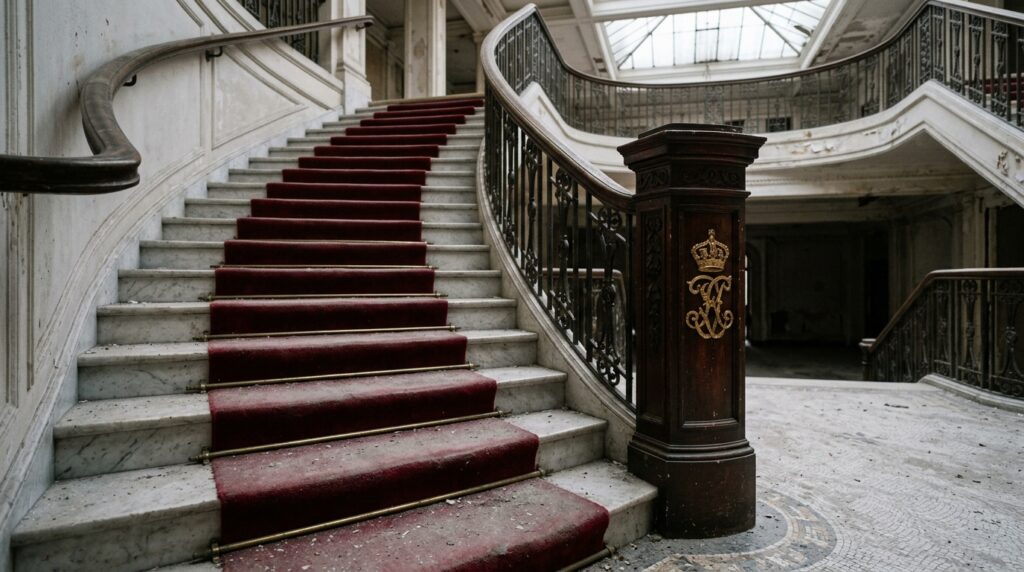
The ballroom was clearly the jewel. Even now, stripped and grey, it communicates scale in a way that few rooms can.
The stage at the far end still has its proscenium arch. Red velvet curtains — or something that was once red velvet — hang in rigid, mould-darkened folds. The sprung dance floor has lifted along one wall where water got underneath. But the ceiling. The ceiling is extraordinary.
Plasterwork panels, each one depicting a classical scene — Neptune, dolphins, waves, distant coastlines. Painted originally in blues and greens and gold. Now faded to pastels, the colours bleached by decades of damp. But the detail in the plasterwork is still there. Still sharp. Tiny shells modelled along the cornice. Rope-twist borders around each panel.
Someone spent months on that ceiling. And it’s still spending its days in an empty room, being admired by nobody.
The History Behind the Hull
Ships like this weren’t built — they were composed. The interiors were contracted out to the finest design firms of their era. Cabinet makers, metalworkers, textile weavers, tile manufacturers. A single first-class staircase might represent the work of a dozen different artisans.
The World Monuments Fund, which advocates for threatened architectural heritage globally, has increasingly drawn attention to the loss of mid-century maritime interiors — a design heritage that is poorly documented and rapidly disappearing.
The vessel I’m describing here was launched during the post-war boom, when shipping companies were flush with optimism and government contracts. The brief was simple: make it grand. Make it feel like Europe at its most elegant, transported to the high seas.
They succeeded. The design language is unmistakably of its moment — streamlined Art Deco transitioning into the warmer, more organic Mid-Century Modern aesthetic. Chrome and walnut. Curves and cantilevers. The materials were the finest available at the time, which is part of why so much has endured.
Why These Ships Are Never Saved
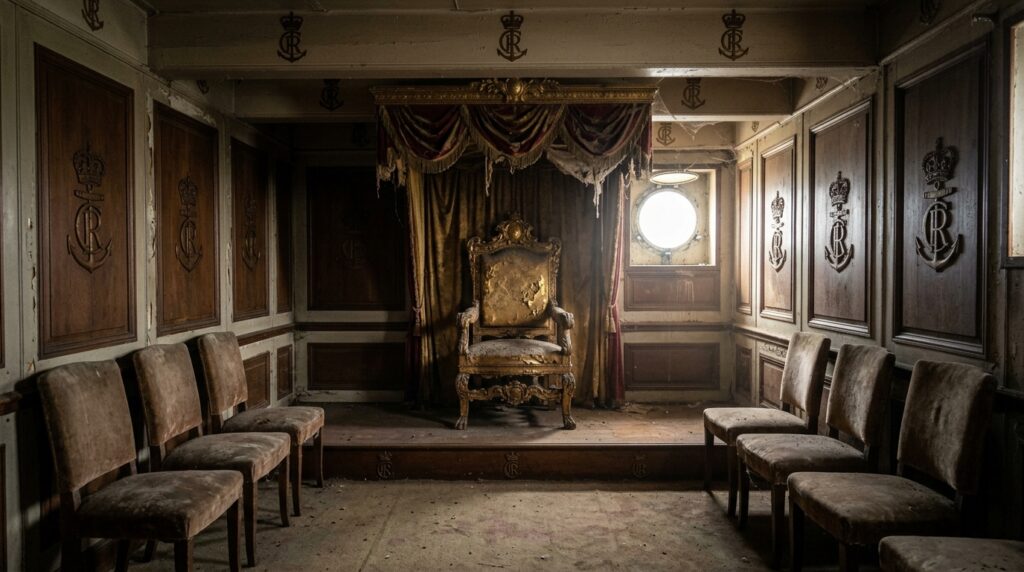
It’s a question worth asking. Why does a ship this beautiful sit and rot?
The answer is almost always the same, and it comes down to numbers.
Restoring a vessel of this size costs tens of millions. The structural work alone — hull integrity, watertight compartments, mechanical systems — runs into figures that make heritage grants look laughable. And that’s before you touch a single chandelier or parquet tile.
Museums want the romance but not the liability. Private buyers want the prestige but not the operating costs. Local governments want the tourism but not the controversy over public money.
So the ships wait. And slowly, year by year, the water gets in.
There are a handful of preserved historic ships around the world — the Queen Mary in Long Beach, the SS Rotterdam in the Netherlands — that show what’s possible when the will and the funding align. But they are the exceptions. For every ship that makes it, a dozen more quietly disappear.
The Smell, the Silence, the Feeling
I want to spend a moment on the sensory reality of this kind of place, because photographs never quite capture it.
The smell hits you at the gangway. Rust and salt, obviously — but underneath that, something older. Varnish going rancid. Old carpet releasing decades of absorbed moisture. Wood that has given up trying to be wood.
The silence is layered. There’s the base layer of absolute quiet. Then the ship’s own sounds — creaks, the soft percussion of water somewhere in the bilges, the occasional distant moan of metal contracting in the afternoon heat. It sounds inhabited. Which makes the emptiness stranger.
And there is a particular emotional weight to spaces that were designed for celebration and now hold nothing. Ballrooms are sadder than bedrooms. Dining rooms are sadder than offices. The grander the original intention, the more acute the loss.
That’s what makes abandoned cruise ships different from most other urbex subjects. A factory ruin speaks of industry and economics. A cruise ship speaks of joy.
Conclusion: The Ship Remembers
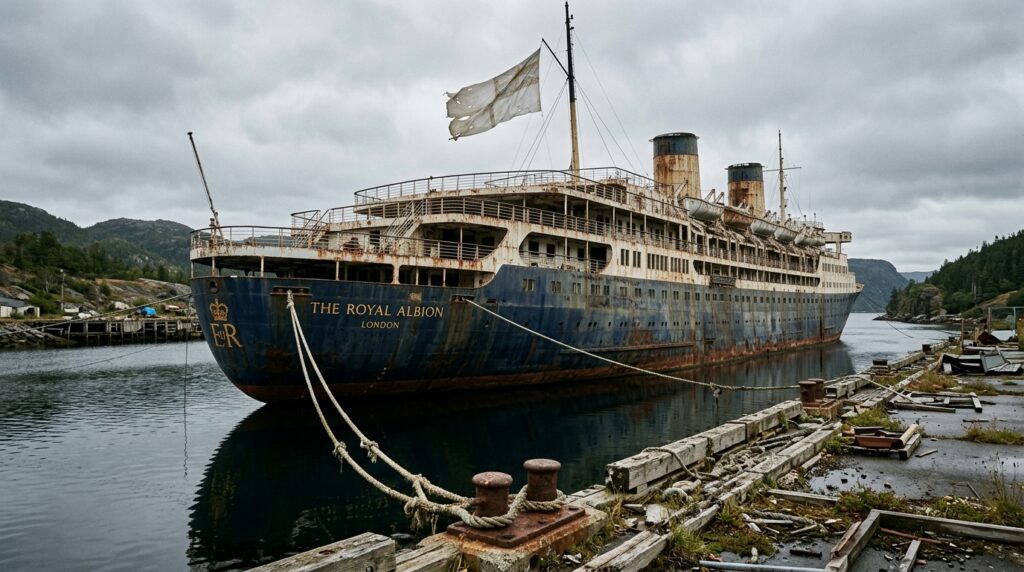
The abandoned royal cruise ship I walked through that day hasn’t forgotten what it was.
You can feel it in the grand hall, where the chandelier still catches light after all these years. You can see it in the dining room’s marquetry panels, patient and precise in the dark. You can hear it — almost — in the hollow acoustics of the ballroom, where the ceiling still tells its painted stories to an empty floor.
These places matter. Not because they can be saved — most of them can’t. But because they’re documents. Living archives of a particular human ambition: the desire to cross vast distances in beauty, surrounded by the best that craftspeople could make.
If you want to explore more sites like this — honestly, responsibly, with the history given the weight it deserves — start withthe forgotten places documented at Abandoned Blog. The stories are there. You just have to know where to look.
Go carefully. Go respectfully. And go before they’re all gone.
FAQ: Abandoned Royal Cruise Ships
Q: Is it legal to explore abandoned ships?
A: Abandoned ships are almost always on private or government-controlled property. Entry without permission is trespassing and can carry serious legal penalties. Always obtain proper authorisation before visiting any abandoned site.
Q: Are abandoned ships dangerous to enter?
A: Yes. Rotting decks, asbestos insulation, toxic paint, unstable structures, and the risk of flooding in lower decks make abandoned ships genuinely hazardous. Professional-level safety equipment and experience are essential.
Q: What happens to most abandoned cruise ships?
A: The majority are eventually scrapped — broken down at ship-breaking yards, primarily in South Asia. A small number are preserved as museum ships or tourist attractions. Heritage protection for ships is far less developed than for buildings.
Q: What is the most famous abandoned cruise ship?
A: The SS United States is perhaps the most famous — a record-breaking American ocean liner that has sat abandoned in Philadelphia for decades while preservation efforts continue. Several other vessels, including various former Soviet cruise ships, have also become well-known in urban exploration circles.
Q: Why do abandoned ships keep their interiors intact?
A: Ships are often inaccessible to casual looters, and their interiors are sometimes too damaged or dangerous to strip easily. Combined with legal disputes that delay demolition for years, this means original fixtures can survive surprisingly long after a ship is decommissioned.
Q: Where can I find more abandoned place content?
A:Abandoned Blog covers a wide range of forgotten and derelict sites with historical context and responsible exploration practices.
All urban exploration described in this article was conducted legally and with appropriate permissions. This article does not encourage trespassing. Always respect private property and local laws.