Introduction
Some places stay with you long after you leave.
Not because of what happened there. But because of what didn’t. The silence. The stillness. The feeling that time slipped out through the windows and never came back.
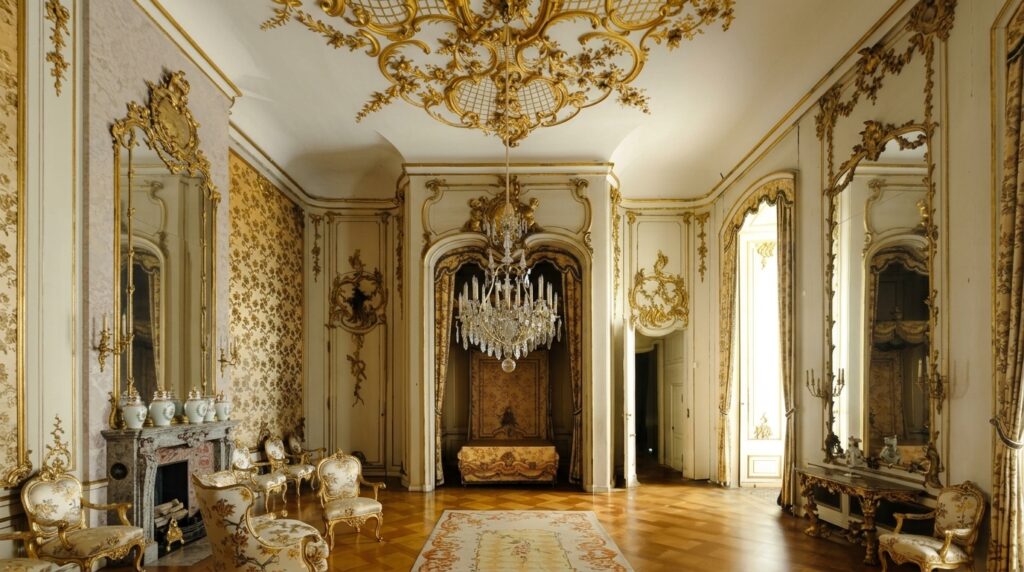
The Grand Bedroom of the Lower Prince’s Quarter in the Neues Palais of Potsdam is one of those places.
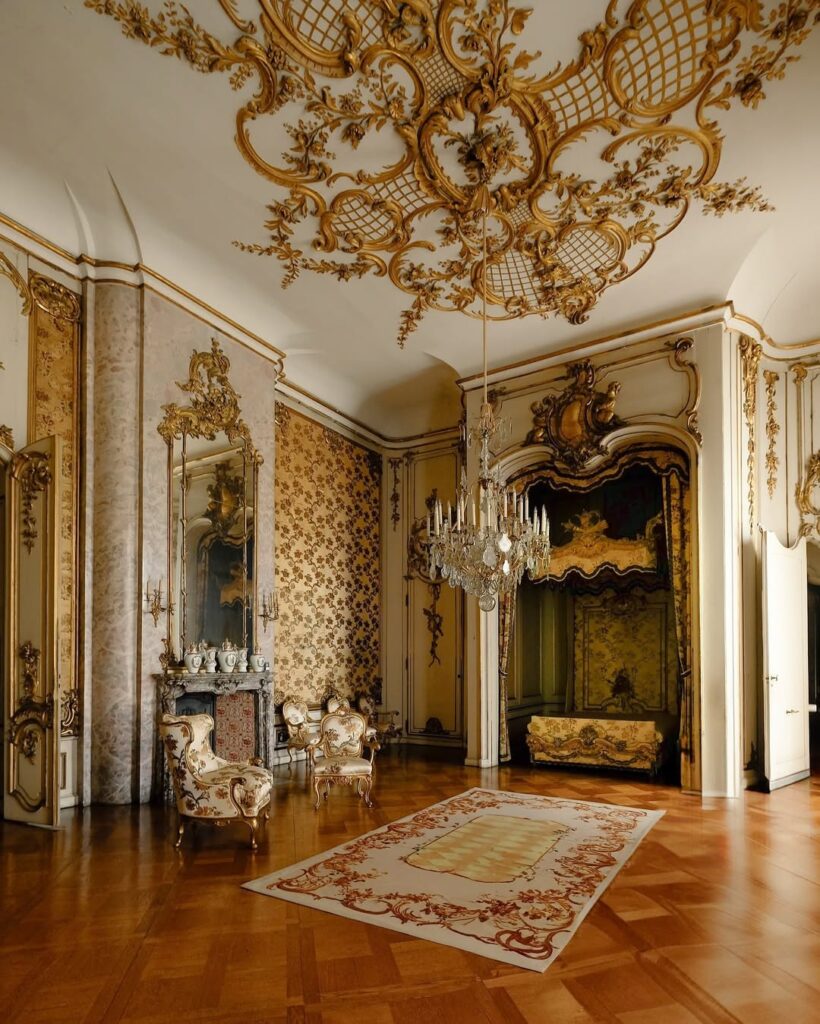
This forgotten estate — tucked inside a baroque palace on the edge of Sanssouci Park — holds a room that feels almost too beautiful to be real. Silk walls shimmer under pale light. An ornate sofa curves against the far wall like a whispered secret. A cabinet of dark ebony stands guard in the corner, its surface inlaid with flowers that will never wilt.
Most visitors to Potsdam walk past this room without a second glance.
That’s a mistake.
Because this room tells a story. About a king obsessed with power. About craftsmen who poured their lives into a single piece of furniture. About a forgotten estate that refused to let its splendor die — even after two world wars, a divided Germany, and more than 250 years of history pressed down upon its gilded walls.
Let’s step inside.
What Is the Neues Palais? A Forgotten Estate With a Purpose
Before we get to the bedroom, you need to understand the building it sits inside.
The Neues Palais — which translates simply to “New Palace” — was commissioned by Frederick II of Prussia, better known as Frederick the Great. Construction began in 1763 and finished in 1769. The timing matters.
Frederick had just survived the Seven Years’ War. It was one of the bloodiest conflicts of the 18th century, and Prussia had barely held on. The country was exhausted. The treasury was strained. And yet, Frederick immediately ordered the construction of an enormous, extravagant palace.
Why?
Because that’s exactly what a weakened king does when he wants the world to stop questioning him.
The Neues Palais was never meant to be a cozy home. It was a statement. A show of strength aimed directly at foreign dignitaries, visiting royals, and anyone who dared doubt Prussia’s resilience. Every room was designed to dazzle. Every corridor was meant to intimidate.
The result was one of the grandest palaces in all of Europe — 200 rooms, a 213-meter façade, and interiors dripping with Rococo excess.
The Grand Bedroom of the Lower Prince’s Quarter sat within this world like a jewel in a crown.
A Room Built for Royalty — But Which Royals?
The Northern Wing and Its Hidden Apartments
The Grand Bedroom was part of a suite of apartments in the northern wing of the palace. These rooms were designed for members of Frederick’s royal family — not for Frederick himself, who famously preferred his more intimate summer palace, Sanssouci.
The northern wing apartments were reserved for high-ranking guests. Princes. Visiting nobles. People whose comfort and impression mattered enormously to the Prussian court.
So every detail of the Grand Bedroom was curated with one goal in mind: to make whoever slept there feel like the most important person in the world.
The room succeeded.
What the Room Felt Like
Imagine walking in for the first time.
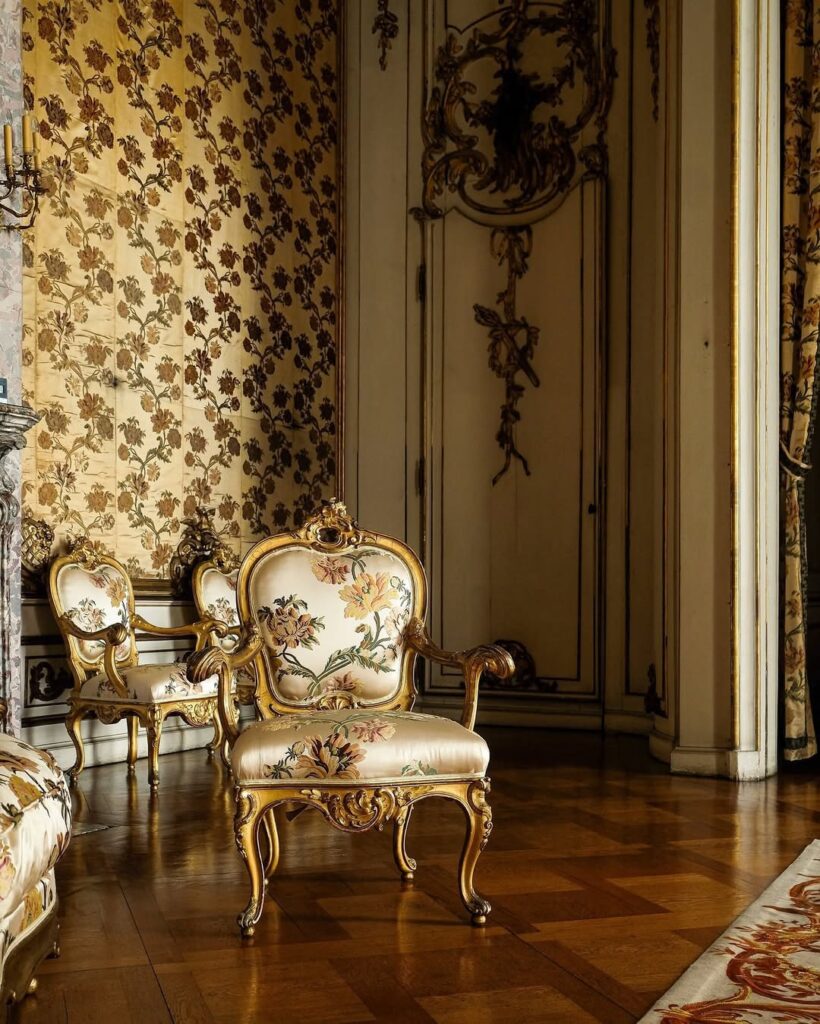
The silk on the walls catches the light before you even notice the furniture. It’s a deep, warm chrysanthemum pattern — cream and gold and something slightly faded, the way old things always are. The pattern repeats in precise intervals, floor to ceiling, wrapping the entire room in botanical opulence.
Then your eyes adjust and you start to notice everything else.
The sofa in the corner. The cabinet against the wall. The proportions of the space — not too large, not too intimate, but perfectly, deliberately calibrated for ceremony and rest in equal measure.
This wasn’t just a bedroom. It was a stage. And it still feels that way today.
The Canapé by Matthias Müller: A Sofa That Tells a Story
Rococo in Transition
In 1768, a craftsman named Matthias Müller built a canapé — a sofa — for this room.
If you know anything about Rococo furniture, you know that the style could be overwhelming. Curlicues stacked on curlicues. Gilding on top of gilding. Decoration that seemed to reproduce itself endlessly, filling every available surface until the eye had nowhere to rest.
Müller’s canapé is different.
It still speaks Rococo. The curved lines are unmistakable — that signature softness, that gentle bow of the frame, those legs that taper with elegant confidence. But the ornamentation is restrained. Thoughtful. The decoration knows when to stop.
Why That Restraint Matters
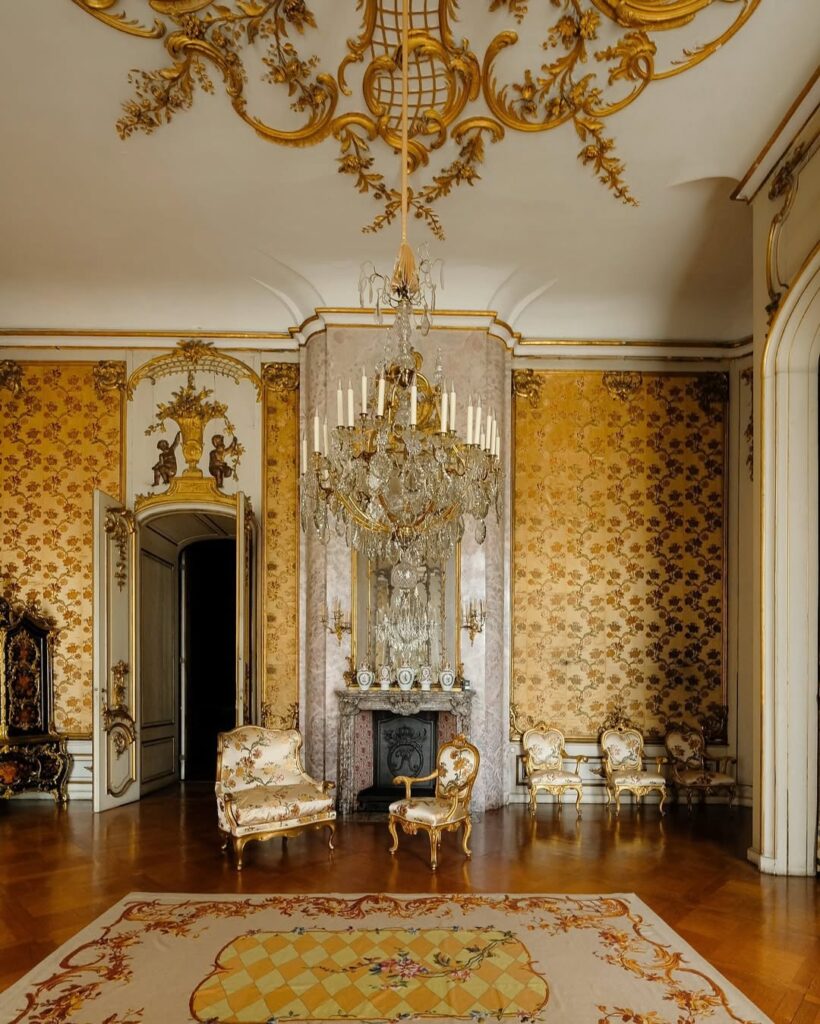
This sofa sits at a turning point in design history.
By 1768, Rococo was beginning to exhale. The excesses of the early and mid-18th century were giving way to something quieter, more refined. Neoclassicism was waiting in the wings. And Müller’s canapé seems to know this — one foot in the old world of ornamental exuberance, the other stepping carefully toward the elegance of what came next.
It’s furniture as philosophy. And it’s still sitting in that corner, more than 250 years later, holding its shape.
The Ebony Cabinet by Heinrich Wilhelm Spindler: A Masterpiece in Wood
The Finest Cabinetmaking in Prussia
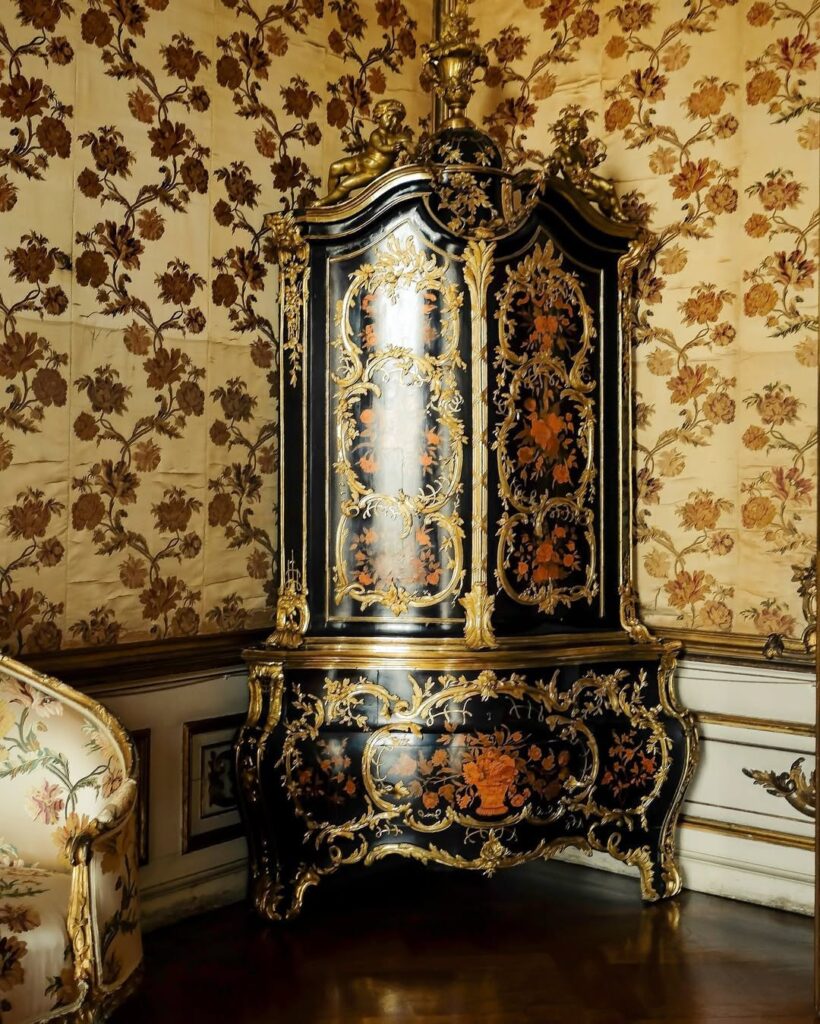
The other great furniture triumph of this room is a corner cabinet crafted by Heinrich Wilhelm Spindler from ebony.
Spindler was one of the most celebrated cabinetmakers of Rococo-era Germany. His work was in demand across Berlin and Potsdam, and his name appears on some of the finest pieces produced during Frederick’s reign. This cabinet is considered among the most significant examples of furniture art in the entire region.
Look closely at the surface and you’ll see why.
The inlays are extraordinary. Floral designs — intricate, precise, impossibly detailed — spread across the ebony surface in patterns that look more like painting than woodworking. The gilt bronze fittings catch the light at different angles throughout the day, so the cabinet seems almost alive, shifting subtly as shadows move.
Ebony as Language
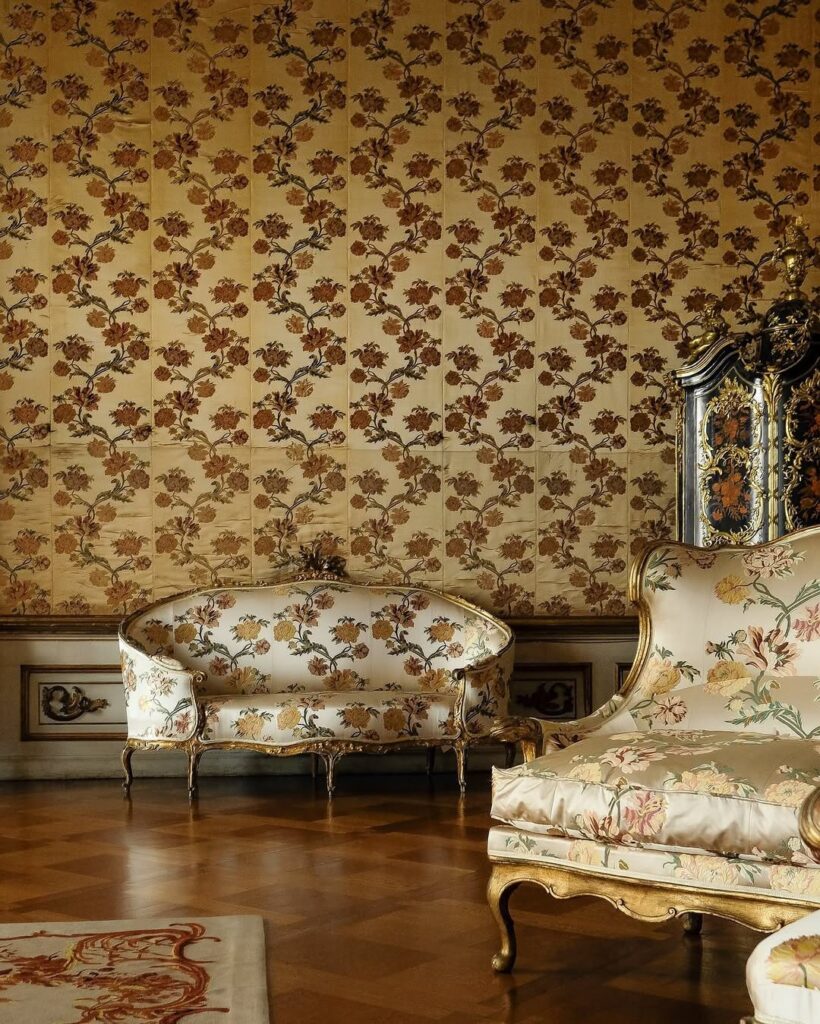
There’s something symbolic about the choice of ebony.
It was one of the most expensive and difficult materials a craftsman could work with in 18th-century Europe. It arrived by trade routes from tropical forests. It resisted tools. It demanded patience.
Using ebony for a piece of furniture was a declaration. It said: we spared nothing. We valued this. We wanted it to last.
Spindler’s cabinet was built to outlast everything around it. So far, it has.
The Silk Walls: When History Gets Recreated
A Pattern That Survived Two Centuries
The most striking feature of the Grand Bedroom isn’t the furniture. It’s the walls.
Floor to ceiling, the room is dressed in silk. The pattern is chrysanthemum — a flower with deep resonance in European decorative arts, associated with nobility, longevity, and the kind of quiet beauty that doesn’t shout for attention.
The original design dates to the 18th century. The chrysanthemum motif was woven into the fabric’s DNA from the beginning, part of the room’s founding vision.
But here’s the detail that makes this room genuinely fascinating.
The silk you see today was not woven in Frederick’s time. It was recreated in Lyon, France, in 1889 — more than a century after the original panels were first hung. The weavers in Lyon worked from the historical patterns, painstakingly reproducing every repeat, every color relationship, every thread count.
Lyon: The Silk Capital of Europe
This choice of Lyon was not accidental.
Lyon had been the silk-weaving capital of Europe since the 16th century. Its weavers understood historical fabrics. They had the looms, the knowledge, and the craft tradition to replicate 18th-century patterns with genuine fidelity.
The result is a wall covering that looks, from any reasonable distance, exactly as it would have in Frederick’s time. The chrysanthemums bloom across the silk just as they did when a Prussian prince first laid eyes on this room.
It is reproduction as preservation. And it works.
Frederick the Great and the Psychology of Splendor
Why a King Builds Rooms Like This
To truly understand this bedroom, you have to understand Frederick II.
He was a contradiction. Privately, he was an intellectual — a flautist, a philosopher, a correspondent of Voltaire, a man who genuinely preferred books and music to court ceremony. His personal apartments at Sanssouci were relatively modest by royal standards.
But publicly, he was a performer. He understood that kingship was theatre. That foreign dignitaries needed to be shown power, not just told about it. That a palace could do more diplomatic work than any speech.
So he built the Neues Palais as a kind of grand performance space. Every room was a set. Every piece of furniture was a prop. Every square meter of silk-covered wall was a message.
The Grand Bedroom whispered that message with particular elegance.
It said: Here, we give our most honored guests only the finest. Because we can. Because we always could. And we always will.
For more stories about the psychology behind royal architecture and how wealth was encoded in stone and silk, explore the abandoned châteaux and forgotten estates documented in our archive.
The Legacy of Rococo in Forgotten Spaces
What Rococo Really Means
The term Rococo gets thrown around loosely. It’s often used as a shorthand for “overly decorated” or “too fancy.” That’s an oversimplification.
Rococo was an 18th-century artistic movement that emerged in France and spread across Europe. It favored asymmetry over rigidity, curves over straight lines, natural motifs over classical geometry. It was, in many ways, a reaction to the heavier formality of Baroque — lighter in spirit, more playful, more intimate.
In furniture, Rococo produced some of the most inventive and technically demanding designs in Western history. The cabinetmakers who worked in this style were genuine artists. Müller’s canapé and Spindler’s cabinet are perfect examples of what the movement achieved at its height.
When Rococo Becomes Abandoned
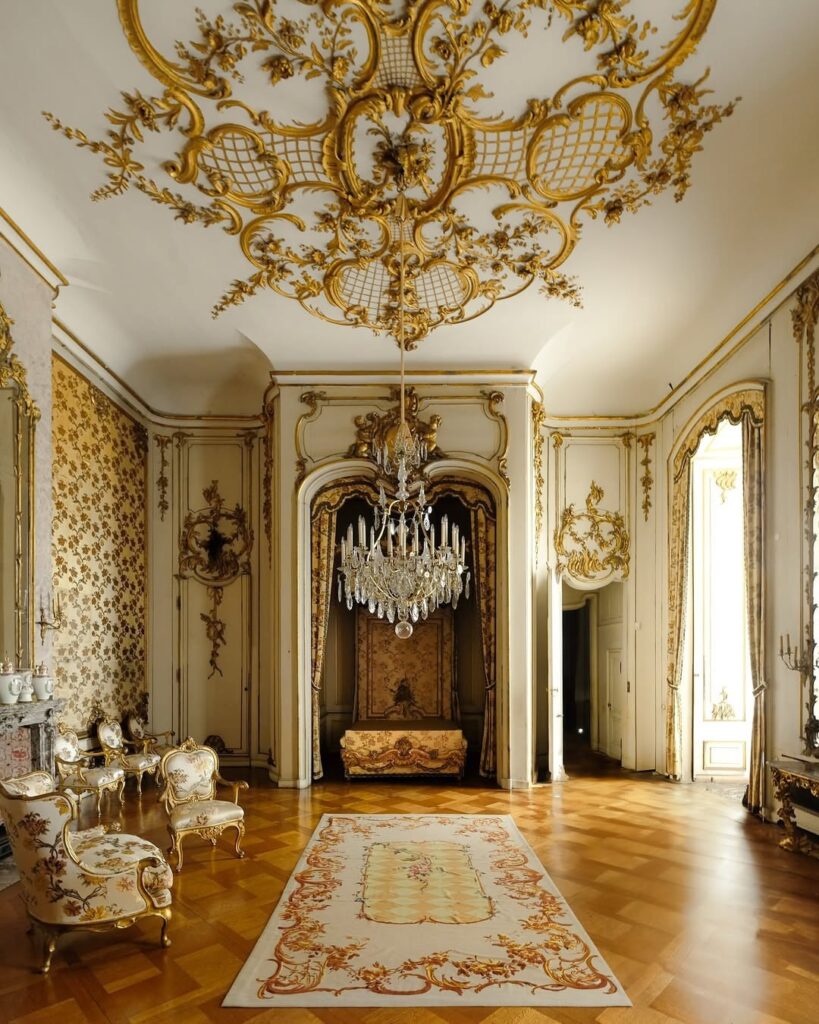
There’s something deeply melancholy about Rococo rooms left to age.
The style was built on optimism — on the idea that beauty itself was a kind of argument for the goodness of life. When you encounter a Rococo interior in a building that’s been emptied, or partially shuttered, or cut off from the life it was designed to contain, that optimism curdles slightly.
The silk still shimmers. The gilt still catches the light. But the people are gone.
That tension — between the permanence of the art and the transience of the people it was made for — is part of what makes sites like Neues Palais so quietly devastating to visit.
If you’re drawn to that particular feeling, you’ll find it in abundance among the forgotten estates and abandoned castles we’ve documented across Europe.
Visiting the Neues Palais Today
What You Need to Know
The Neues Palais is a UNESCO World Heritage Site, part of the broader Palaces and Parks of Potsdam and Berlin designation. It is managed by the Prussian Palaces and Gardens Foundation and is open to visitors on a guided tour basis.
Here are the key practical details:
- Location: Park Sanssouci, Potsdam, Germany — about 30 minutes by train from central Berlin.
- Access: The palace interior is accessible via guided tours only. Check the official foundation website for current opening hours and tour schedules.
- Photography: Generally permitted in public areas without flash. Specific rules apply in some rooms — always follow posted guidance.
- Getting there: Take the S-Bahn or regional train to Potsdam Hauptbahnhof, then a local bus to the park. The Neues Palais is at the western end of Park Sanssouci.
- Best time to visit: Weekday mornings in shoulder season (spring or autumn) offer the quietest experience and the best light in the interior rooms.
What to Look For in the Grand Bedroom
When you reach the Grand Bedroom in the Lower Prince’s Quarter, slow down. Most visitors don’t.
- Stand still for a moment and let the silk walls settle around you.
- Look at the canapé’s legs — notice how the curves resolve into the floor.
- Approach Spindler’s cabinet and examine the inlay work up close. The floral details are astonishing at proximity.
- Look at the wall fabric and try to imagine the Lyon weavers in 1889, following a century-old pattern, thread by thread.
This room rewards attention. It was designed for people who knew how to look.
The Rooms That Outlast the People Who Built Them
There’s a particular kind of beauty that only time can create.
Not decay — not exactly. Something more nuanced. The way light falls differently on old silk than on new. The way a piece of hand-carved furniture develops a presence over centuries, as if absorbing the weight of every eye that has ever rested on it.
The Grand Bedroom of the Neues Palais has that presence now.
Frederick the Great has been dead for nearly 240 years. The princes who slept in this room are dust. The weavers who recreated the chrysanthemum silk in Lyon in 1889 are forgotten. Even the political purpose of the palace — the show of strength after the Seven Years’ War — is a footnote in history books.
But the room remains.
The silk still shimmers. The sofa still holds its elegant curve. The ebony cabinet still guards its corner with quiet authority. And the chrysanthemum pattern still blooms across the walls, patient and unchanging, waiting for the next person who is willing to slow down and truly look.
That’s what the best forgotten estates do. They wait.
For more immersive explorations of Europe’s extraordinary interior spaces — from crumbling ballrooms to sealed royal apartments — visit abandoned.blog and discover what history left behind.
FAQ: The Grand Bedroom of Neues Palais, Potsdam
Q: Who commissioned the Neues Palais? Frederick II of Prussia (Frederick the Great) commissioned the palace after the Seven Years’ War. Construction ran from 1763 to 1769.
Q: What is the Grand Bedroom used for today? The room is part of the palace’s museum interiors, preserved and accessible to visitors on guided tours managed by the Prussian Palaces and Gardens Foundation.
Q: Why was the silk wall covering recreated? The original 18th-century silk deteriorated over time. In 1889, the chrysanthemum pattern was faithfully reproduced by weavers in Lyon, France, using historical designs to maintain the room’s authentic appearance.
Q: Who made the furniture in the Grand Bedroom? The canapé (sofa) was crafted by Matthias Müller in 1768. The corner cabinet was made by Heinrich Wilhelm Spindler, one of the foremost German cabinetmakers of the Rococo period.
Q: Is the Neues Palais open to the public? Yes. It is a UNESCO World Heritage Site and open for guided tours. Check the Prussian Palaces and Gardens Foundation website for current schedules and ticket information.
Q: Is the Neues Palais the same as Sanssouci Palace? No. Both palaces are located within Park Sanssouci in Potsdam, but they are separate buildings. Sanssouci was Frederick’s personal retreat; the Neues Palais was built for entertaining and impressing guests.
Q: What architectural style is the Grand Bedroom? The room is Rococo in style — characterized by curved forms, ornamental elegance, silk wall coverings, and finely crafted furniture emphasizing both artistry and comfort.
All visits to heritage sites should be conducted respectfully and in accordance with the rules set by the managing institution. The Neues Palais is an active museum and conservation site.