Europe’s layers of history — Roman, medieval, industrial, imperial, and post-Soviet — have left a remarkable inheritance of abandoned places. From crumbling Renaissance palaces to Cold War military installations, the continent offers an unparalleled range of urbex destinations. This curated guide focuses on sites with genuine historical significance, photographic richness, and verifiable information — not just viral appeal. For each location, we’ve included historical context, access considerations, and what to realistically expect.
Italy: Decay in the Land of Beauty
1. Abandoned Bugatti Factory, Campogalliano
Built to produce the iconic EB110 supercar, this late-1980s industrial complex combines architectural ambition with the melancholy of interrupted dreams. The building’s striking blue exterior and vast production halls remain largely intact, making it one of the most photographically coherent industrial ruins in Europe. The surrounding region of Emilia-Romagna contains numerous other automotive and industrial heritage sites worth combining in a single trip.
2. Craco, Basilicata — Italy’s Most Famous Ghost Town
Perched on a 1,300-foot summit in southern Italy’s Basilicata region, Craco was evacuated in 1963 following a landslide and has been uninhabited since. The medieval townscape — church, castle, and tightly packed stone houses — remains remarkably complete, frozen at the moment of evacuation. Unlike many Italian ghost towns, Craco has been partially secured for guided visits organized through the municipality of Craco. The town has appeared in numerous films including The Passion of the Christ and Quantum of Solace.
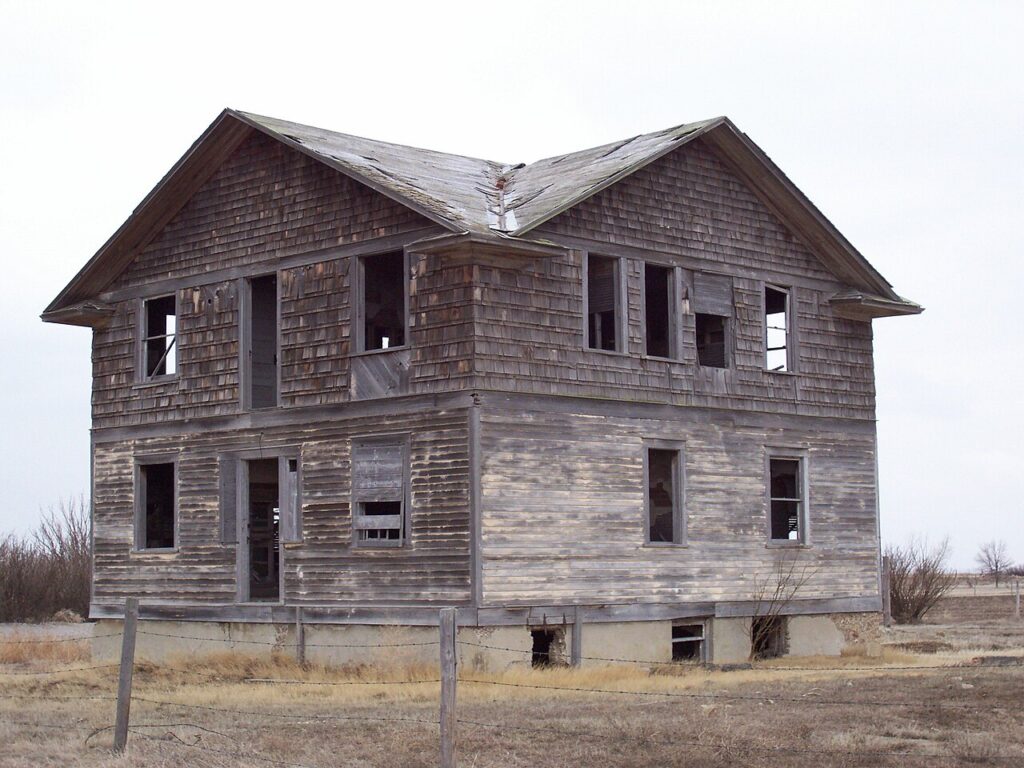
Robsart Hospital, one of many abandoned buildings in Robsart, Saskatchewan
3. Poveglia Island, Venice Lagoon
The most historically layered site on this list: Roman settlement, medieval plague quarantine, Napoleonic fortification, and 20th-century psychiatric hospital. Access is officially restricted, though the island is visible from the water routes between Venice and Chioggia. The psychiatric hospital closed in 1968, and subsequent demolition plans have repeatedly been blocked, leaving the complex in a remarkable state of natural decay intensified by the lagoon’s salt air and humidity.
Germany: Industrial Memory and Institutional Weight
4. Beelitz-Heilstätten Sanatorium, Brandenburg
This 200-hectare tuberculosis sanatorium complex, built between 1898 and 1930, is now partially accessible via an official treetop walkway (Baumkronenpfad) that provides an extraordinary aerial perspective on the decaying pavilion architecture below. The remaining inaccessible portions are among the most photographed abandoned buildings in Germany, featuring ornate Wilhelmine architecture slowly being consumed by mature forest.
5. Völklingen Ironworks, Saarland
A UNESCO World Heritage Site and the most comprehensively preserved blast furnace complex in the world. Unlike most industrial heritage sites, Völklingen is fully accessible and professionally managed, with regular art installations, concerts, and exhibitions staged within the industrial structures. It represents the gold standard for what abandoned industrial heritage can become with investment and vision.
6. Abandoned Soviet Military Installations, Former East Germany
The Soviet military maintained an enormous infrastructure across the former German Democratic Republic. Following reunification, the rapid withdrawal of Soviet forces left barracks, airfields, hospitals, and command facilities across Brandenburg, Saxony, and Thuringia in varying states of abandonment. Wünsdorf — formerly the headquarters of the Group of Soviet Forces in Germany — is the most significant of these sites and is partially accessible through organized heritage tours.
France: Belle Époque Decline
7. La Cathédrale de Sel (The Salt Cathedral), Lorraine
The Varangéville salt mine in Lorraine contains one of the world’s most extraordinary underground spaces: a vast subterranean cathedral created as a byproduct of salt extraction. While not abandoned in the strict sense, parts of the mine complex have been repurposed as underground heritage space, offering legal access to genuinely extraordinary industrial architecture. The working portions of the mine remain active.
8. Château Miranda (Noisy Castle), Ardennes
One of Europe’s most photographed abandoned castles before its demolition in 2017, Château Miranda — also known as Noisy Castle — was a neo-Gothic masterpiece built in 1866 that stood empty for decades before vandalism and structural compromise made its preservation impossible. Its demolition was widely mourned in the urbex community and serves as a reminder that abandoned sites have limited windows of accessibility. Numerous photographs and documentation videos preserve its memory.
Eastern Europe: Soviet Legacy and Pre-War Grandeur
9. Buzludzha Monument, Bulgaria
The most spectacular piece of Soviet-era monumental architecture still standing: a vast UFO-shaped concrete saucer perched on a Balkan mountain summit at 1,441 metres, built in 1981 to commemorate the founding of the Bulgarian Communist movement. The interior was renowned for its enormous socialist mosaics before weather damage and vandalism reduced them significantly. The Buzludzha Project — a dedicated conservation initiative — has been working to secure and partially restore the building. Access has been intermittently possible through official permissions.
10. Pripyat, Ukraine — The Most Famous Ghost Town in the World
No list of abandoned places in Europe would be complete without Pripyat, the Soviet model city built to house workers at the Chernobyl Nuclear Power Plant and evacuated within 36 hours of the 1986 disaster. Today, Pripyat is a UNESCO Tentative World Heritage Site candidate and receives thousands of legitimate visitors annually through a well-developed tour infrastructure. Amusement park, swimming pool, gymnasium, hospital, supermarket — all frozen at the moment of evacuation. Radiation levels in most accessible areas are now lower than during a long-haul flight.
11. Abandoned Palaces of Poland
Poland’s turbulent 20th century — Soviet occupation, Nazi destruction, post-war border shifts, and communist collectivization — left hundreds of aristocratic residences without owners or maintenance. The Silesian and Pomeranian regions contain concentrations of baroque and neoclassical manor houses in varying states of decay. Organizations including the Polish Forum of Heritage and the Zamki i Pałace (Castles and Palaces) foundation document and campaign for their preservation.
12. Kolmanskop Ghost Town, Namibia — A European Creation Outside Europe
Technically located in southern Africa, Kolmanskop was built by German colonial settlers during the diamond rush of the early 20th century and is architecturally entirely Germanic. Abandoned when diamond deposits were exhausted in the 1950s, the Namib Desert sand has gradually reclaimed the houses, filling rooms to window-height with fine red sand. It is legally accessible through permits arranged with the Namdeb Diamond Corporation and has become one of the most photographed locations in the world.
UK and Ireland: Victorian Grandeur and Institutional Legacy
13. Hellingly Hospital, East Sussex, England
Built in 1903 as the East Sussex County Asylum and designed according to the Italianate institutional aesthetic popular at the time, Hellingly served as a psychiatric hospital for nearly a century before closing in 1994. It has since been partially demolished for residential conversion, but significant portions remained intact for many years and were among the most documented abandoned hospital structures in England.
14. Kilchurn Castle, Loch Awe, Scotland
A ruined 15th-century castle whose gradual decay over five centuries creates one of the most dramatically photogenic landscapes in Britain. Unlike most urbex sites, Kilchurn is fully accessible under Scottish access rights, and its island setting in Loch Awe — accessible via causeway — makes it one of the most rewarding legally accessible abandoned structures in Europe. The castle is managed by Historic Environment Scotland.
15. Loftus Hall, County Wexford, Ireland
Ireland’s most famous haunted house — a Victorian Gothic mansion on the isolated Hook Peninsula with a history that includes persistent supernatural legends, use as a convent, and periodic episodes of abandonment. Unlike most sites on this list, Loftus Hall is now in active commercial use as a heritage attraction offering tours, ghost hunts, and accommodation. Its combination of genuine historical complexity and managed accessibility makes it an ideal destination for those new to abandoned-place tourism.