
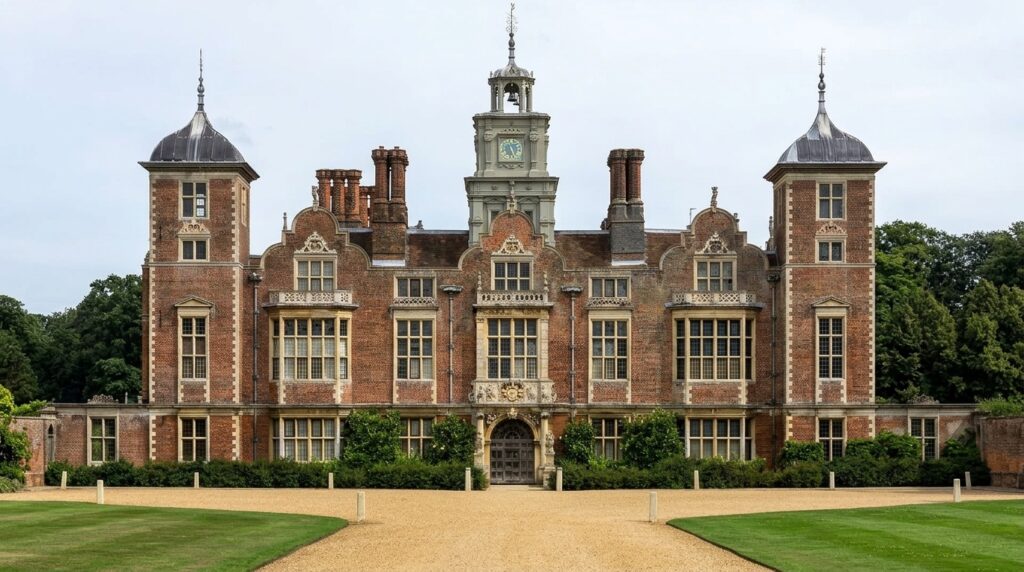
Some places hold history the way old stone holds cold. You feel it before you understand it. Blickling Estate, tucked into the quiet countryside of Norfolk, England, is exactly that kind of place — heavy with time, beautiful in its stillness, and impossible to forget once you’ve stood beneath its red-brick towers.
This is not a ruin in the traditional sense. It’s something rarer. A place that has survived four centuries nearly intact. And yet, walking its corridors and gardens today, you feel the unmistakable weight of everything it has witnessed.
The Ground Blickling Hall Stands On
Before there was a Jacobean masterpiece, there was a medieval manor. And before that — earth that belonged to powerful families, passed from hand to hand through marriage, inheritance, and royal favour.
The Boleyn family owned this land in the early 16th century. Sir Thomas Boleyn, a courtier of considerable ambition, held the manor here. It’s widely believed that his daughter — Anne Boleyn, the ill-fated second wife of Henry VIII — spent part of her childhood in an earlier house on this very site.
That original building no longer stands. But its memory does.
Anne Boleyn was executed at the Tower of London in 1536, accused of adultery and treason in a trial many historians now regard as a politically motivated farce. She was 35 years old. Her name was erased from royal records. Her daughter, Elizabeth, was declared illegitimate.
And yet here, in Norfolk, the ground itself seemed to remember her.
The Boleyn connection gives Blickling Estate a particular kind of darkness — not the theatrical kind found in ghost-tour brochures, but something quieter. Something that sits in the architecture like a stain that never quite lifts.
How the Jacobean Hall Was Born
After the Boleyn family’s fall from grace, the estate passed through several hands before landing with Sir Henry Hobart, Lord Chief Justice of England, in the early 17th century.
It was Hobart who tore down the decaying medieval manor and commissioned something extraordinary in its place.
Construction of the current Blickling Hall began around 1616 and was completed in 1624. The architect is believed to be Robert Lyminge, the same man responsible for Hatfield House in Hertfordshire — another monument to Jacobean ambition.
What Lyminge built at Blickling was remarkable:
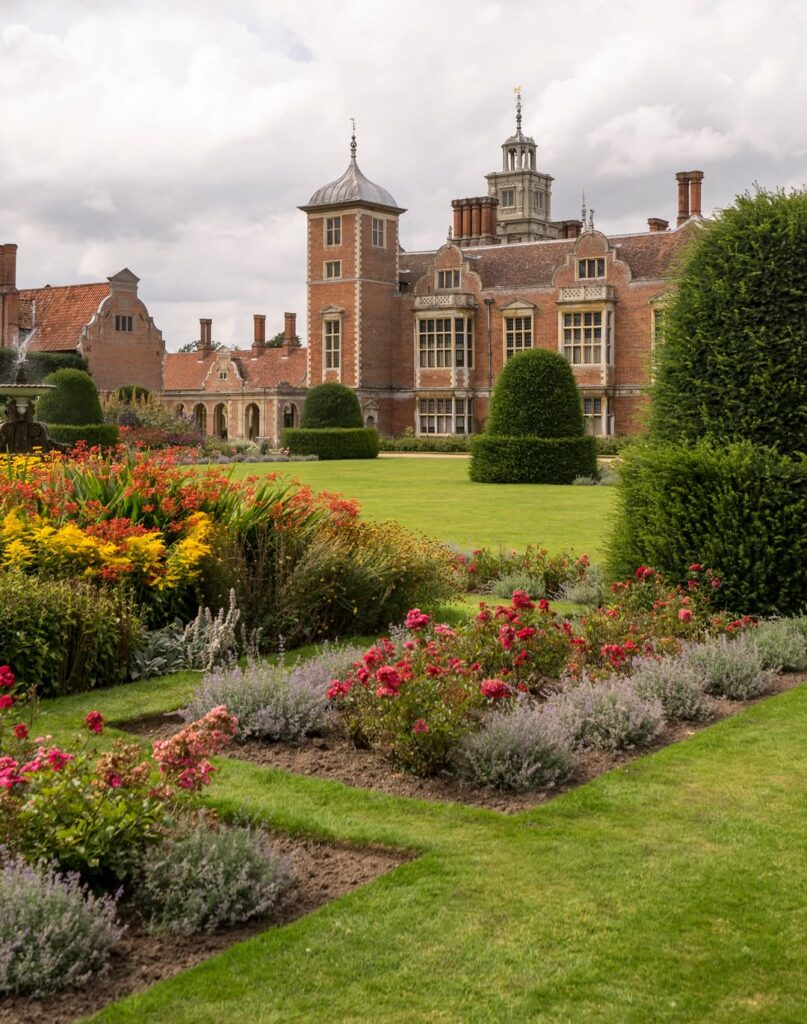
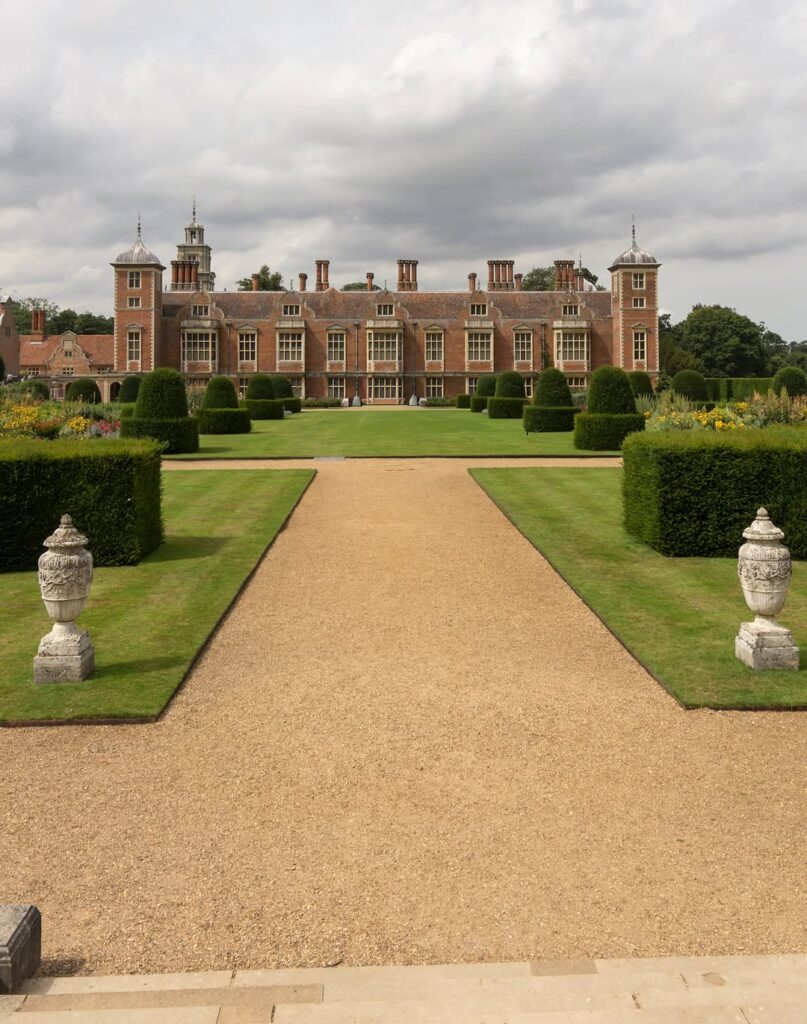
- Red-brick façades with precise, almost mathematical symmetry
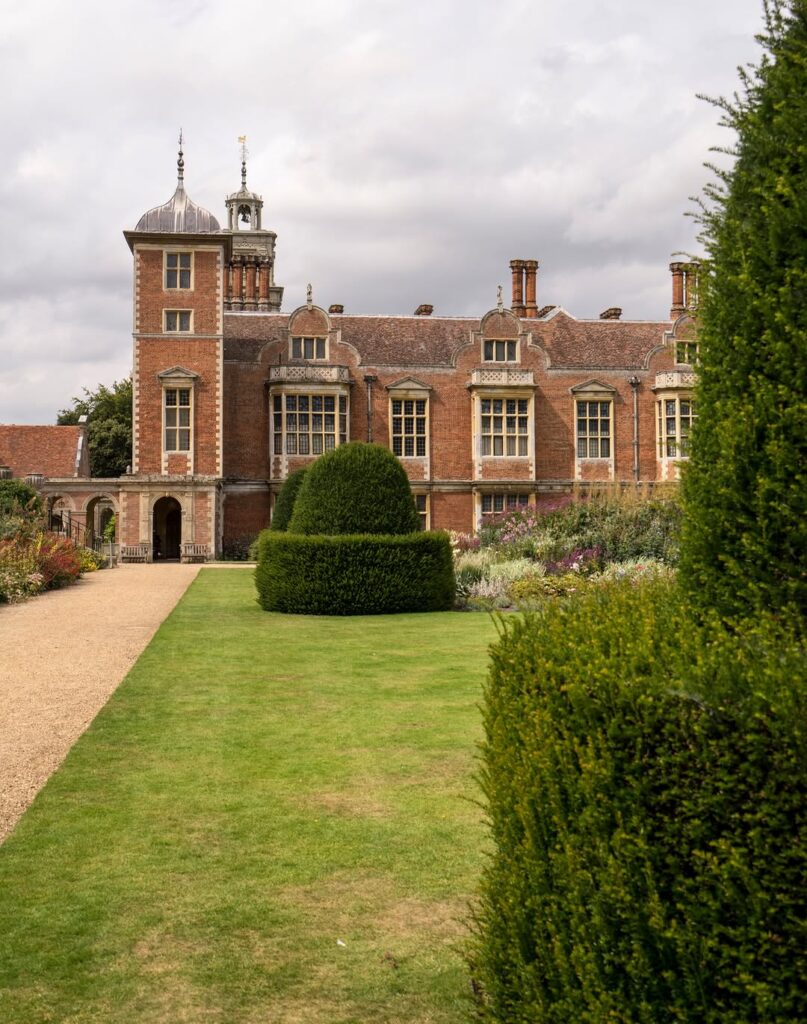
- Curved Dutch gables rising dramatically at each corner
- Ornate chimneys clustered like stone forests against the Norfolk sky
- A formal forecourt framed by matching wings and towers
- Lead-paned windows reflecting grey English light like old mirrors
The whole structure speaks the language of power. This was a house designed to impress. And four hundred years later, it still does.
Inside the Hall: Art, Architecture, and Silence
Step through the entrance and the world outside disappears.
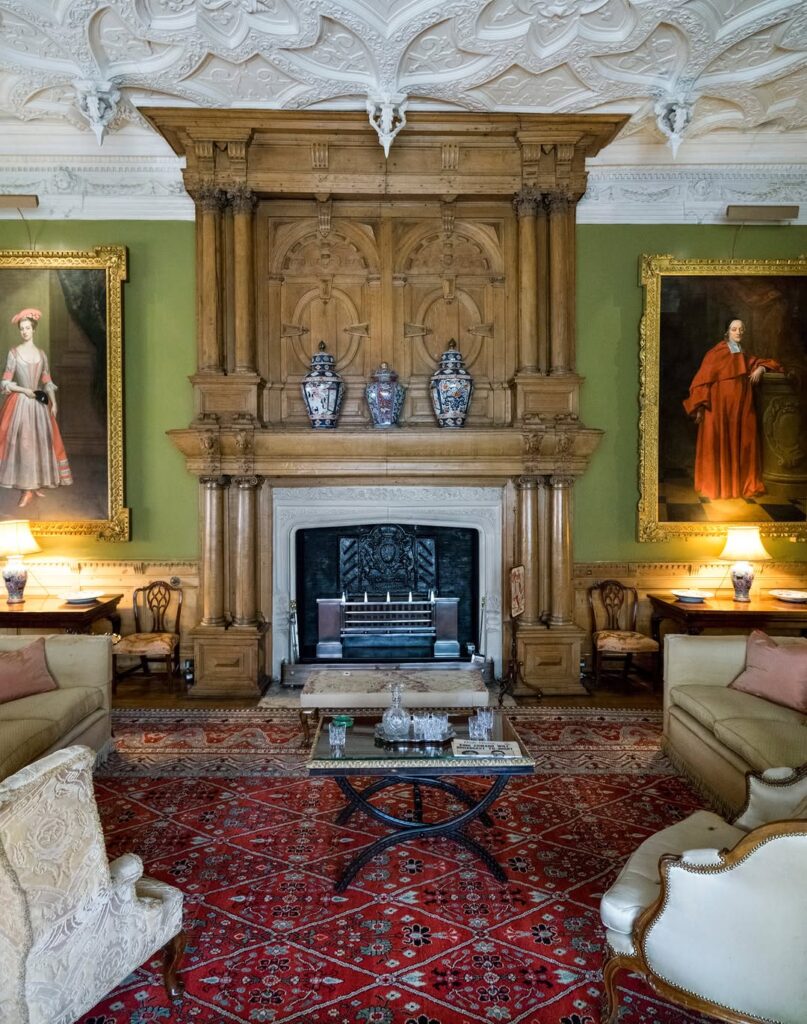
The Long Gallery stretches 123 feet along the top floor — one of the finest surviving Jacobean galleries in England. Its plaster ceiling is extraordinary: intricate panels depicting emblems, figures, and geometric patterns applied with a precision that seems impossible for the tools of the early 17th century.
The library holds over 12,000 books, many of them rare. It was assembled by generations of owners who understood that a great house needed a great mind behind it.
Walk through the state rooms and you encounter:
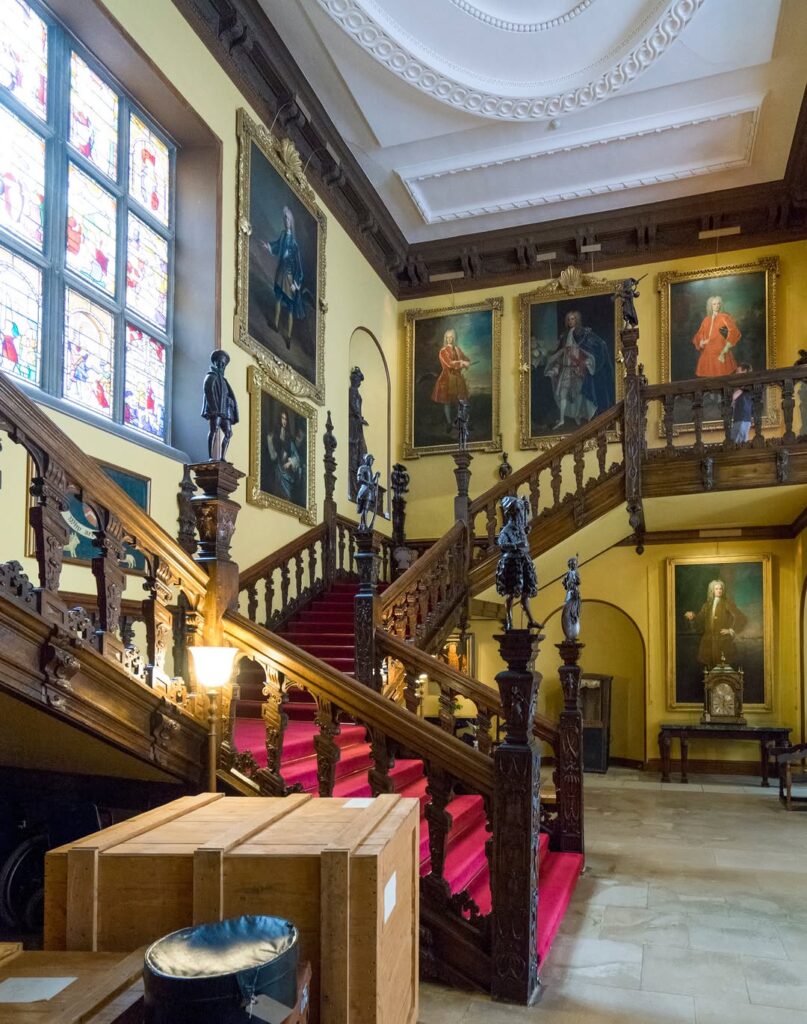
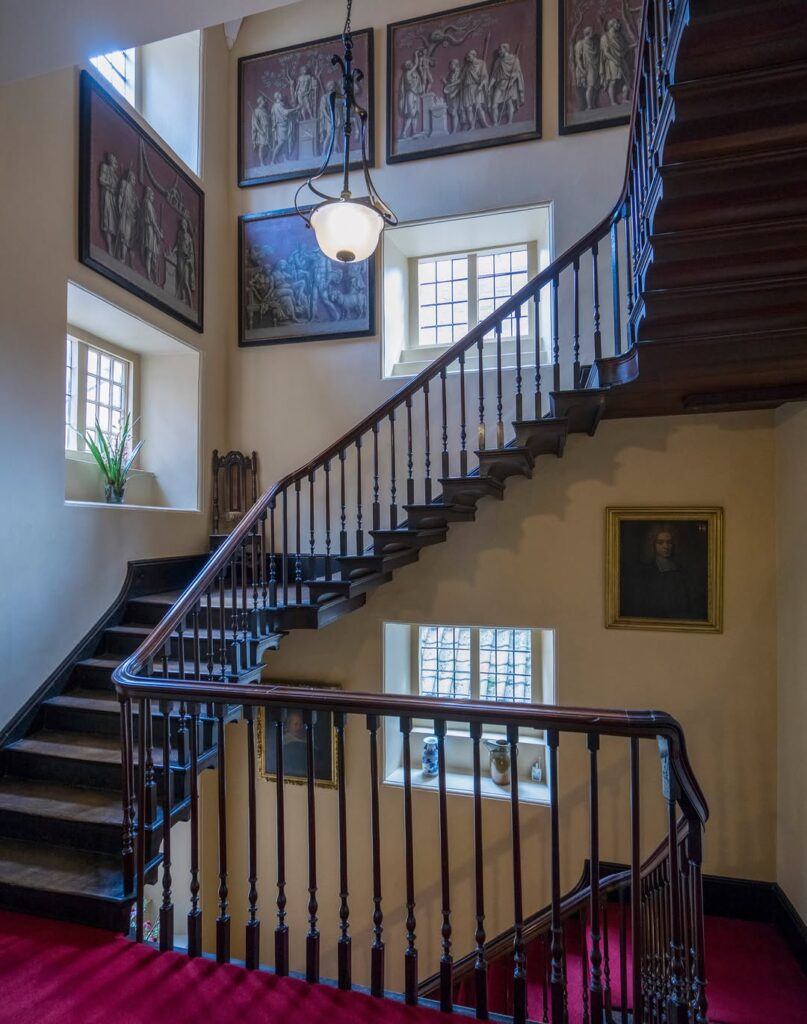
- Portraits in heavy gilt frames, their subjects staring with that particular aristocratic vacancy
- Tapestries that have faded from scarlet to a dusty, muted rose
- Ornate fireplaces carved from stone — cold now, but built for rooms full of people and warmth
- Original furniture that has barely moved in centuries
There is something deeply affecting about rooms that have been preserved but not lived in. They have the atmosphere of a place that is waiting. For what, exactly, is difficult to say.
For those drawn to properties where time seems to have stopped, you might recognise that sensation from our piece on this forgotten mansion that still has everything inside — that particular silence that comes with rooms untouched for generations.
The Gardens: Formal Beauty and Quiet Decay
Outside, the formal gardens extend the Hall’s geometry into the landscape.
The parterre garden stretches in geometric precision — box hedges clipped into patterns that mirror the plasterwork inside. Beyond it, a long yew hedge walk leads to a secret garden and an orangery.
But the most dramatic feature is the woodland path that leads to a lake.
The Blickling estate encompasses over 4,700 acres of parkland, farms, and woodland. Walking the outer grounds, away from the manicured gardens, you find something wilder. Ancient oaks with split trunks. Paths overgrown at the edges. The occasional crumbling brick wall where an outbuilding once stood.
This is the other face of Blickling — not the grand showpiece, but the quiet, slightly melancholy countryside that surrounds it. Grass gone long. The distant sound of rooks. A horizon with no visible modernity.
It calls to mind the kind of forgotten estate landscapes explored in pieces like Abandoned But Still Worth Millions: Inside a Forgotten Estate Nobody Dares Touch — that feeling of magnificent beauty left to exist on its own terms.
The Anne Boleyn Legend: Headless and Still Returning
No article about Blickling Estate is complete without this.
Every year, on the anniversary of Anne Boleyn’s execution — May 19th — local legend claims that a phantom coach arrives at the estate gates. It is drawn by headless horses, driven by a headless coachman. And inside, carrying her own severed head in her lap, sits Anne Boleyn herself.
The coach is said to circle the Hall before disappearing at dawn.
This is, of course, the stuff of folklore — elaborated over centuries, polished by retelling, and almost certainly shaped by the region’s appetite for dramatic legend. But it persists. And in a place with this much history, you understand why.
The more unsettling reality is this: Anne Boleyn almost certainly played as a child somewhere on this ground. The house that stands today replaced the one she knew. In a very real sense, she was erased from this place as thoroughly as she was erased from royal history.
The ghost story is just the landscape’s way of refusing to forget.
The Hobart and Lothian Years: Centuries of Change
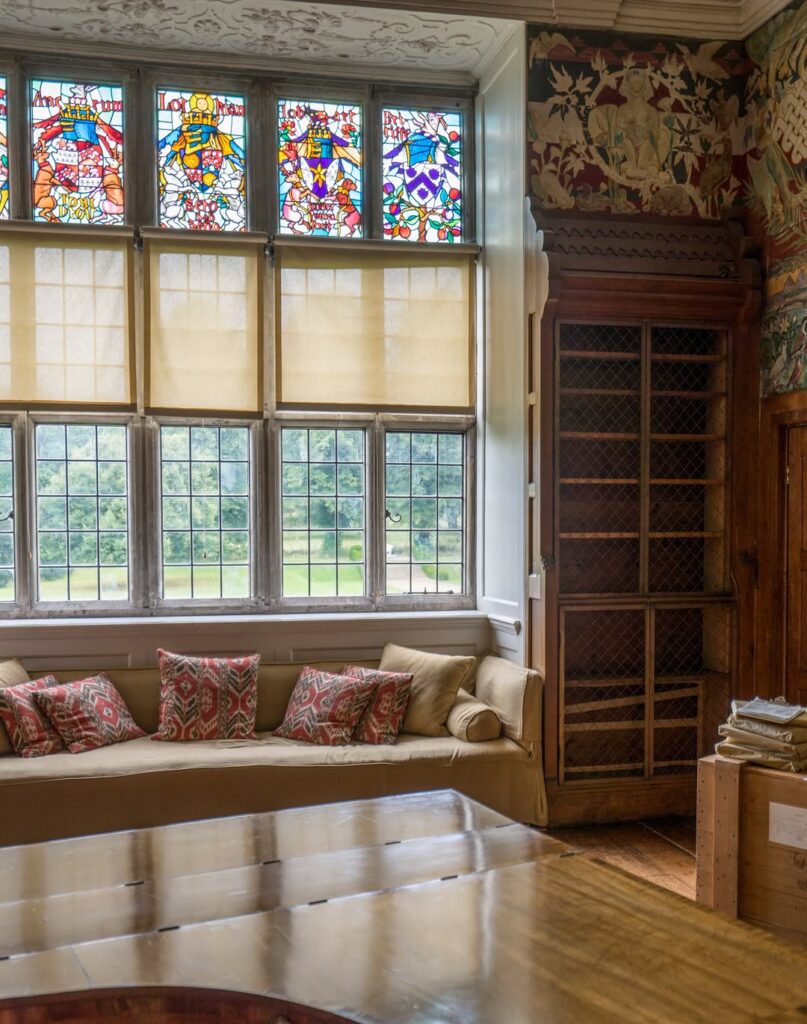
After Sir Henry Hobart’s death, the estate passed to his descendants and eventually, through the female line, to the Earls of Buckinghamshire and then to the Marquesses of Lothian.
Each generation added to Blickling. Wings were modified. The gardens were redesigned in different periods. The library grew. The art collection deepened.
The 11th Marquess of Lothian — Philip Kerr, a diplomat and politician — inherited the estate in 1930. He died without direct heirs in 1940, while serving as British Ambassador to the United States. In his will, he bequeathed Blickling Hall to the National Trust — making it one of the first great houses to be given to the Trust in lieu of inheritance taxes.
That decision preserved everything. The art. The books. The architecture. The gardens.
Without it, Blickling might have become another casualty of the 20th century — stripped, sold in lots, left to collapse like so many of England’s great houses that slipped through the cracks between old money and modern reality. We’ve documented what that fate looks like in our piece on The Most Expensive Abandoned Mansion Nobody Wants to Buy.
What Makes Blickling Different From Truly Abandoned Estates
Here is the honest thing: Blickling Estate is not abandoned. It never quite was.
Under National Trust stewardship since 1940, it has been maintained, conserved, and opened to the public. Visitors can walk the state rooms, explore the gardens, and trace the history of the building from its medieval origins to its Jacobean height.
And yet.
There is a quality to Blickling that resembles the atmosphere of places that have been left behind. The rooms feel preserved rather than lived in. The Long Gallery has the stillness of a space that no longer has a daily purpose. The portraits watch you with the indifference of subjects who have been watched by strangers for eighty years.
It is a different kind of abandonment — not physical decay, but the quiet vacancy that comes when a house is turned from home into museum. The furniture stays. The books stay. The people don’t.
That duality is what makes Blickling Estate so resonant. It occupies a unique space between the grand historic showpiece and the forgotten interior — closer in spirit to the silk-draped rooms of places like the Neues Palais forgotten estate than to a truly derelict shell.
Visiting Blickling Estate Today
Blickling Hall is managed by the National Trust and is open to the public for much of the year. Standard entry fees apply. The grounds are accessible separately.
What to expect:
- The state rooms are open with guided access and audio trails
- The Long Gallery is frequently used for exhibitions
- The gardens are well maintained and change through the seasons
- The parkland and woodland walks are open year-round
- A restaurant and tea room operate on site
The estate sits near Aylsham in north Norfolk — about 15 miles north of Norwich. It is not remote. But it has that quality, particular to certain historic places, of feeling like it exists slightly outside the present tense.
Practical notes:
- Photography is permitted in the grounds; restrictions apply indoors
- The estate is dog-friendly in the parkland
- Parking is on site
- Accessibility provisions are available across most of the property
Always visit responsibly, respect the property and its management guidelines, and support preservation efforts where you can. Historic sites like Blickling survive because people choose to care about them.
Why Blickling Estate Still Matters
Four hundred years is a long time for any building to stand. Most don’t.
Blickling Hall survived the English Civil War, the agricultural collapse of the 19th century, two world wars, and the slow erosion that claimed so many of England’s great houses in the 20th century. It survived because the people who held it, in the end, chose legacy over profit.
There is something significant about a place where you can stand in a gallery built in 1624 and look at a ceiling that no one has changed. Where the books in the library were placed on their shelves by hands that have been dust for three centuries. Where the land outside still holds the shape it held when Anne Boleyn was a child somewhere on its ground.
That kind of continuity is rare. It deserves attention.
For anyone drawn to historic properties — the grand, the forgotten, the decaying, and the surprisingly preserved — Blickling Estate represents something important. It is proof that history, properly cared for, can survive almost anything.
And in a world that tends to demolish what it no longer finds useful, that is worth something.
Conclusion
Blickling Estate is many things at once. It is a triumph of Jacobean architecture. It is a landscape haunted by one of English history’s most tragic figures. It is a house that nearly fell through the cracks of the 20th century and was saved by a single bequest.
Standing beneath those red-brick towers in Norfolk — the yew hedges dark and formal behind you, the countryside wide and quiet in every direction — you feel the full weight of what it means for a place to persist. Not just to survive, but to remain itself.
Not every forgotten estate is physically decayed. Some of them are simply waiting, very quietly, for someone to remember why they matter. Blickling Estate never needed rescuing from that particular forgetting. But it rewards, deeply, anyone who takes the time to really look.
FAQ: Blickling Estate
1. Is Blickling Estate open to the public? Yes. Blickling Hall and its grounds are managed by the National Trust and are open to visitors for much of the year. Entry to the hall requires a ticket; parkland access is often free for National Trust members.
2. Was Anne Boleyn born at Blickling Estate? Possibly. Anne Boleyn’s birthplace is historically disputed — both Blickling and Hever Castle in Kent have been suggested. Her family did own the earlier manor at Blickling, and she likely spent time there as a child, but no definitive records confirm it as her precise birthplace.
3. Who built the current Blickling Hall? The Jacobean hall was commissioned by Sir Henry Hobart and completed in 1624. It is attributed to architect Robert Lyminge, who also designed Hatfield House.
4. Is Blickling Hall haunted? According to local legend, the ghost of Anne Boleyn returns to Blickling each year on the anniversary of her execution, arriving by phantom coach. It is folklore rather than documented fact, but the story has persisted for centuries.
5. How did Blickling Estate come to be managed by the National Trust? The 11th Marquess of Lothian bequeathed the estate to the National Trust upon his death in 1940, making it one of the first great houses transferred to the Trust in lieu of inheritance tax. This decision preserved the entire contents and structure.
6. Can you walk the grounds without visiting the hall? Yes. The parkland and woodland walks at Blickling Estate are accessible to visitors independently of the hall. The gardens require standard admission. National Trust members enjoy free access throughout the season.


[…] other examples of grand English country houses left to the elements, you may also want to read about England’s most haunting Jacobean manor, which shares a similarly dramatic architectural […]